


Last updated: September 26, 2026
LinkedIn prospecting is the process of finding relevant people, researching their business context, and starting conversations that can become qualified sales opportunities. The work starts with choosing the right accounts and ends with a clear handoff to sales.
A useful LinkedIn prospecting workflow has six parts: define the audience, find the right people, verify a reason to contact them, send a relevant message, handle replies, and measure the resulting opportunities. Sales Navigator can support account and lead discovery. Clay can support research and enrichment. Your team still needs to judge relevance and own the conversation.
This guide explains that workflow, gives practical message examples, and shows what to look for if you hire a LinkedIn lead generation agency.
Start with an audience you can explain
Before searching for job titles, write down who benefits from your offer and why. “B2B decision-makers” is too broad to guide a useful conversation.
For a hypothetical outbound service campaign, a starting segment might be B2B software companies selling to mid-market customers, with an established sales team and a clear need to improve prospect research. That is an example to test, not a universal ideal customer profile.
Define four things:
- Account fit: business model, geography, company size, and the problem you can solve.
- Person fit: responsibilities, likely involvement in the decision, and relevant seniority.
- Reason for contact: an observed change or business situation that makes the conversation timely.
- Exclusions: existing customers, active opportunities, unsuitable markets, and people who have asked not to be contacted.
Separate evidence from inference. A company advertising for SDRs is evidence of hiring. It does not prove that its pipeline is weak or that it wants an agency. Your message should acknowledge what you know and ask about what you do not.
Make your profile support the conversation
A prospect may check your profile before replying. They should be able to understand who you help, what you do, and why your message is relevant.
Use a clear headline, a concise About section, and proof that relates to your offer. Feature a useful walkthrough or case study you can substantiate. Make the next step easy to find.
For example, “Helping B2B teams build researched outbound campaigns with Clay” tells a buyer more than a collection of broad claims about growth. Use wording that accurately reflects your work.
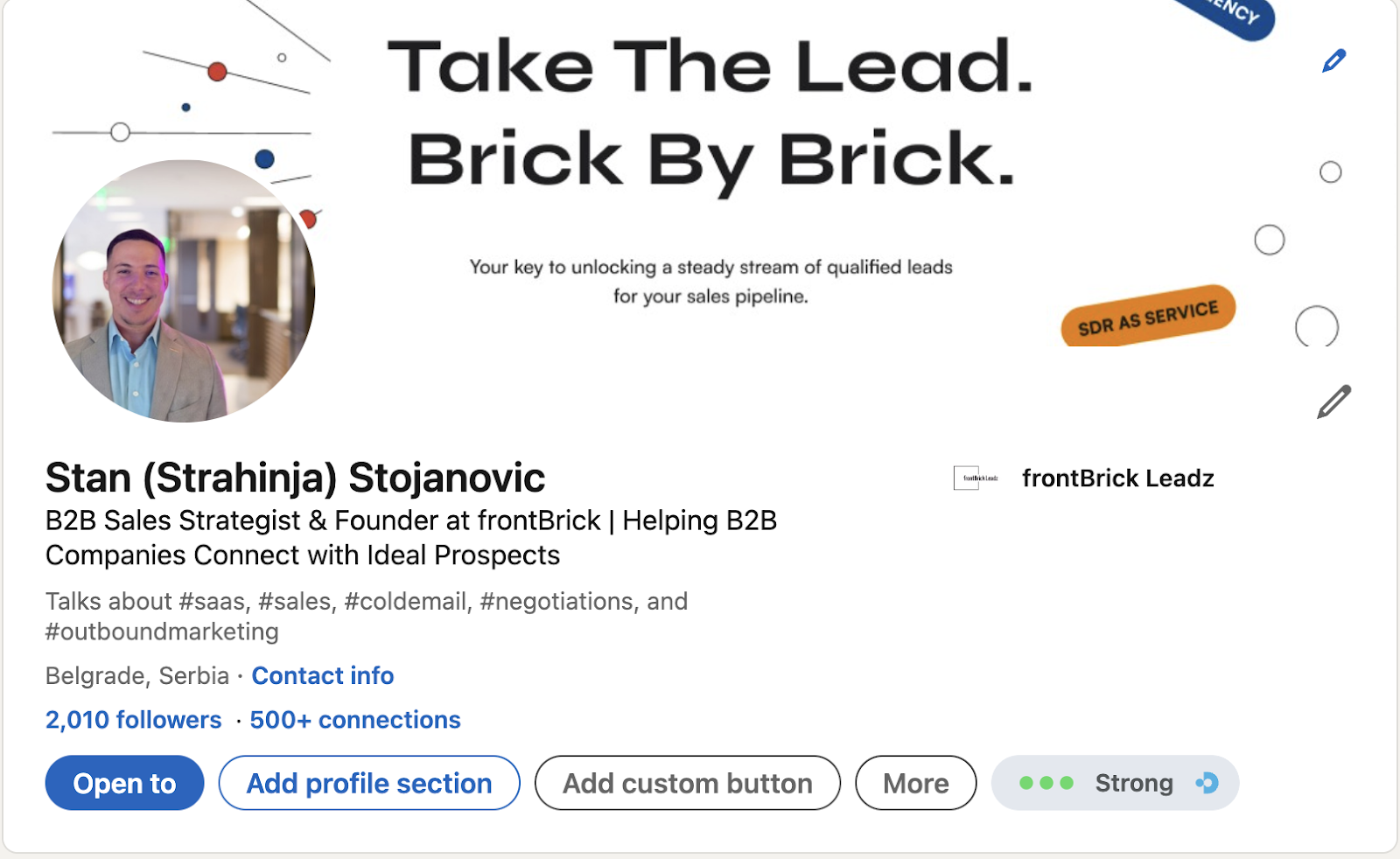
The example above shows how a banner and headline can reinforce the same offer. Treat the principle as the lesson: your current profile should match the service you are discussing, with up-to-date proof and positioning.
Find accounts first, then the people involved
For focused B2B prospecting, build a manageable account shortlist before collecting individual names. This makes it easier to avoid contacting people at companies that were never a good fit.
Sales Navigator supports account searches, saved account lists, and lead filters such as function, seniority, current company, and region. Its official getting-started guide explains how to save accounts and find people within them.
A practical sequence is:
- Search for companies that match your account criteria.
- Review their websites to confirm what they sell and who they serve.
- Save suitable accounts in a clearly named list.
- Find people whose responsibilities relate to your offer.
- Check whether a relevant relationship or introduction already exists.
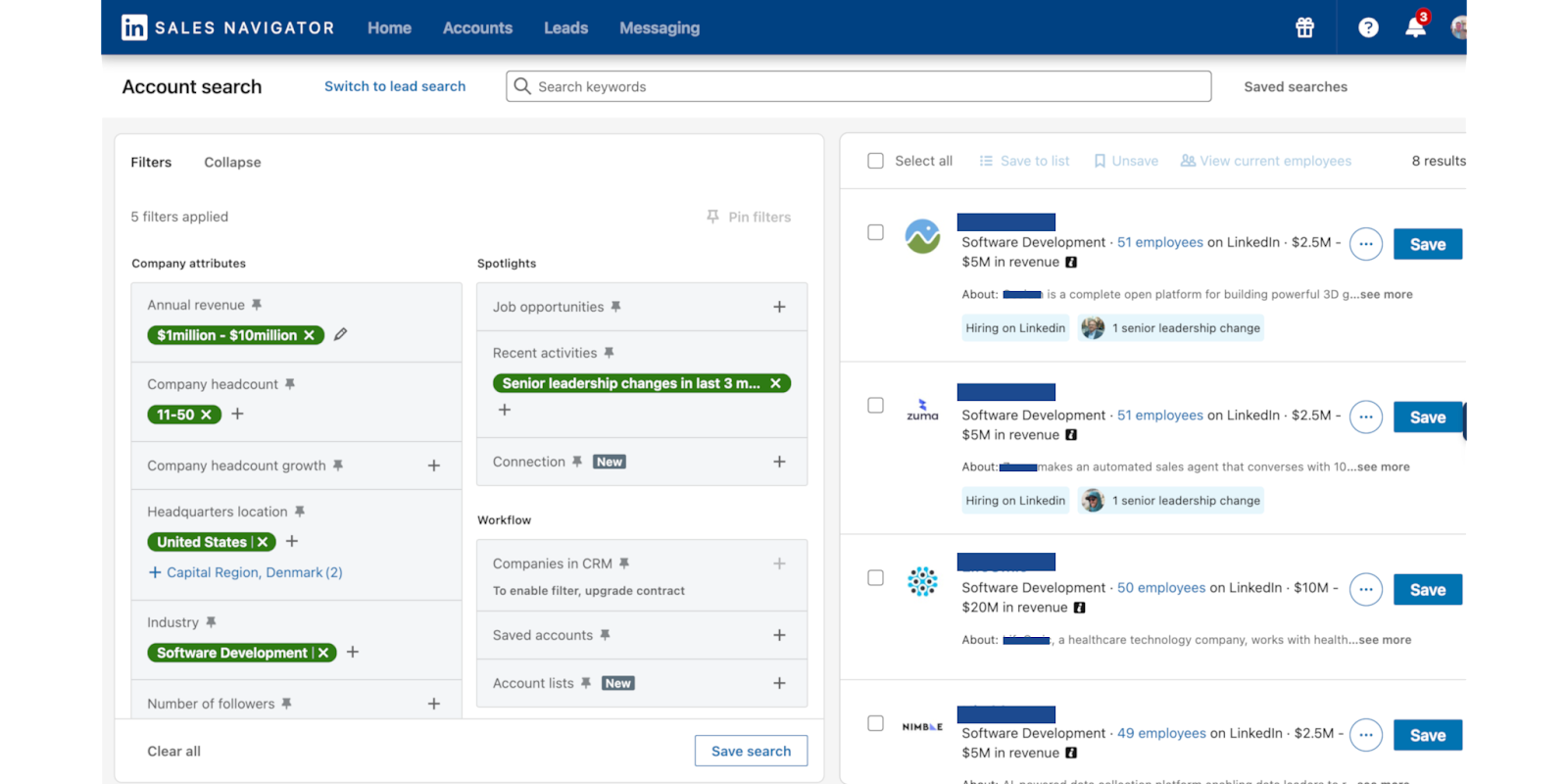
Avoid assuming one title owns every decision. A head of sales may care about meetings, a revenue operations leader may own data quality, and a founder may own agency selection. Choose the person whose responsibilities best match the problem you want to discuss.
Use saved searches to maintain the list
Saved searches preserve your criteria and notify you when new matching leads or accounts appear. They are useful for maintaining a segment rather than rebuilding it from scratch. Follow LinkedIn's current instructions for saving lead and account searches.
An alert is a reason to review a record. Confirm that the person still fits before making contact. It is not evidence that they are ready to buy.
Use Clay to improve research, not invent relevance
Clay can help organize company and person research around the audience you have defined. Its guide to finding companies and people covers company discovery, finding people at companies, and enriching person records.
Start from your CRM, an approved data source, or a company list you are entitled to use. Keep the source and date alongside each important observation so a reviewer can check it.
For a small pilot, a useful research table might contain:
| Field | Example purpose | Review before using |
|---|---|---|
| Company domain | Identify the correct business | Is this the intended company? |
| Person and current role | Find the relevant stakeholder | Is the role current and relevant? |
| Customer segment | Check account fit | Does the website support the classification? |
| Observed business change | Explain why you are researching now | Is the source recent and reliable? |
| Relevant offer | Connect the observation to your service | Is the connection plausible? |
| Source URL and review date | Make the research inspectable | Can another person verify the claim? |
| Owner and contact status | Coordinate follow-up | Is another teammate already speaking to them? |
AI-generated research should remain a draft until checked. If a lookup is uncertain, mark it as unknown. Do not turn an ambiguous sentence on a website into a confident claim about budget, strategy, or buying intent.
Our Clay consulting service supports this research and workflow layer. It is useful when prospect selection or data handoffs are the bottleneck, whether your internal team or an agency handles outreach.
Write LinkedIn prospecting messages around one useful question
A good first message explains the context quickly and gives the recipient an easy way to respond. Personalization should change the substance of the message, not just its greeting.
The examples below are illustrative. Use them only when the observation is true and the resource you offer exists.
Connection request based on a relevant topic
Hi Maya, your post on moving prospect research out of spreadsheets caught my attention. I work on that problem for B2B sales teams and would be glad to connect.
This works as a structure because it identifies a specific shared topic. Do not claim to have read a post you have not read.
First conversation after connecting
Thanks for connecting, Maya. When your team researches target accounts, is the slower part finding the right companies or checking the people inside them? We work on both, so I was curious which matters more for you.
The question helps establish relevance before proposing a meeting. Adapt it to your actual service and the recipient's responsibilities.
Follow-up with a concrete resource
One practical idea on the research side: keep a source link beside each qualification decision so the SDR can check it before using it. I have a short example table showing the fields. Would it be useful?
A follow-up should contribute something or clarify the original question. Repeating “just checking in” does little to help a buyer decide whether to reply.
Moving a relevant conversation toward a meeting
That sounds like the handoff problem we work on. Happy to walk through how the research table could connect to your existing process. Would a short working session be useful?
Send this only after the prospect has described a relevant need. A connection acceptance alone does not establish interest in a sales conversation.
Coordinate LinkedIn with email and sales follow-up
If you run both channels, maintain one shared contact status. A person who has replied on LinkedIn should not receive an unrelated cold email introduction the next morning.
Use a simple progression such as researched, approved, contacted, replied, meeting booked, meeting held, and accepted opportunity. Record an owner and next action. Keep opt-outs and exclusions visible wherever prospecting work happens.
Your team should agree who handles responses, what information is needed before booking, and how the sales representative receives the conversation history. If the prospect says “later,” capture the timing and context rather than treating the reply as an immediate opportunity.
A coordinated program can combine cold email prospecting with LinkedIn, but each touchpoint should reflect the same account context and conversation.
Keep LinkedIn activity within the platform's rules
LinkedIn states that it does not allow third-party software or extensions that scrape or automate activity on its website. Review its automated activity guidance when evaluating tools or an agency's process.
Use native LinkedIn features for activity on LinkedIn and keep research, data preparation, and internal task management clearly defined. A vendor's claimed daily limit does not establish that its workflow is permitted. Ask how any proposed integration is authorized rather than relying on a promise of “safe automation.”
Measure sales progress, not just connection growth
Connection acceptance and replies can help diagnose a campaign. They do not tell you whether the campaign creates usable sales opportunities.
| Metric | Definition | What to investigate |
|---|---|---|
| Acceptance rate | Accepted invitations divided by invitations sent in a defined cohort | Audience fit, profile clarity, and request relevance |
| Positive reply rate | People showing relevant interest divided by people contacted in that cohort | Offer and message relevance |
| Held qualified meetings | Attended meetings that meet agreed criteria | Whether outreach reaches useful sales conversations |
| Meeting-to-opportunity rate | Accepted opportunities divided by held qualified meetings | Qualification and discovery quality |
| Cost per accepted opportunity | Relevant campaign costs divided by accepted opportunities | Commercial efficiency |
Define “positive” and “qualified” before reporting. Separate interested replies from referrals, polite acknowledgments, and meeting requests. Allow enough time for the cohort to respond and progress.
If acceptance is healthy but conversations are weak, review the message and offer. If meetings happen but sales rejects them, revisit qualification. Change one major variable at a time so the next review is interpretable.
Should you hire a LinkedIn lead generation agency?
Keep prospecting in-house when your team has the time and capability to research accounts, conduct conversations, and learn from feedback. Consider an agency when execution capacity, research quality, or coordination is preventing a workable strategy from reaching the market.
An agency proposal should explain what it will actually own. Ask for:
- A sample target-account list and the reasons for inclusion.
- Examples of research-backed messages for your audience.
- Its LinkedIn operating process and approach to platform rules.
- A definition of a qualified meeting and exclusions.
- Who handles replies, booking, reporting, and CRM updates.
- Ownership and handover arrangements for data and campaign learning.
If Clay expertise matters, request a walkthrough of the research workflow. Ask how it deals with missing information and false matches. A polished automation demo does not show whether the resulting prospects fit your offer.
frontBrick's LinkedIn lead generation service is an option to discuss when you need help with targeting, messaging, and campaign delivery. Define the scope around your audience and sales capacity rather than a generic activity target.
Frequently asked questions
Can I start LinkedIn prospecting without Sales Navigator?
Yes. You can start with a small, manually researched audience and LinkedIn's native features. Sales Navigator becomes worth evaluating when you need more structured account and lead discovery, saved lists, and search alerts. Choose it around the workflow you need, not a promise of automatic results.
How many LinkedIn prospecting messages should I send each day?
There is no universal number that establishes quality or permission. Work within the limits and rules shown for your account, and keep the audience small enough to research and handle replies properly. Evaluate useful conversations and opportunities rather than maximizing daily activity.
Can Clay help with LinkedIn prospecting?
Clay can support company discovery, person enrichment, and research preparation. Review the data and its source before using it. Research support is a different function from automating actions on LinkedIn, which must be evaluated against LinkedIn's rules.
What should I track after someone replies?
Record their interest, relevant context, owner, and next step. Then distinguish a booked meeting from a held qualified meeting and an accepted opportunity. This gives your team a shared definition of progress.
Start with one segment and a reviewable process
Choose a specific audience, verify a reason to contact each person, and give one teammate clear ownership of the conversation. Review what becomes a qualified meeting before expanding the campaign.
If you want help connecting research to LinkedIn outreach, explore frontBrick's LinkedIn lead generation services. Bring your target accounts and current process so the discussion starts with the work your team needs done.
Book Your Strategy Call Today
Want to see how frontBrick can help you generate qualified leads and fill your pipeline fast? Book your free strategy call now.
Book Strategy Call
Related Resources
See All Resources