



Evaluate with preferred AI model
Last updated: September 25, 2026
Outsourced sales and marketing means hiring an external partner to run defined parts of your customer acquisition process. That might include prospect research, outbound campaigns, appointment setting, content, or paid acquisition. It does not automatically mean handing over every sales conversation or your entire marketing strategy.
For a B2B company, the right decision starts with the bottleneck. If your team can close qualified opportunities but cannot create enough of them, outsourcing sales development may help. If you still do not know who buys, why they buy, or which offer gets a response, buying more outbound capacity can make an unclear strategy more expensive.
This guide explains how to compare an agency, an internal team, and a hybrid model, what to include in the budget, and what to ask before signing a contract.
What should you outsource?
Define the work before comparing providers. Two companies selling “outsourced sales” can deliver very different services.
| Model | Typical responsibility | What your team still needs to own |
|---|---|---|
| Outsourced SDR team | Prospecting, outreach, reply handling, qualification, meeting booking | Offer, qualification criteria, sales follow-up, closing |
| Marketing specialist or agency | A defined channel such as content, paid acquisition, or campaign production | Positioning, budget, approval, connection to revenue |
| Full-cycle sales partner | Prospecting through negotiation and closing, where contracted | Commercial limits, product knowledge, customer delivery |
| GTM implementation partner | Data workflows, enrichment, CRM connections, automation | Business rules, system ownership, ongoing operating responsibilities |
| Hybrid team | External specialist capacity combined with internal sales ownership | Clear handoffs and one accountable internal lead |
Salesforce’s guide to sales outsourcing similarly distinguishes partial outsourcing from full-cycle sales. Make that distinction explicit in your brief: a calendar full of appointments and a fully managed revenue function are different purchases.
For example, a company with an experienced account executive might use an outsourced SDR agency to source and qualify conversations. A team with enough salespeople but poor prospect data may get more value from a Clay implementation partner.
In-house, outsourced, or hybrid: which fits your business?
An internal team gives you direct control over hiring, coaching, and product knowledge. An external partner can provide an established operating process and specialist capacity. A hybrid model lets you keep ownership of the customer relationship while bringing in help with a defined part of the work.
Use these questions to decide:
| Your situation | A practical starting point | What to check |
|---|---|---|
| You have repeat customers and a clear offer, but limited prospecting capacity | Test outsourced SDR support | Can the partner reach the same buyer profile and qualify to your standard? |
| You are still learning why anyone buys | Keep discovery close to founders and sales leadership | Are you learning from actual conversations before scaling outreach? |
| Your product needs deep technical discovery | Keep technical selling internal; consider external research or meeting qualification | How does the partner recognize a relevant opportunity and hand it over? |
| You have strong sellers but disconnected data and tools | Start with GTM implementation | Who maintains the workflows and fixes failures after launch? |
| You already have a repeatable process and managers to coach new hires | Compare an internal hire with external capacity | What is the fully loaded cost and time to productive output? |
Do not assume outsourcing removes management work. Someone on your side still needs to review targeting, explain product changes, respond to feedback, and make decisions about the campaign.
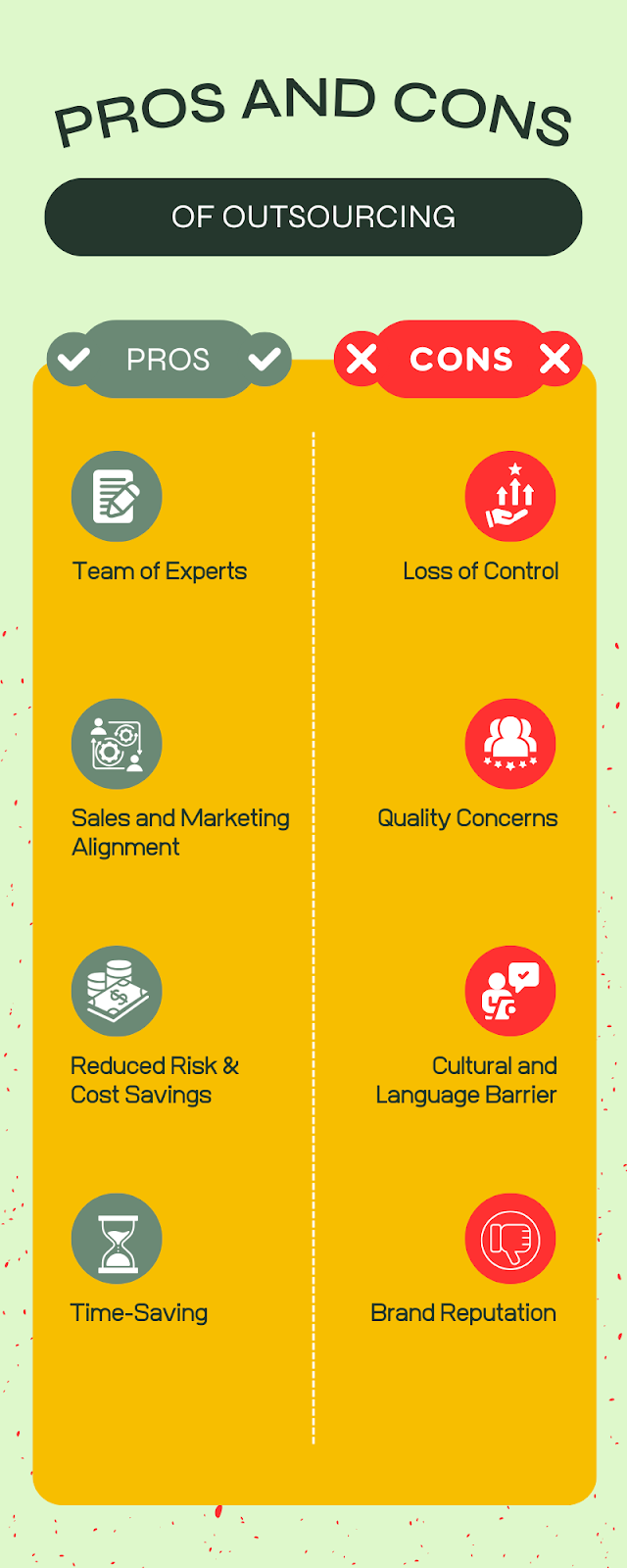
How much does outsourced sales and marketing cost?
There is no reliable single price for this entire category. The scope, team location, channel mix, data requirements, and division of responsibility all affect the quote.
Compare the total cost of running the program, not only the agency retainer:
Total program cost = partner fees + setup + data and software + media or sending infrastructure + internal operating time.
Ask which items are included. As one current example, SalesHive’s pricing page describes custom quotes based on team model, channel mix, and activity volume, with data and tooling included in its service package. That is a provider-specific offer, not a market-wide cost benchmark. Check the current quote and agreement before comparing it with a provider that bills those items separately.
For an internal team, include recruiting, compensation, benefits, management, training, data, software, and the period before the hire becomes productive. For a hybrid model, include both sets of responsibilities without counting the same software twice.
Compare outcomes on the same basis
An illustrative example shows why meeting definitions matter:
- Program A costs $6,000 for a month and produces 20 held meetings that meet your agreed criteria: $300 per held qualified meeting.
- Program B costs $4,000 and books 30 appointments, but only 10 are held and qualified: $400 per held qualified meeting.
These are hypothetical numbers, not frontBrick results, price quotes, or industry averages. They illustrate why the lower retainer does not necessarily buy the lower acquisition cost.
Keep tracking what happens next. If those meetings do not become accepted opportunities, you may have a qualification or offer problem. Our cost per lead guide explains the earlier-stage metric; use it alongside opportunity and customer acquisition costs rather than as the sole success measure.
What changes when AI is part of the service?
In 2026, an outsourced sales proposal may include AI research, enrichment, message drafting, reply classification, and automated CRM updates. Ask the provider to show where each system sits in the workflow.
The useful questions are practical:
- What evidence supports a prospect’s fit, and can we inspect the source?
- What happens when the enrichment provider returns missing or contradictory information?
- Who checks a message before a new campaign launches?
- Which replies can automation handle, and which go to a person?
- How do opt-outs, booked meetings, existing customers, and active opportunities stop future outreach?
- Who is alerted when a workflow fails or runs beyond its budget?
At frontBrick, our SDR service combines prospect research and qualification with human outreach work. The implementation still needs clear ownership. You can see a specific example in our Clay and Grok Bot outbound workflow, including where human review remains part of the process.
Evaluate the system by its inputs, decisions, and handoffs. A list of AI tools is not evidence of qualified pipeline.
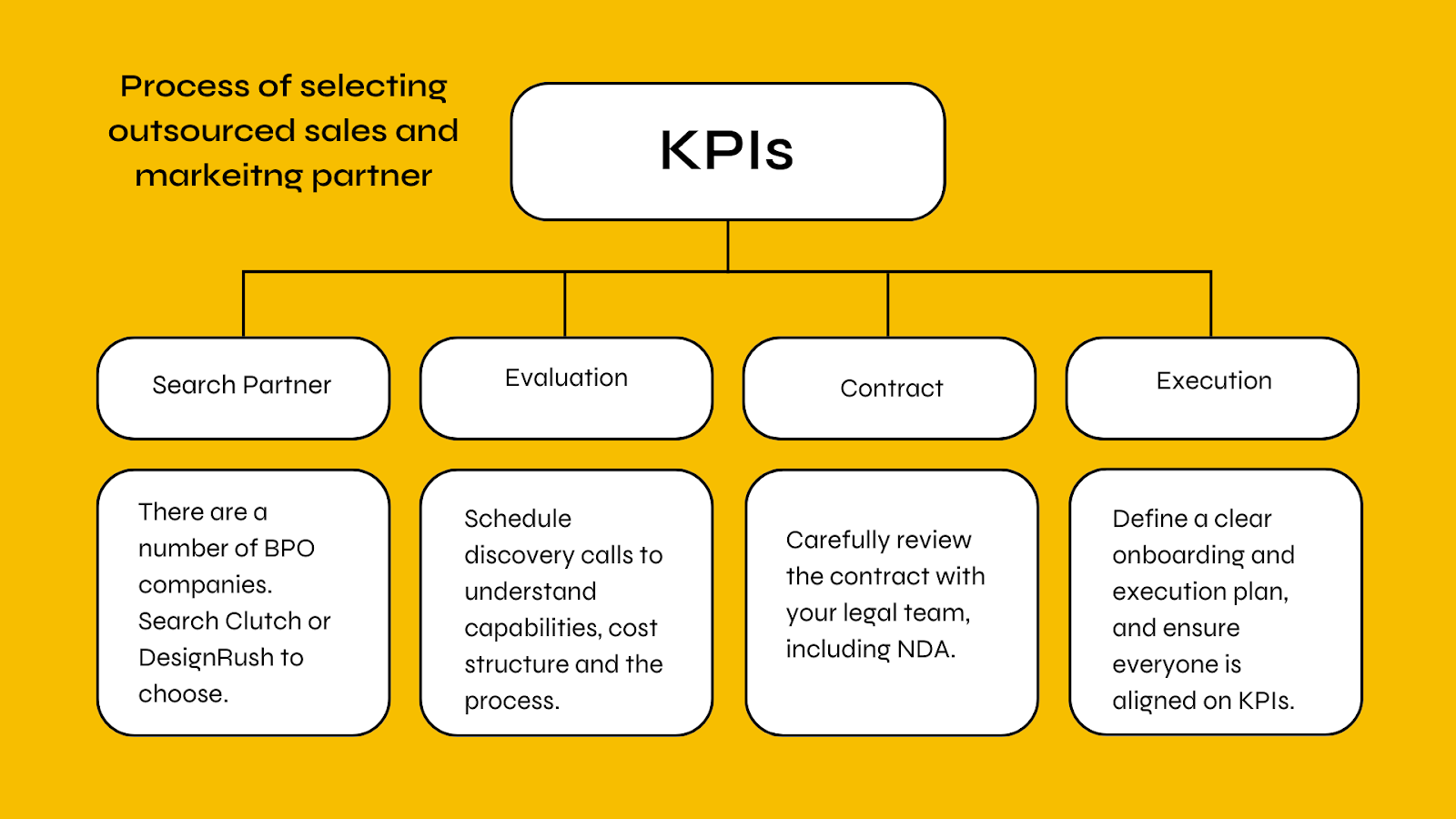
How to evaluate an outsourced sales partner
Give each shortlisted partner the same brief: target accounts, buyer roles, offer, geographic coverage, exclusions, existing sales capacity, and the outcome you want to improve.
Then ask for evidence against six criteria.
1. Relevant execution experience
Ask for a case study that resembles your sales motion. A result from a low-cost self-service product does not establish that the same approach will work for a complex enterprise sale. Look for the audience, time period, channel, qualification standard, and outcome definition.
2. An inspectable targeting process
Request a sample of proposed accounts and the reason each belongs. A job title alone is rarely enough. The team should be able to explain company fit, the problem you solve, and why the selected contact is relevant.
3. A written definition of a qualified meeting
Agree on company criteria, attendee role, the reason for the conversation, exclusions, and whether the appointment must actually be held. Decide how no-shows, duplicates, reschedules, and existing opportunities are counted.
4. Clear ownership of assets
Confirm who controls the sending accounts, domains, CRM records, lists, message variants, and workflow documentation. Ask what is exported or transferred when the engagement ends. Put the answers in the agreement rather than relying on a sales-call promise.
5. Reporting that follows the funnel
Request a sample report showing contact attempts, relevant replies, booked meetings, held qualified meetings, accepted opportunities, and eventual wins. Make sure the definitions match the way your internal team reports sales.
6. A realistic learning and exit process
Agree on review dates and decisions in advance. What would cause you to change the audience, adjust the offer, reduce volume, or stop? An initial test should produce learning you can use, even if it does not justify a larger engagement.
A practical first 90 days
Treat this as an example operating plan, not a promised launch or revenue timeline. Your preparation, channel, and sales cycle may require a different schedule.
| Period | Work | Evidence to review |
|---|---|---|
| Days 1–15 | Agree on ICP, offer, exclusions, qualification, access, and reporting | Approved account sample, message examples, written handoff rules |
| Days 16–30 | Run a controlled initial campaign and inspect responses | Data accuracy, reply quality, operational errors, sales feedback |
| Days 31–60 | Adjust the strongest segment and fix weak handoffs | Held meetings, accepted opportunities, reasons for rejection |
| Days 61–90 | Decide whether to expand, revise, or end the test | Cost by funnel stage, opportunity quality, delivery reliability |
For long sales cycles, closed revenue may arrive later. Record the campaign cohort and follow it through your CRM instead of counting the same opportunity as a new success each month.
Questions buyers ask about sales and marketing outsourcing
Is outsourcing cheaper than hiring an SDR?
It can be, but compare complete costs and equivalent responsibilities. An agency fee may include tools and management that an employee salary excludes. An experienced internal team may also become more efficient over time. Use your own compensation, capacity, and conversion assumptions.
Can an agency guarantee revenue?
Revenue depends on targeting, the offer, qualification, your sales process, and customer decisions. If a provider offers a guarantee, inspect exactly what it covers and what remedy applies. A guarantee of booked appointments does not establish that you will win customers.
Should I outsource sales and marketing to the same company?
That can simplify coordination when the company has relevant capability across both functions. It can also concentrate dependency in one provider. Decide based on the actual scope and who owns the handoff between interest, qualified conversations, and sales opportunities.
Can I keep closing in-house?
Yes. A common arrangement is to outsource research and sales development while internal sellers handle discovery, demonstrations, negotiation, and closing. Document the handoff, the information supplied, and the response time expected from your team.
What should I ask before signing?
Ask who does the work, what qualifies as a result, what the fee includes, how performance is recorded, who owns the assets, and what happens when the contract ends. If those answers remain vague, the service is not yet specific enough to compare.
Start with the bottleneck you need to solve
The best outsourced sales and marketing arrangement has a defined job, visible execution, and a clear connection to your sales process.
If your team needs help turning prospect data into qualified conversations, explore frontBrick’s outbound lead generation service. Bring your current audience, offer, and sales capacity to the discussion so the scope can be built around the work you actually need.
Book Your Strategy Call Today
Want to see how frontBrick can help you generate qualified leads and fill your pipeline fast? Book your free strategy call now.
Book Strategy Call