




Evaluate with preferred AI model
Last updated: October 18, 2026
An SDR in sales is a sales development representative: someone who identifies relevant prospects, starts or responds to conversations, checks fit and prepares a useful handoff to the person responsible for progressing the sale. The role creates qualified opportunities for further discussion rather than treating every booked meeting as success.
For a sales leader, the important design question is what the SDR owns and what evidence the next person needs. For someone considering the role, the work combines research, communication, follow-up and careful record keeping.
What does a sales development representative do?
Salesforce describes SDR work as early-stage sales activity including prospect research, education, qualification and meeting booking. It also notes that SDRs can work across inbound and outbound. See its overview of the SDR role.
In practice, agree on responsibilities explicitly. One organization may assign inbound inquiries to SDRs and outbound prospecting to business development representatives. Another may use the titles differently. The job description and handoff rules matter more than the acronym.
| Responsibility | Useful output | Quality check |
|---|---|---|
| Account research | A short brief with fit evidence | Sources support the claims and exclusions are applied |
| Contact selection | A relevant person and reason to engage | Role and company details are current |
| Outreach | A clear message or conversation | The offer fits the context and claims are approved |
| Qualification | Known needs, fit and open questions | Buyer statements are separated from assumptions |
| Follow-up | An appropriate next action | Timing and ownership are recorded |
| Handoff | Context the next seller can use | The buyer does not have to repeat everything |
This is a suggested operating model. Adapt it to the product, sales cycle and people available rather than imposing the same activity quota on every team.
SDR vs BDR vs account executive
SDR and BDR responsibilities can overlap. Some teams distinguish them by inbound versus outbound work, market segment or the type of relationship being developed. Ask which accounts, channels and stages each role actually owns.
An account executive typically takes responsibility for progressing a qualified sales discussion through evaluation and commercial decisions. The exact boundary varies. In a small business, a founder may perform several of these roles, while a larger team may separate research, development and closing.
Avoid a handoff that is based only on a calendar booking. Define the information needed, who accepts the handoff and what happens when the next seller decides the opportunity is not ready.
The skills that matter in SDR work
Research judgment: An SDR needs to know whether a fact supports a reason to contact someone. A company announcement can provide context, but it does not prove an internal problem, budget or willingness to buy.
Clear communication: Good outreach explains one relevant idea in language the buyer understands. The rep should be able to ask a focused question and listen to an answer that changes the plan.
Qualification: The rep needs to recognize both fit and non-fit. Passing an unsuitable prospect to the next seller wastes time and teaches the team to optimize for meetings rather than useful opportunities.
Organization: Follow-up dates, opt-outs, account ownership and conversation notes need consistent handling. A thoughtful conversation loses value when the next action is missing.
Coachability: Reps should be able to review a conversation, identify an unsupported assumption and improve the next attempt. Confidence helps, but it should not prevent the rep from acknowledging uncertainty.
A practical daily workflow
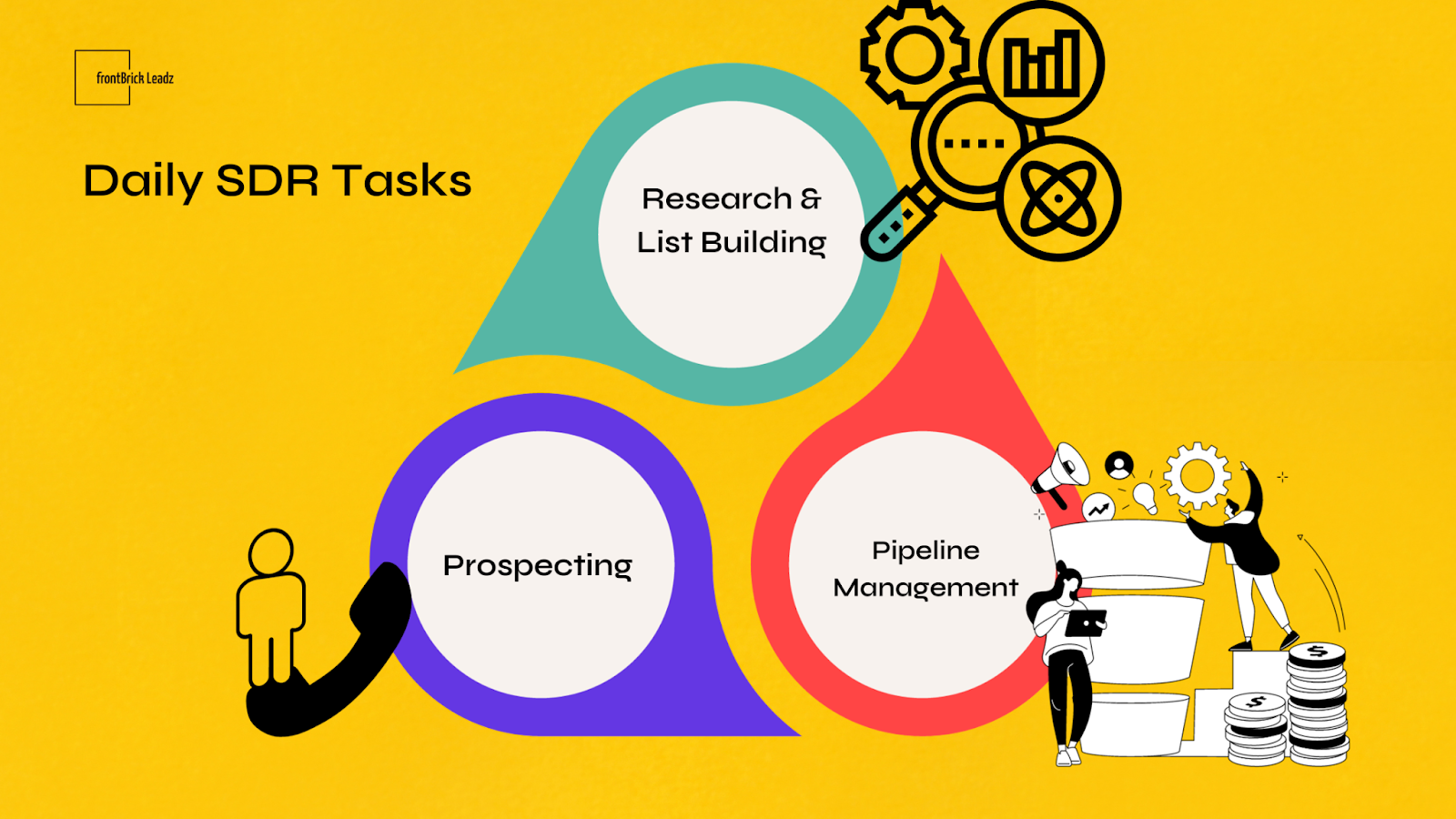
Start by reviewing new replies and commitments that need a response. Separate interested conversations from administrative messages and requests not to be contacted. Apply the team's suppression and routing rules before continuing outreach.
Next, research and prioritize accounts using the agreed criteria. Prepare the reason for contact and choose the appropriate channel. Work through the planned outreach while preserving time for real conversations and follow-up.
End by updating the system of record and identifying questions that need help from a manager or specialist. A daily review should surface obstacles such as weak data, unclear proof or accounts already owned by another team.
There is no universal number of calls or emails that defines a good SDR day. Activity expectations should reflect the market, research depth, channel and actual workload. Use activity to understand capacity, then judge the value of the resulting conversations.
What a qualified handoff should include
A suggested handoff note covers:
- The company and contact, with the relevant role and account context.
- Why the account appears to fit the agreed criteria.
- What the buyer actually said, distinguished from the SDR's interpretation.
- The topic or need to explore and any known constraints.
- Questions still unanswered, including timing or stakeholders when unknown.
- The agreed next step, owner and date.
- Links to the relevant conversation and research in the approved system.
For a fictional example, “The buyer asked to compare our enrichment process with their current workflow” is more useful than “Hot lead, wants AI.” The first statement gives the next seller a concrete agenda. It does not imply budget or purchase intent that has not been established.
How to measure SDR performance
Use a small set of metrics that represent different stages. Track relevant conversations, meetings held, accepted handoffs and opportunities created using definitions agreed with the sales team. Keep booked meetings separate from held meetings, and meetings separate from qualified opportunities.
Review the reasons handoffs are rejected or opportunities stall. If buyers repeatedly misunderstand the offer, coaching and messaging may matter more than activity volume. If good conversations are not followed up, the issue may be ownership or capacity downstream.
Do not attribute all revenue to the SDR's first touch when other channels and sellers contributed. Record the role of sales development clearly and use the same attribution rules across the team.
Where AI and Clay can support SDRs
AI can assist with structured research, draft preparation and organizing approved information. Human review remains important where the work requires interpreting a buyer's situation, making a commitment or deciding that an account is qualified.
Claygent Builder supports agents for account research, scoring and outbound copywriting. Our recommended implementation separates evidence from generated text, defines an unknown state and routes exceptions to a person. Those controls must be designed and tested; they are not implied by adding AI to the stack.
A useful division of work is to automate repeatable preparation and let the rep spend more attention on interpretation and conversations. For implementation help, see our Clay consulting agency. For practical drafting exercises, use our ChatGPT for sales prompts.
Hiring internally or using an SDR agency
An internal SDR may be appropriate when you have management capacity, a defined market, coaching and enough ongoing work. Hiring the rep without those foundations leaves them responsible for solving several different problems at once.
An external team may help when execution capacity or process development is the bottleneck. Compare the complete scope: research, data, channels, training, reporting, reply handling and handoff. Your team still needs to own product expertise and decisions about what can be promised.
When evaluating an SDR agency, ask who owns the accounts and data, how qualification is agreed and how feedback changes the campaign. Request evidence that matches your sales context rather than selecting a provider only by promised meeting volume.
Frequently asked questions
Is SDR an entry-level sales role?
It can be an entry point, but the work still requires judgment and structured training. Review the specific responsibilities, support and progression path rather than assuming every SDR position is the same.
Does an SDR close deals?
The role generally focuses on early-stage work and qualification. Some teams combine responsibilities, so establish the boundary with the account executive or founder explicitly.
Can AI replace the whole SDR process?
Evaluate individual tasks and the controls they require. Research or drafting assistance is different from taking responsibility for buyer conversations, qualification and commitments. Assign accountability for those decisions even when parts of the work are automated.
Book Your Strategy Call Today
Want to see how frontBrick can help you generate qualified leads and fill your pipeline fast? Book your free strategy call now.
Book Strategy Call