

Back to Resources
How to Use ChatGPT for Sales: 7 Practical Workflows and Prompts
Author
Jovana Stojanović
Date
December 22, 2023
Read time
8
min.


Last updated: October 17, 2026
Use ChatGPT for sales work that benefits from organizing information, producing a first draft or practicing a conversation. Give it verified context, a specific task and a review standard. Keep facts, assumptions and suggestions separate before anything reaches a prospect.
The most useful workflow starts with a sales decision: which account deserves attention, what question to ask, or how to explain an offer. Generating more words is not the objective.
What ChatGPT can do for a sales team
ChatGPT can help with research, drafting, comparing information and analyzing material you provide. Available capabilities depend on your plan, settings and workspace. OpenAI's guide to using ChatGPT also emphasizes reviewing important facts and iterating on the output.
Treat it as a working assistant with an explicit brief. It should not decide that a company has budget, invent a customer success story or turn a public hiring announcement into proof of buying intent.
Before each task, supply the audience, objective, source material, approved claims and output format. For sensitive customer or deal information, use your organization's approved workspace and data-handling rules. Do not paste information simply because it would make the prompt more detailed.
1. Build an account brief from evidence
A good account brief separates what you know from what you want to investigate. Start with the company's own website, relevant public announcements and approved CRM notes. Include the source URLs and the date you checked them.
Create an account brief using only the material below. Return: company offering, target customers, verified recent changes, relevant buying roles, possible reasons our offer could matter, and unanswered questions. Cite the supplied source for every factual statement. Label inferences as hypotheses. If evidence is missing, write unknown. Do not invent budget, intent, technology use or internal pain points. Our offer: [description]. Source material: [verified excerpts and URLs].
Review whether the sources actually support the statements. A job advertisement for a sales role can support a hiring observation. It does not prove dissatisfaction with an agency or a need for your product.
2. Turn account research into qualification questions
ChatGPT can help structure an ideal customer profile, but the team must decide which criteria matter. Separate required fit from useful signals and from disqualifiers. Do not ask for a precise score without explaining the scoring rules.
Compare this account brief with our ICP criteria. For each criterion, return pass, fail or unknown, the supporting evidence, and one question needed to resolve uncertainty. Keep company fit separate from engagement and buying intent. Do not interpret missing information as a pass. ICP criteria: [rules]. Account brief: [reviewed brief].
Use the output to direct further research or a discovery conversation. For example, an unknown geographic service area may need a website check. An unknown procurement process may require a conversation rather than more public research.
3. Draft a cold email from a verified reason to contact
A useful prompt connects an observation to an offer without pretending to know the buyer's mind. Supply the exact proof you are allowed to use, including any limits on customer names or results.
Write two cold email drafts for [role]. Use this verified observation: [fact and source]. Offer: [specific deliverable]. Approved proof: [exact claim, or none]. Explain a plausible connection without claiming the prospect has a problem. Keep each draft under 90 words as a working constraint, use plain language and end with one low-effort question. No invented familiarity, praise, urgency or results. After each draft, list the factual claims for review.
The word limit is an editing choice, not a conversion benchmark. Check whether a shorter version preserves the meaning. If the draft could be sent unchanged to almost any company, improve the reasoning before adding more personal details.
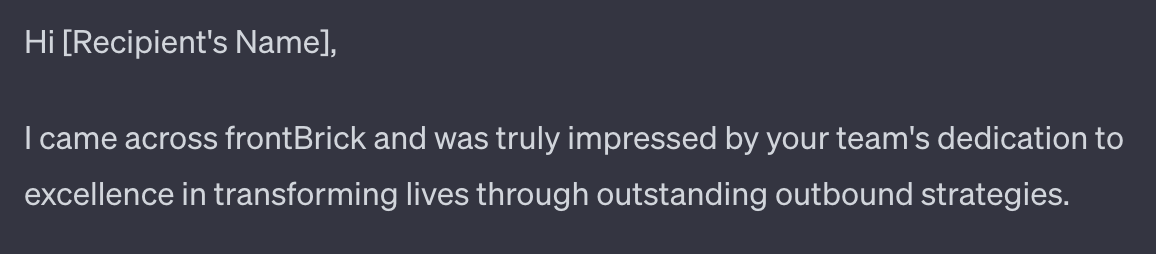
Generic flattery is a useful failure case. “I was impressed by your commitment to excellence” does not explain why the recipient should care. Replace it with an observation you can verify and a relevant offer. Our cold email subject line guide helps connect the subject to that message.
4. Prepare discovery questions that test assumptions
Use research to prepare better questions, not to script answers for the buyer. A discovery outline should identify what would change your recommendation.
Prepare six discovery questions for [buyer role] about [business workflow]. Use the account brief below. For each question, state which uncertainty it resolves and what different answers would imply for fit. Avoid leading questions and claims that the company has a known problem. Finish with two conditions under which we should not recommend our service.
A useful question might ask how accounts are selected today and where the process slows down. It gives the buyer room to explain that the current process works well. A weaker question assumes the buyer is struggling and asks them to confirm it.
5. Practice objections without inventing promises
Role-play can expose vague answers before a real call. Give ChatGPT boundaries around pricing, scope and evidence so the exercise does not reward unsupported confidence.
Role-play a skeptical buyer evaluating [service]. Ask one question at a time about scope, cost, ownership or proof. Wait for my answer. Then assess whether I answered the question directly, made an unsupported claim or missed a useful follow-up. Use only these approved facts: [facts]. Do not invent competitor weaknesses or customer results.
Review the feedback with the person who owns the offer. A polished answer that promises work outside the agreement is still a bad answer. Store the approved responses as examples for future practice.
6. Compare options using current sources
ChatGPT can organize a buying comparison when you supply the evidence. Require an explicit unknown rather than a guessed feature, price or integration.
Build a comparison table for these options using only the linked excerpts below. Columns: intended use, relevant capability, requirement or limitation, source and date checked. Distinguish vendor statements from our own assessment. Do not rank the options or fill gaps from memory. End with the questions we must ask before choosing. Options and sources: [material].
This is useful for evaluating a research tool or agency. The team can then weight the criteria by its actual workflow. A feature list alone cannot establish that an option fits the available data, budget or operating capacity.
7. Turn meeting notes into a follow-up and handoff
A follow-up should preserve what was agreed, not upgrade tentative interest into a commitment. Provide notes you are permitted to use and ask for separate internal and external outputs.
From these approved meeting notes, draft a short follow-up email and an internal handoff. Separate agreed actions from open questions. Include an owner and date only when present in the notes. Flag missing information instead of assigning it. Do not imply the buyer approved a proposal unless the notes explicitly say so. Notes: [notes].
Check names, dates, responsibilities and commitments before sending. Save the reviewed outcome in your system of record so the next person does not need to reconstruct the conversation from an AI chat.
When to use ChatGPT with Clay
ChatGPT is useful for developing a research method or improving a draft interactively. For a repeatable account workflow, define structured inputs and review rules before scaling it across a list.
Claygent Builder supports agents for account research, scoring and outbound copy. A practical implementation can store the source evidence separately from the generated message and route uncertain records to review. That is our recommended design, not a claim that every workflow has those checks automatically.
Use our Clay consulting agency page if you need help turning a validated method into an operating process. If the requirement includes targeting, outreach and reply handling, discuss the broader scope with our outbound lead generation team.
For a complete campaign example, follow our AI outbound sales workflow in ChatGPT. It starts with a free company dataset and shows sourcing, enrichment, validation and outreach review with BlitzAPI and Clay.
How to evaluate whether ChatGPT is helping sales
Compare reviewed work with a baseline from the same task. Track research completeness, unsupported claims, editing time and the usefulness of the finished output. For live outreach, review qualified replies and downstream opportunities with a consistent definition.
A faster first draft is useful only if the total review burden and final quality make sense. Include difficult examples in testing: incomplete account data, ambiguous company names, conflicting notes and prospects who clearly do not fit.
Frequently asked questions
Can ChatGPT find accurate leads on its own?
Do not treat generated company or contact details as verified leads. Check identities, current roles, source evidence and contact information through an appropriate research and validation process.
Can ChatGPT write a sales sequence?
It can help draft one. Give each step a purpose, supply approved claims and review the entire sequence for repetition, accuracy and an appropriate next action before using it.
Should an AI draft be sent automatically?
Only after you have established and tested the controls for that workflow. Start with human review, define exceptions and keep responsibility for the final message clear.
Book Your Strategy Call Today
Want to see how frontBrick can help you generate qualified leads and fill your pipeline fast? Book your free strategy call now.
Book Strategy Call
Related Resources
See All Resources