

Back to Resources
Consultative selling: discovery questions and an outbound sales workflow
Author
Jovana Stojanović
Date
December 14, 2023
Read time
6
min.


Last updated: October 20, 2026
Consultative selling means understanding the buyer's situation before recommending a course of action. In outbound sales, that starts with a relevant reason to talk and continues through discovery, a checked summary and an agreed next step. The recommendation may be a smaller engagement, a different approach or no purchase.
Salesforce's consultative sales guide describes an approach centered on the customer's needs and acknowledges that a sale is not always the outcome. The workflow below applies that principle to a practical B2B services conversation.
Research creates questions, not answers about the buyer
Prepare by checking the company's current offering, the contact's role and any relevant public changes. Review existing conversations in your approved customer relationship management system before contacting the account again.
Separate three kinds of information: verified observations, statements the buyer has made and hypotheses you want to test. A new office or sales vacancy can suggest a useful question. It cannot confirm a budget, an operational problem or a buying deadline.
A proposed Clay research workflow can organize observations and source links for review. Our Clay consulting service helps with that preparation. Enrichment should not overwrite what a buyer directly told you with a generated guess.
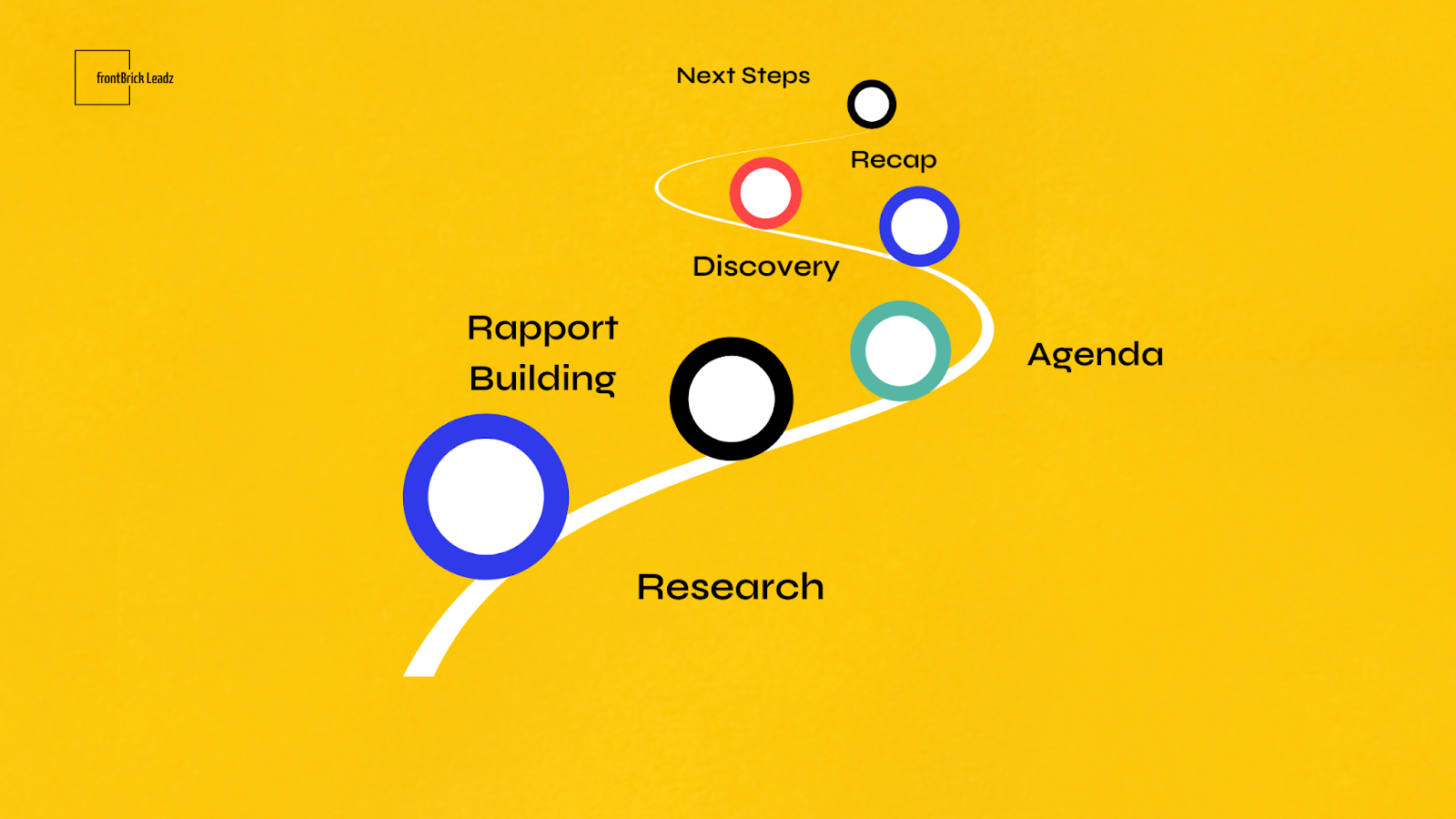
A six-stage consultative conversation
Use the stages as a guide, not a script to force every buyer through. Someone requesting a specific answer may need that answer before a broader discovery discussion.
1. Prepare the business context
Write down the reason for the conversation, the information already available and the most important unknowns. Identify which decisions your service could actually help with. Avoid researching unrelated personal details simply to manufacture rapport.
2. Establish a useful working relationship
Be clear about your role and why you are speaking. Let the buyer choose how much informal conversation is appropriate. There is no required number of minutes of small talk before a productive discussion can begin.
3. Agree on the agenda
Offer a short agenda and invite adjustments. For example: “Could we start with how account research works today, look at where support might help, and decide whether a follow-up is useful?” This is a suggested phrase, not a required script.
4. Explore the current process and desired change
Ask open questions, listen to the answer and follow the important detail. Do not move through a checklist so quickly that you miss a contradiction or a reason the service is unnecessary.
5. Recap and check your understanding
Distinguish confirmed facts from remaining questions. Say what you heard and invite correction before presenting a proposal. A recap should help the buyer recognize their situation, not make it sound worse to justify a sale.
6. Agree on a concrete next step
Record the action, owner and timing only when they are agreed. If there is no fit or no priority, say so. A polite conversation is not automatically an opportunity, and a vague “send something over” needs clarification about what would be useful.
Discovery questions for outbound services
These questions are suggested starting points. Choose the ones that fit the conversation instead of asking every question in order.
| Area | Example question | What to establish |
|---|---|---|
| Current process | How does a target account move from research to a sales conversation today? | Actual workflow and ownership |
| Friction | Where does work tend to wait, repeat or need correction? | A specific issue, if one exists |
| Impact | What does that affect, and how are you measuring it? | Evidence behind the business consequence |
| Desired outcome | What would a useful improvement look like to your team? | The buyer's definition of success |
| Constraints | What systems, access or team capacity would an implementation need to fit? | Practical limitations |
| Evaluation | Who needs to assess a change, and what would they need to see? | Decision process without assuming authority |
| Priority | How does this compare with the other work you have planned? | Whether action is appropriate now |
Avoid leading questions such as “How much revenue are you losing because your data is poor?” unless the buyer has already established both the problem and a defensible way to measure it.
A fictional example: recommending less work
Suppose a sales leader says account research is adequate, but interested replies regularly wait several days for an owner. The original proposal was to add more prospecting volume.
A consultative response would examine reply routing, team capacity and handoff rules before recommending more sending. The useful next step might be reviewing the current process with the person responsible for follow-up. More leads could make the existing delay worse.
This example is hypothetical. It illustrates why the recommendation should follow discovery rather than remain fixed before the conversation begins.
Compare consultative, solution and product-led conversations
These approaches can overlap. Consultative selling emphasizes diagnosing the situation and advising on an appropriate action. Solution selling connects a defined problem with a suitable solution. A product-focused conversation explains capabilities and how they work.
A buyer can need all three in one evaluation. After discussing the workflow, they may reasonably want a direct demonstration of a feature. Do not use “consultative” as a reason to avoid clear answers about scope, limitations or cost.
Turn discovery into a usable handoff
The next person should receive a concise record of the buyer's stated objective, current process, confirmed issue, constraints, stakeholders and agreed action. Label anything still unverified. Include the buyer's wording when it prevents ambiguity, while following your team's information-handling practices.
Review the quality of the handoff as well as the number of meetings. A meeting with no context, no relevant participant or no clear purpose may consume capacity without moving an evaluation forward.
Our five-step outreach process explains how research, campaign execution and reply handling connect before this handoff.
What to assess in a representative or agency
Use a realistic practice conversation. Look for follow-up questions, accurate summaries, willingness to acknowledge missing information and recommendations that fit the buyer's situation. A polished pitch alone does not demonstrate those skills.
Ask how discovery notes reach the delivery team and how qualification is defined. Our outbound lead generation service can be scoped around those responsibilities. Agree what counts as a relevant conversation before comparing provider reports.
Frequently asked questions
Can consultative selling start with cold outreach?
Yes. The first message can offer a relevant conversation without claiming to know the buyer's internal situation. Deeper discovery happens when the person chooses to engage.
Does every discovery call need a proposal?
No. A corrected assumption, an agreed research task or a decision not to proceed can be a useful outcome. A proposal is appropriate when there is enough understanding to make a relevant recommendation.
Can AI run the discovery process?
AI can assist with preparation and organizing notes, subject to your approved tools and policies. A responsible seller still needs to check accuracy, understand the buyer's answers and own the recommendation.
Book Your Strategy Call Today
Want to see how frontBrick can help you generate qualified leads and fill your pipeline fast? Book your free strategy call now.
Book Strategy Call
Related Resources
See All Resources