

Back to Resources
Inbound vs outbound marketing: how to choose a B2B channel mix
Author
Jovana Stojanović
Date
November 28, 2023
Read time
7
min.


Last updated: October 20, 2026
Inbound marketing attracts people through useful content, discoverability and experiences they choose to engage with. Outbound marketing starts contact with a selected audience through channels such as email, calls or professional outreach. The practical difference is how the conversation begins, not whether one approach builds relationships and the other does not.
For a B2B team, the choice depends on reachable buyers, available expertise, budget, sales capacity and the question you need to answer next. Neither approach guarantees immediate pipeline, and inbound content is not free simply because a visitor arrives organically.
Compare the operating requirements
| Decision | Inbound marketing | Outbound marketing |
|---|---|---|
| Starting point | A buyer discovers or seeks out a useful resource | Your team selects an account and initiates contact |
| Typical work | Research, content, distribution, website experience and response handling | Account selection, contact research, messaging, delivery and reply handling |
| Audience control | Content can target a topic and buyer group; actual visitors vary | The team can choose accounts, but cannot guarantee attention or interest |
| Learning opportunity | Questions, content engagement and inquiries reveal useful themes | Replies can test the relevance of an offer for a defined segment |
| Main constraint | Creating and distributing material worth finding | Reaching relevant people with an appropriate reason to engage |
| Commercial measure | Qualified opportunities and eventual revenue, with attribution limits | Qualified opportunities and eventual revenue, with attribution limits |
These are planning distinctions, not a ranking. An email can deliver a requested inbound resource or initiate a cold approach. Classify the interaction by its context rather than assuming a channel always belongs in one category.
What inbound marketing involves
Useful inbound work answers questions a buyer has while understanding a problem, comparing approaches or evaluating suppliers. Examples include implementation guides, comparison pages, product demonstrations and clearly documented case studies.
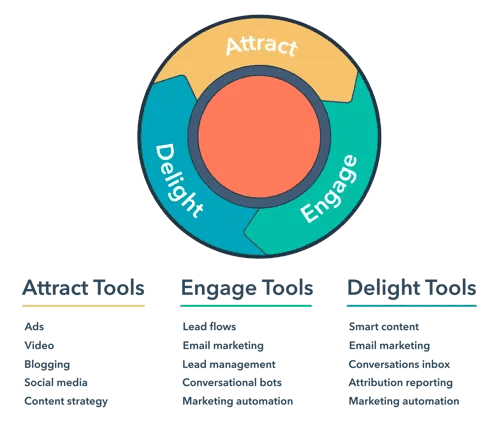
HubSpot's inbound methodology organizes the work around attracting, engaging and supporting customers. A page that attracts visits still needs to help the right person take a useful next step. That could be checking service scope, watching a relevant demonstration or making a specific inquiry.
Budget for subject expertise, editing, design, technical maintenance, distribution and handling responses. Existing content may remain useful, but it still needs factual review and upkeep. Avoid forecasting a fixed time to organic results without evidence from the site's actual market and performance.
What outbound marketing involves
Outbound starts with a defined audience and a reason to approach it. A B2B team might research a group of suitable companies, identify relevant responsibilities and offer a concrete conversation or deliverable.
Selection is not the same as intent. A company can match your ideal customer profile and still have no need, budget or interest in the offer. Treat public changes as research context and use replies to learn what is actually relevant.
Plan for setup, data quality, message review, sending operations and follow-up capacity. A campaign can generate responses without producing qualified opportunities. Our outbound lead generation service can support that wider process, while our cold email service focuses on the email channel.
Choose the next investment by the constraint
If buyers already ask detailed evaluation questions but your website does not answer them, prioritize useful decision content. If you have a specific offer and a clearly defined group of reachable accounts, a bounded outbound pilot may help test relevance.
If interested people are already waiting for responses, address ownership and sales capacity before increasing either activity. More acquisition does not resolve an unhandled inquiry queue.
A fictional software business with a complex implementation could build an honest integration guide and offer a relevant discussion to selected accounts. The guide helps a buyer inspect the offer; the outreach introduces it to a suitable audience. This is a proposed combined workflow, not a claim that the combination produces a particular return.
Compare complete costs and time horizons
List internal time alongside invoices. For inbound, include expert input, production, publishing, maintenance and distribution. For outbound, include research, enrichment, tooling, message approval and conversation handling. Both also depend on sales work after the first inquiry or reply.
Use the same definitions when comparing results. Cost per lead is difficult to interpret if one channel counts every download while another counts only a relevant meeting. Define the conversion event, follow-up window and qualification criteria first.
Set a review date around the decision you are testing. An early outbound review may tell you whether the offer is understood. An early content review may reveal indexing, usability or unanswered questions. Neither necessarily provides enough evidence about eventual revenue.
Combine the channels without duplicating contact
A suggested shared workflow is:
- Define the audience and the buyer questions your team can answer well.
- Publish a useful resource with clear scope, evidence and a relevant next step.
- Use reviewed account research to identify where that resource may be appropriate.
- Coordinate contact ownership, existing conversations and requests not to be contacted.
- Route replies and inquiries to a named owner with the relevant context.
- Record what helped the buyer evaluate the offer and what remains unclear.
Clay can support research and enrichment within a designed workflow. Our Clay consulting service helps connect that preparation to downstream processes. A database match should not be treated as permission, demand or a confirmed buying project.
Account-based marketing can coordinate content and outreach around selected accounts. It still requires a clear audience, suitable evidence and agreement between marketing and sales; combining channels alone is not a complete strategy.
Where Google and AI discovery fit in 2026
Buyers may encounter content through search results or AI-assisted research. Google's guidance for AI features in Search says established SEO practices remain relevant and that no special AI markup is required for AI Overviews or AI Mode. Eligibility does not guarantee inclusion.
For a practical content brief, answer the buyer's actual comparison questions: who the service fits, what implementation requires, which responsibilities remain with the customer and what evidence supports the claims. Make important information available as readable text and keep sources current.
Track visibility separately from business outcomes. An observed mention in an AI answer is not a measured visit or qualified opportunity. These are different signals and should not be added together as if they were equivalent leads.
Avoid false certainty in attribution
A buyer may read an article, receive an email and return later through a branded search. A report that assigns credit to one interaction simplifies that journey. Use consistent attribution rules and supplement them with the buyer's own explanation where available.
Review qualified conversations, opportunities and revenue alongside the route by which the contact arrived. Look for useful patterns, but do not treat every observed association as proof that one activity caused the outcome.
Frequently asked questions
Is inbound cheaper than outbound?
Not inherently. Compare the full production and operating cost against equivalent outcomes. Organic visits still require investment in useful content and a functioning sales process.
Is outbound better when we need results quickly?
It can let you approach a defined audience directly, but response timing and commercial outcomes remain uncertain. Check setup requirements, audience fit and your ability to handle replies before assuming it solves an urgent pipeline problem.
Should a small team do both?
Only at a scope it can execute well. A focused resource and a reviewed outreach pilot can be more manageable than launching several channels without clear owners. Choose the next step by the constraint you need to resolve.
Book Your Strategy Call Today
Want to see how frontBrick can help you generate qualified leads and fill your pipeline fast? Book your free strategy call now.
Book Strategy Call
Related Resources
See All Resources