
Lead Generation Cost in 2026: How to Price, Budget and Compare B2B Lead Gen
B2B lead generation costs between about $270 a month, if you run a basic tool stack yourself, and $11,500 a month or more for a fully managed multichannel program. Most managed cold email and LinkedIn programs for small and mid sized B2B companies land between $3,000 and $6,000 a month. Pay per meeting providers publish rates from $250 to $500 per held meeting, and account based marketing starts around $7,000 a month before media spend. Those are published prices from each provider's own website, checked between 3 and 13 November 2026.
The price on the proposal is only half of the answer, though. What you actually want to know is what one qualified sales meeting costs you, and whether that number is lower than what a meeting is worth. This guide shows you how to work that out step by step, using the same math I use with frontBrick clients before we agree a scope. I run frontBrick, an outbound and GTM agency, so I will show you our own prices too, next to the published prices of other providers. Where a company does not publish a number, I say so instead of guessing.
Key takeaways
| Question | Short answer |
|---|---|
| How much does lead generation cost? | About $270 a month for a do it yourself tool stack, $1,500 to $11,500 a month for managed outreach, from about $4,249 a month to rent an SDR |
| What does a cold email agency cost per month? | Published entry prices run from $1,500 to $3,250 a month. frontBrick's focused cold email project is $3,000 a month for 60 days |
| What does pay per meeting cost? | SalesGent publishes from $250 per qualified meeting, A-Sales from $500 per held meeting |
| What does ABM cost for a 50 to 250 person company? | frontBrick ABM starts at $7,000 a month, plus a media budget agreed in the proposal |
| What is the right budget for you? | Work out what one meeting is worth, spend at most a fifth of that per qualified meeting, and check the real number at day 90 |
| What is the biggest pricing mistake? | Comparing monthly fees instead of cost per qualified meeting and what is included |
How much does lead generation cost in 2026?
There is no single price for lead generation because you are not buying one product. You are buying a mix of data, sending infrastructure, copy, people's time and someone's judgment about who to contact. Each pricing model bundles those differently. Here is what the market publishes right now.
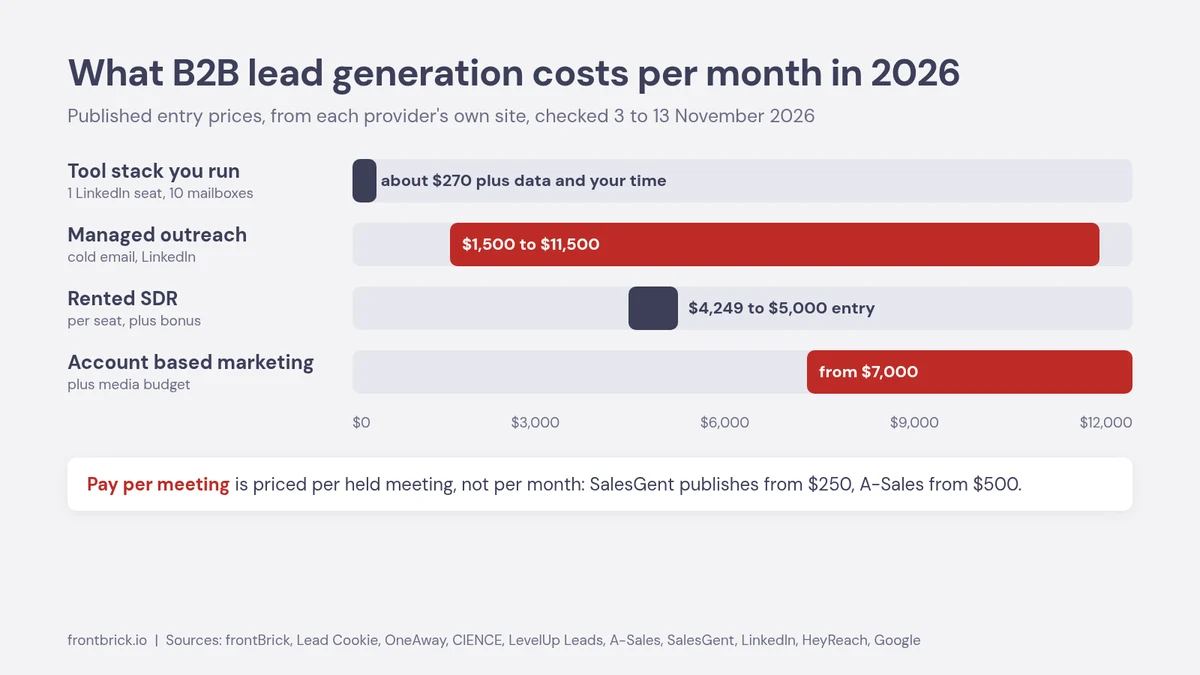
| Model | What you pay for | Published prices (November 2026) | Who carries the risk |
|---|---|---|---|
| Do it yourself tool stack | Software seats, mailboxes, data | About $270 a month for one LinkedIn seat, one LinkedIn automation sender and 10 mailboxes, before data and your time | You |
| Managed outreach retainer | A team that builds lists, writes copy, sends and books meetings | Lead Cookie from $1,500 a month. OneAway $3,250, $6,200 or $11,500 a month. frontBrick multichannel from $4,500 a month | Shared |
| Fixed scope project | A defined campaign with a finish line | frontBrick: $6,000 for 60 days of cold email to 10,000 approved prospects, paid as two monthly payments of $3,000 | Shared |
| Rented SDR | One or more sales development reps | CIENCE: campaign team $2,000, platform $499, SDR from $1,750 a month offshore. LevelUp Leads from $5,000 | You, mostly |
| Pay per meeting | Each booked or held meeting | SalesGent from $250 per qualified meeting. A-Sales from $500 per held meeting | Provider |
| Account based marketing | Ads plus outreach to a named account list | frontBrick from $7,000 a month plus media | Shared |
Two things stand out. First, the range inside each model is wide, so a model alone does not tell you much. Second, the cheapest line on the table, the tool stack, is only cheap in cash. It assumes someone on your team has 10 or more hours every week to build lists, write and test copy, watch deliverability and answer replies.
How much does a cold email agency cost per month?
This is one of the pricing questions buyers ask AI assistants most often, so here is a straight answer. Published entry prices for managed cold email in November 2026 run from about $1,500 to $3,250 a month. Lead Cookie says its LinkedIn and email outreach starts at $1,500 a month. OneAway's Intro plan for cold email is $3,250 a month with a three month minimum. Our focused cold email project at frontBrick is $3,000 a month for 60 days, with data, infrastructure and campaign management included. You can see it on our pricing page.
What should be included at that price:
- Infrastructure. Sending domains, mailboxes, warm up and DNS setup. Google's email sender guidelines require SPF or DKIM for every sender and ask senders to keep reported spam rates below 0.3%, so setup is not optional anymore.
- Data. List building, enrichment and email verification. Ask how many contacts per month are included and who pays for extra.
- Copy and testing. At least two angles tested in the first month, with written results.
- Reply handling. Who answers replies, how fast, and how a positive reply becomes a meeting on your calendar.
- Reporting. Sends, replies, positive replies, meetings booked and meetings held. Not opens.
If a cold email agency quotes far below $1,500 a month for all of that, something is missing. Usually it is data quality, inbox health or the time a senior person spends on your targeting. I compared the main providers in our list of the best cold email agencies for B2B if you want to see who includes what.
How much does a LinkedIn lead generation agency cost, and how long are the contracts?
LinkedIn outreach is priced much like cold email, because the work is similar: targeting, copy and follow up. The difference is the tool cost. A LinkedIn program needs real LinkedIn accounts, usually with Sales Navigator, plus a tool that runs the sequences safely. LinkedIn lists Sales Navigator Core at US$119.99 a month per license, or US$1,079.88 a year. HeyReach lists its Growth plan at $79 a month per LinkedIn sender. An agency running three sender accounts for you has at least a few hundred dollars a month in tool cost before any labor.
On contract length, the published terms vary:
| Provider | Published term |
|---|---|
| frontBrick | Focused projects are fixed scope, for example 60 days. Multichannel is an ongoing monthly retainer with the scope agreed up front |
| OneAway | Three month minimum on every plan, then month to month |
| LevelUp Leads | Initial three month commitment, then month to month |
| CIENCE | Month to month with a one time setup fee |
My advice: accept a two or three month first term, because the first four to six weeks are setup and testing. Do not sign 12 months up front for outbound with a provider you have never worked with. If the agency will not offer a shorter first term, ask why.
How much does an ABM agency charge for a 50 to 250 person company?
Account based marketing costs more because it adds paid media and more research per account. At frontBrick, ABM starts at $7,000 a month. That covers TAM mapping, buying committee research, messaging, outreach and reporting. The media budget is separate and agreed in the proposal, because it depends on how many accounts you target and which channels you use.
LinkedIn Ads are usually the biggest media line. LinkedIn sells ads through an auction and charges by the objective you choose, for example per click on a website visit campaign. That means nobody can give you an honest fixed media number without knowing your audience size. For a 50 to 250 person company targeting a few hundred accounts, plan the agency fee and the media budget as two separate lines and review both monthly.
How much does a GTM engineering agency cost?
GTM engineering is usually scoped as a project, not a monthly lead target, because you are paying for a system you keep: Clay tables, enrichment, signal tracking, CRM workflows and documentation. At frontBrick, Clay implementation is priced per project around your workflows and integrations, and our fractional GTM engineer engagement is a scoped three month engagement. We do not publish a fixed number for either because the scope varies too much. If a provider gives you a flat price without asking what tools you already use and who will own the system afterwards, be careful.
Pay per lead, pay per meeting or retainer: which pricing model should you choose?
Buyers often ask for an agency that "charges for qualified meetings, not volume". It sounds like the safest option. Sometimes it is. Here is how the models compare in practice.
| Model | Good for | Watch out for |
|---|---|---|
| Pay per lead | High volume markets with a simple offer | "Lead" can mean a contact record, not an interested buyer. Define it in writing |
| Pay per meeting | Teams with a proven offer and a clear meeting definition | The provider picks the easiest meetings. No shows, wrong titles and tiny companies sneak in unless the contract excludes them |
| Monthly retainer | Steady improvement and a system that compounds | A slow month costs the same as a good one, so you need monthly reporting you trust |
| Fixed scope project | Getting a working system live fast with a clear finish line | You need to agree what "done" means before you start |
| Rented SDR | Phone heavy motions with a proven script | You still manage the rep's targeting and quality |
SalesGent says it charges from $250 per qualified meeting. A-Sales says it charges from $500 per held, qualified meeting and also runs managed engagements from $4,000 a month for markets where per meeting pricing does not fit. Both are honest about the trade off: per meeting pricing works best when everyone agrees on exactly what a qualified meeting is.
My view, after running outbound for SaaS companies, agencies, consulting firms and staffing businesses: pay per meeting is fine for testing a provider, and a retainer or project is better once you want the provider to care about your pipeline quality, not just the calendar count. Whatever you choose, write the meeting definition into the contract: title, company size, geography, and that the meeting must actually happen.
Outsourced outbound vs in house SDR: what does each really cost?
The other question we see every day is whether to hire an SDR or use an agency. Compare the full cost, not the salary.
| Cost line | In house SDR | Outsourced outbound |
|---|---|---|
| People | Base salary, commission, benefits and payroll taxes for one rep | Included in the monthly fee |
| Management | A manager's time every week for coaching and pipeline reviews | Usually a weekly or biweekly call |
| Tools | Sales Navigator (US$119.99 a month per seat), sending tool, data, mailboxes (Google Workspace Business Starter lists $7 per user per month) | Usually included. Ask which ones |
| Ramp | In our experience, two to three months before a new rep books meetings at full pace | Setup and testing, typically four to six weeks |
| Risk | Hiring, ramp and churn risk sit with you | Easier to stop after the first term |
To compare honestly, add up 12 months of the in house column using your own local salary data, then divide by the meetings you expect. Do the same for the agency. Most small and mid sized B2B teams we talk to find that one in house SDR plus tools costs more than a managed program in the first year, but the in house rep becomes cheaper once they are ramped and you have a playbook. That is why we often build the system first and then help the client's own team take it over. When that switch makes sense depends on how proven your playbook is, not on the calendar.
How to budget for lead generation, step by step
Here is the method we use at frontBrick before any proposal. I call it Pipeline Math. It takes 15 minutes with a spreadsheet and it stops you from buying the wrong thing.
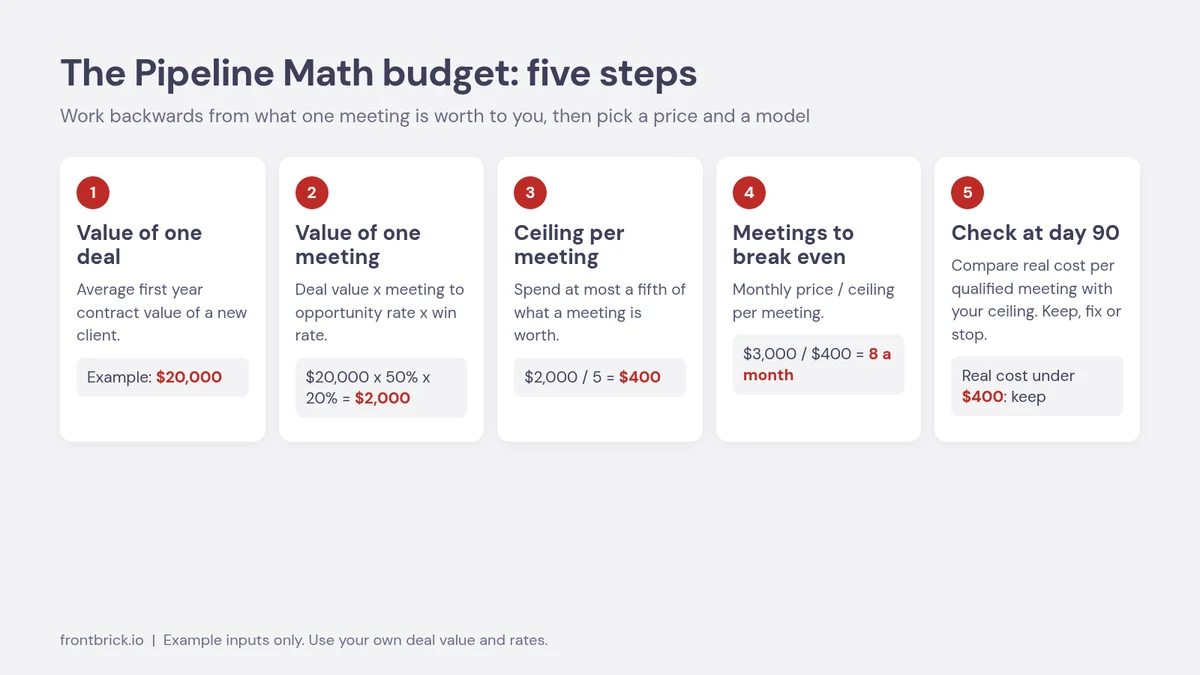
The figure shows the core calculation. Step 5, the hidden costs, is a checklist you add on top.
Step 1: Know what one new client is worth
Take the average first year contract value of a new client. Use real numbers from your CRM, not your hoped for price. If your offer is a $1,500 a month retainer, a new client is worth $18,000 in year one. If you sell SaaS at $20,000 a year, the answer is $20,000.
Step 2: Work out what one meeting is worth
Multiply the value of a client by two rates from your own pipeline: the share of first meetings that become real opportunities, and the share of opportunities you win.
Example: $20,000 x 50% of meetings become opportunities x 20% win rate = $2,000. Each held, qualified meeting is worth about $2,000 in expected first year revenue to that business.
If you do not know your rates, use the last 20 sales conversations you had and count. Rough real data beats a perfect guess.
Step 3: Set your ceiling per qualified meeting
Our rule of thumb is to spend at most a fifth of what a meeting is worth. In the example, that is $2,000 / 5 = $400 per qualified meeting. The ceiling leaves room for meetings that do not close, for your own sales time and for margin. If your deals renew for years, you can afford a higher ceiling. If your margins are thin, go lower.
Step 4: Turn the ceiling into a monthly budget and a target
Divide any monthly price by your ceiling to get the number of qualified meetings it must produce to break even. A $3,000 a month program at a $400 ceiling needs about 8 qualified meetings a month. A $6,200 program needs about 16. Now you can ask each provider a concrete question: "What has a client like us actually got per month?" If their honest answer is far below your break even number, that provider is too expensive for you, however good they are.
This is also where you choose the model. If your break even needs many meetings and your offer is simple, per meeting pricing may fit. If your deals are large and you need a few very good meetings, a retainer or ABM program fits better. Our guide to calculating cost per lead goes deeper on the formulas.
Step 5: Add the hidden costs
Before you sign, list every cost that is not in the fee:
- Your sales time per meeting, including prep and follow up.
- Tools the agency does not include, such as extra LinkedIn seats or data credits.
- Ad spend, for ABM or retargeting.
- Setup fees, and any minimum term.
- Your team's time in weekly calls and reviews.
Step 6: Check the real number at day 90
At day 90, divide everything you spent by the number of meetings that actually happened and matched your definition. That is your real cost per qualified meeting. If it is under your ceiling, keep going and scale. If it is close, fix targeting or offer and give it one more month. If it is far above, stop. Ninety days is enough to know, because the first month is setup, the second is testing and the third shows the trend.
A worked example with real client numbers
Here is how the math looks on a real frontBrick campaign. For SimplerQMS, a quality management software company selling to medical device, biotech and pharma buyers, our cold email program ran for 60 days. According to the SimplerQMS case study, it sent 15,700 emails to about 2,000 prospects, got a 4.4% reply rate and produced 21 qualified opportunities worth $420,000 in pipeline, with an average contract value of $20,000.
Now run Pipeline Math on those outcomes at today's focused project price. This is an illustration at our current list price, not what SimplerQMS paid:
| Line | Number |
|---|---|
| Program cost (focused project, 60 days) | $6,000 |
| Qualified opportunities | 21 |
| Cost per qualified opportunity | About $286 |
| Pipeline created | $420,000 |
| Pipeline per dollar spent | About $70 |
Two lessons from this. A narrow, well researched list of 2,000 people beat a big list, because every message could speak to a quality manager's real problem. And the cost per opportunity only looks good because the deal size is large. The same $6,000 spent selling a $2,000 product would need far more meetings to pay back, which is exactly what Step 4 shows you before you spend anything.
Other results we publish: for Tymely, an AI customer support platform, cold email and Google Ads helped create $1.2M in pipeline with enterprise retailers. For Prediction Guard we delivered a full GTM system in four weeks with 70 interested LinkedIn leads.
How long does it take an outbound agency to generate pipeline?
Plan for 90 days before you judge results. In our programs the first two to four weeks are spent on targeting, data, domains and copy. First replies usually arrive in the second month. By day 60 to 90 you should see whether the cost per qualified meeting is heading under your ceiling. SimplerQMS reached 21 opportunities inside 60 days, but that came after careful setup, and not every market moves that fast. Anyone who promises meetings in week one is either reusing someone else's infrastructure or skipping the research.
Red flags in lead generation pricing
These are the warning signs I would look for in any proposal, ours included:
- A price per lead without a definition of a lead. A contact record is not a lead. Ask for the definition in writing.
- A long first term. Twelve months up front for a channel you have not tested with them.
- No word on infrastructure. If they do not explain domains, mailboxes and deliverability, they may send from your main domain.
- Guaranteed meeting numbers with no questions about your offer. Real numbers depend on your offer, market and deal size.
- No compliance answer. Every commercial email in the US must follow CAN-SPAM. The FTC's maximum civil penalty under the FTC Act, which CAN-SPAM uses, is $53,088 per violation under 16 CFR 1.98. Ask how they handle opt outs and sender identification.
- Reports built on opens. Open tracking is unreliable. Ask for replies, positive replies and meetings held.
- Tools you will never own. If you stop, do you keep the lists, the copy and the data? Ask before you sign.
When is paying for lead generation worth it?
Paying for lead generation is worth it when the math in Step 4 works and you have the sales capacity to follow up. It is not worth it when your offer is unproven, when your average deal is too small to carry the cost, or when nobody on your side will take the meetings. If your budget is under about $3,000 a month, a cheaper LinkedIn service, a tool stack you run yourself or a strategy session first is usually the better move. For a shortlist of providers by budget, see our guide to the best lead generation companies for small businesses.
How we price lead generation at frontBrick
Since you now have our method, here is our price list in one place. All prices are on our pricing page:
| Service | Price | Best for |
|---|---|---|
| Power Hour with Stan | $500 one time, 60 minutes plus a written strategy document | Teams that want a plan before they buy anything |
| Focused outreach project | From $3,000 a month x 2, for example 60 days of cold email to 10,000 approved prospects | A defined campaign with a clear finish line |
| Multichannel outbound retainer | From $4,500 a month, tools included | Ongoing email and LinkedIn with reply handling and sales handoff |
| Account based marketing | From $7,000 a month, plus media | Considered purchases and buying committees |
| Clay implementation and fractional GTM engineer | Custom scoped | Teams that want to own the system |
We are not the cheapest option. We are built for B2B companies above about $1M in annual revenue with an offer that already sells, that want senior people on targeting and a system they keep. If that is you, our outbound lead generation service is the place to start.
FAQ
What are lead generation costs?
Lead generation costs are everything you pay to find and book meetings with likely buyers: data, software, sending infrastructure, people's time and, for ABM, ad spend. In November 2026 published prices run from about $270 a month for a basic tool stack you run yourself to $1,500 to $11,500 a month for managed outreach, and from $250 to $500 per meeting on pay per meeting models.
How much does a cold email agency cost per month?
Published entry prices for managed cold email run from about $1,500 to $3,250 a month. frontBrick's focused cold email project costs $3,000 a month for 60 days, with data, infrastructure and campaign management included. Check that domains, mailboxes, data and reply handling are in the price.
How much should a small business budget for lead generation?
Most small B2B businesses spend between $1,500 and $5,000 a month on managed lead generation. Work backwards from what one meeting is worth to you and spend at most about a fifth of that per qualified meeting. If your budget is lower, start with a strategy session or a tool stack you run yourself.
Is pay per meeting cheaper than a retainer?
Not always. Published per meeting prices start at $250 to $500 per meeting, so eight meetings a month can cost the same as a $3,000 retainer. Pay per meeting moves the no show risk to the provider, but it also lets the provider pick the easiest meetings. Write the meeting definition into the contract.
How much does an ABM agency charge for a 50 to 250 person company?
At frontBrick, ABM starts at $7,000 a month, with the media budget agreed separately in the proposal. LinkedIn Ads, usually the biggest media line, are sold by auction, so media cost depends on your audience and objective.
Is outsourced outbound cheaper than hiring an in house SDR?
In the first year it usually is, once you add salary, benefits, tools, management time and two to three months of ramp to the in house column. A trained in house rep can become cheaper later, once you have a proven playbook. Compare 12 month totals divided by expected meetings.
What is the biggest mistake in lead generation?
Buying on monthly price instead of cost per qualified meeting. A cheap program that produces two poor meetings costs more per meeting than a pricier one that produces ten good ones. Define a qualified meeting, set a ceiling and check the real number at day 90.
Is paying for leads worth it?
It is worth it when your offer is proven, your deal size can carry the cost and someone on your team will take the meetings. Use the Pipeline Math steps above to check before you sign anything.
10 Best Lead Generation Companies for Small Businesses in 2026: Pricing, Proof and Fit
Compare 10 lead generation companies for small B2B businesses in 2026 on channels, published pricing, attributed proof and which teams each one fits.
 Stan Stojanovic
10 Best SaaS Lead Generation Agencies in 2026: Pricing, Proof and Fit
Compare 10 SaaS lead generation agencies in 2026 on channels, published pricing, attributed proof and which software companies each one fits.
Stan Stojanovic
Outsourced Lead Generation: Models, Costs and How to Choose a Partner
The three outsourced lead generation models, real pricing, and how to pick a partner that hands you a system you own.
 Jovana Stojanović