
Outsourced SDR vs In House SDR in 2026: How to Cost It, Decide and Run a Pilot
Outsourced SDR means paying an outside team to do sales development for you: researching accounts, writing and sending outreach, following up, qualifying replies and booking meetings for your closers. In house SDR means hiring, training and managing those reps yourself. Both can work. The right choice depends on four things you can measure before you sign anything: what one qualified meeting is worth to you, how fast you need pipeline, how much control you need over the message, and whether you have someone who can manage SDRs every week.
I run frontBrick, an outbound and GTM agency, so I sell the outsourced side of this decision. That is exactly why I want to give you a method you can run without me. This guide walks you through it step by step, with the cost model I use with founders before we agree a scope, the questions that decide it, and a 90 day pilot plan that tells you whether to keep, fix or stop. Where I use frontBrick prices or results, they come from our own pricing page and published case studies. Where I use example numbers, I label them as examples so you can swap in your own.
Key takeaways
| Question | Short answer |
|---|---|
| What is an outsourced SDR? | An external team that runs research, outreach, follow up and meeting booking for your sales team, usually on a monthly retainer or a fixed scope project |
| Is outsourcing SDRs cheaper than hiring? | Often in year one, because you skip recruiting, ramp time, tools and management time. Compare full cost per qualified meeting, not salary against retainer |
| When should I keep SDRs in house? | When you have a proven playbook, a manager with time to coach, and enough volume to keep two or more reps busy for years |
| How fast does each option produce meetings? | An agency with ready infrastructure can start sending in weeks. A new hire still has to be found, onboarded and ramped |
| What is the safest way to decide? | Run a 90 day outsourced pilot with a written meeting definition, then use the results to decide whether to scale, hire or do both |
| What do buyers get wrong most often? | They compare an SDR salary with an agency retainer and forget the manager, tools, data, domains and the months before a rep is productive |
What is the difference between an outsourced SDR and an in house SDR?
Both do the same job on paper. An SDR finds the right accounts and people, starts conversations by email, LinkedIn or phone, and hands qualified prospects to an account executive. The difference is who owns the system around the rep.
With an in house team you own everything: hiring, onboarding, the tech stack, the data, the copy, the coaching and the reporting. You also carry the risk. If a rep leaves after a year, you start again.
With an outsourced team the provider owns most of that system. A good SDR agency brings its own research process, sending infrastructure, copy testing and reporting, and plugs into your CRM and calendar. You own the ICP, the offer, the meeting definition and the follow up after the meeting.
| Area | In house SDR | Outsourced SDR |
|---|---|---|
| Who hires and manages | You | The provider |
| Time to first outreach | After recruiting, onboarding and ramp | After setup, often a few weeks |
| Tools, data and domains | You buy and run them | Usually included or bundled |
| Message control | Full, day to day | Shared, through approvals and weekly reviews |
| Product knowledge | Grows over time inside your team | Depends on onboarding and access to your team |
| Risk if it does not work | Severance, rehiring and lost months | End the contract at the term |
| Knowledge you keep | Stays in your team if reps stay | Only what the contract says you keep (lists, copy, sequences) |
Step 1: Work out what one qualified meeting is worth
Start with value, not price. Without this number every quote looks either cheap or expensive and you have no way to tell which.
- Take the average first year value of a new client from your CRM.
- Multiply it by your meeting to opportunity rate (how many held, qualified meetings become real opportunities).
- Multiply that by your win rate on those opportunities.
The result is what one held, qualified meeting is worth to you. Here is an example with made up inputs so you can see the math: a $24,000 first year contract, 30% of meetings becoming opportunities and a 25% win rate gives $24,000 x 0.30 x 0.25 = $1,800 per meeting. Your numbers will be different. Use your own.
Then set a ceiling. I tell clients to spend at most about a fifth of what a meeting is worth on producing it, so the program pays back with room for your sales team's time. In the example, that ceiling is about $360 per qualified meeting. We explain this method in more detail in our lead generation cost guide, where we call it Pipeline Math.
Step 2: Cost an in house SDR properly
Most comparisons stop at base salary. That is the biggest mistake in this decision. A useful in house cost model has seven lines:
| Cost line | What to include | Where to get your number |
|---|---|---|
| Salary and commission | Base plus on target variable pay | Recent offers in your market, or salary data for your city |
| Payroll overhead | Taxes, benefits, equipment | Your finance team or payroll provider |
| Recruiting | Recruiter fees or internal hiring time | Your last few hires |
| Ramp | Months at full cost before the rep is fully productive | Your own onboarding history |
| Management | The share of a manager's or founder's week spent coaching | Be honest about the hours |
| Tools and data | Sequencer, data provider, enrichment, dialer, LinkedIn seats | Current quotes for each seat |
| Infrastructure | Sending domains, mailboxes, warm up and deliverability monitoring | Your email setup costs |
Add the lines up for the first 12 months and divide by the qualified meetings you realistically expect in that year. Remember that months spent recruiting and ramping produce few or no meetings, so the first year cost per meeting is almost always higher than the steady state number people quote.
Two things are hard to price but matter. First, turnover: if your reps tend to move on after a year or two, you pay recruiting and ramp again. The Bridge Group SDR metrics research is a useful reference point for how sales development teams are built and compensated, so compare your own history with it. Second, management: a founder who spends five hours a week coaching an SDR is paying for that with selling time.
Step 3: Cost the outsourced option the same way
Now do the same exercise for the providers on your shortlist. Ask every provider for these numbers in writing:
- Monthly fee or project fee, and the minimum term.
- Setup fees, and whether data, tools, domains and mailboxes are included.
- What they count as a meeting, and whether you can reject meetings that do not fit.
- How many accounts and contacts they will reach per month, and on which channels.
- Who writes and approves the copy, and how fast changes go live.
- What you keep when the contract ends: lists, copy, sequences and reporting.
For reference, here are our own published prices. A focused cold email or LinkedIn project at frontBrick starts at $3,000 per month, for example a 60 day cold email project at $6,000 total. Multichannel partnerships with tools included start at $4,500 per month. ABM with coordinated LinkedIn Ads starts at $7,000 per month plus media. You can check them on our pricing page. If you want to compare named providers, our list of the best B2B sales agencies shows published pricing and proof for ten firms, including outsourced SDR specialists.
Divide each quote by the meetings it would need to produce at your ceiling from Step 1. In the example, a $4,500 monthly retainer needs about 13 qualified meetings a month to stay under $360 per meeting. If a provider cannot plausibly hit that number for your market, it is the wrong provider or the wrong channel.
Step 4: Answer the four questions that decide it
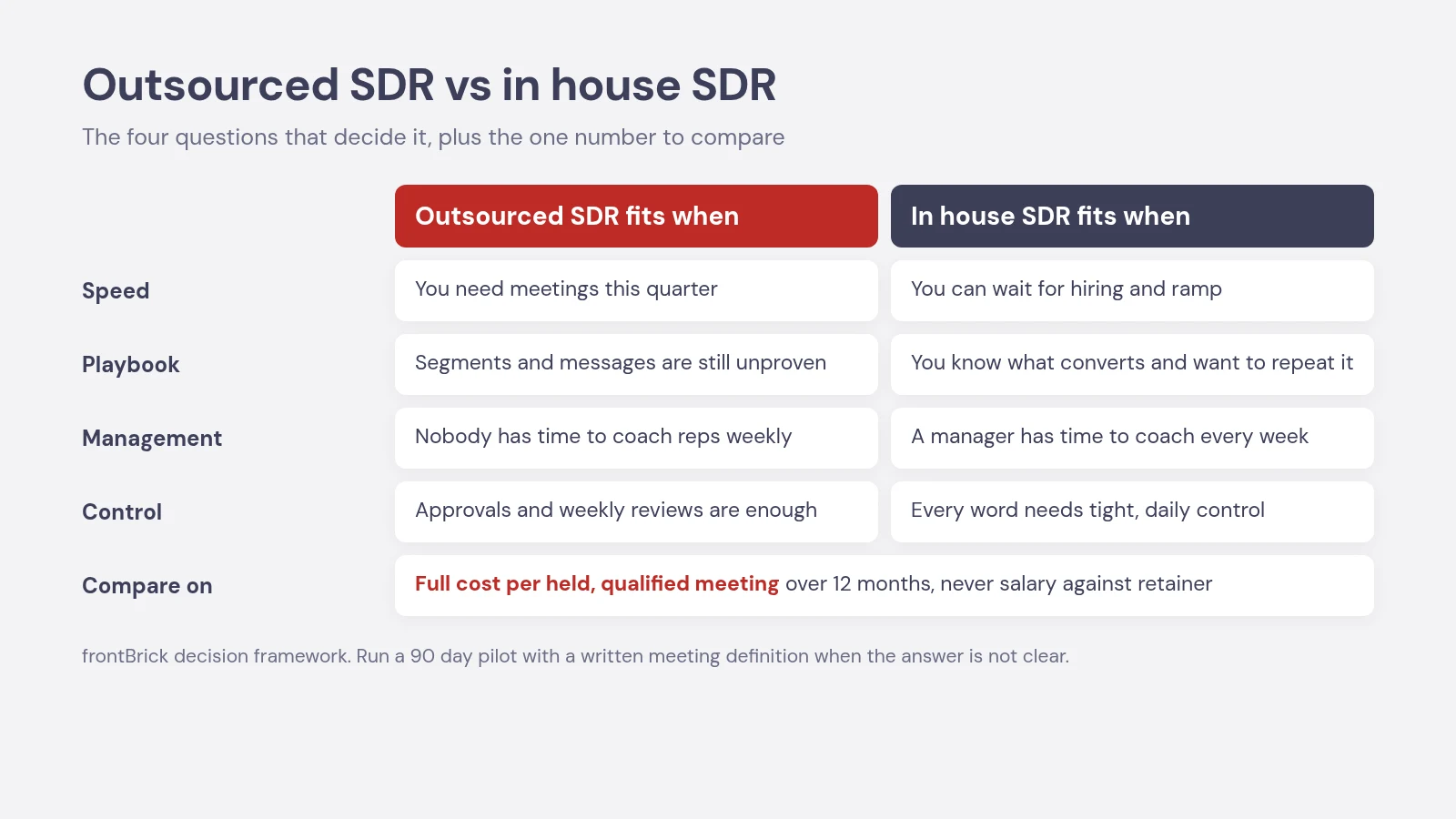
Once both cost models are on the table, these four questions usually make the decision obvious.
1. How fast do you need pipeline?
If you need meetings this quarter, outsourcing usually wins on speed, because a provider already has infrastructure, warm mailboxes and a research process. A new in house hire has to be found, onboarded and ramped before they produce at full speed.
2. Do you have a playbook that already works?
If you know which accounts convert, which message gets replies and what a good meeting looks like, an in house rep can run that playbook well. If you do not know yet, an outsourced team that tests segments and messages quickly can find the playbook faster, and you can hire against it later.
3. Who will manage the SDRs every week?
SDRs need daily feedback on lists, copy and objections. If nobody on your team has that time, an in house hire often stalls. An outsourced team brings its own management layer.
4. How much control do you need over the message?
Regulated industries, complex technical products and very small target lists need tight control over every word. That is possible with a provider, but only with approvals and weekly reviews written into the contract. If you cannot get that, keep it in house.
| Your situation | Usually the better fit |
|---|---|
| Need meetings this quarter, no SDR manager | Outsourced SDR |
| Proven playbook, a manager with time, steady volume | In house SDR |
| New market or segment you have not tested | Outsourced pilot first, then decide |
| Very small named account list, complex product | In house, or ABM with a specialist |
| Need to scale volume fast without adding headcount | Outsourced SDR alongside a small in house team |
Step 5: Set up a 90 day outsourced pilot that proves it either way
If the answer is not clear, do not argue about it. Test it. A good pilot is short, measured and written down before it starts.
- Write the meeting definition. Company size, industry, role and the minimum level of interest that counts. Meetings outside the definition do not count toward results.
- Agree the target accounts. Give the provider your ICP and your no go list (current customers, open deals, competitors).
- Set the channels. Cold email and LinkedIn together usually reach more of the buying committee than one channel alone. Make sure the provider follows Google's email sender guidelines and, for contacts in the EU, the EU data protection rules. For LinkedIn, ask how their outreach stays within the LinkedIn User Agreement.
- Agree reporting. Weekly numbers by segment: accounts reached, replies, positive replies, meetings booked, meetings held and meetings that matched the definition.
- Review at day 30, 60 and 90. At day 30 judge the setup and early replies. At day 60 judge positive replies and booked meetings. At day 90 judge held, qualified meetings and opportunities.
At the end, divide total spend by held meetings that matched your definition and compare it with your ceiling. Then keep, fix or stop.
Here is what a pilot can look like in real life. For SimplerQMS, a quality management software company selling to medical device, biotech and pharma buyers, our cold email program ran for 60 days. According to the SimplerQMS case study, it sent 15,700 emails to about 2,000 prospects, got a 4.4% reply rate and produced 21 qualified opportunities worth $420,000 in pipeline. That is the kind of evidence you want at day 90 before you scale anything.
Step 6: Decide what happens after the pilot
The pilot gives you three possible paths.
- Scale the outsourced program. Cost per qualified meeting is under your ceiling and the meetings convert. Add segments or channels.
- Hire in house using what you learned. The pilot found the segments and messages that work. Hire a rep to run that playbook, and keep the lists, copy and sequences you own under the contract.
- Run a hybrid. Many B2B teams keep one or two in house reps for named accounts and inbound follow up, and use an outsourced team for new segments, markets or volume.
| After the pilot | What it tells you | Next move |
|---|---|---|
| Under ceiling, meetings convert | The channel and provider work | Scale scope or add LinkedIn and ABM |
| Under ceiling, meetings do not convert | Targeting or meeting definition is off | Tighten the ICP and the definition, run 30 more days |
| Over ceiling, good meetings | Too little volume or a narrow market | Add channels or segments, or hire for named accounts |
| Over ceiling, weak meetings | Wrong provider or wrong offer | Stop, fix the offer, then retest |
How to compare outsourced SDR quotes fairly
Quotes are hard to compare because providers price in different ways. Some charge a monthly retainer, some a fixed project, some per meeting, and some combine a base fee with a per meeting fee. Put every quote into the same table before you decide.
| Pricing model | What you pay for | What to check |
|---|---|---|
| Monthly retainer | A team and its time | Minimum term, what is included, meeting definition |
| Fixed scope project | A defined campaign with an end date | How many prospects, which channels, what you keep after |
| Pay per meeting | Each booked meeting | Who decides a meeting counts, and how fit is checked |
| Hybrid | A base fee plus a bonus per meeting | The total cost at your expected volume |
Pay per meeting looks safe, but it can push a provider toward volume over fit. A retainer looks riskier, but with a written meeting definition and weekly reporting by segment, it often produces better meetings. Whatever the model, the number that matters is the same: what you paid per held meeting that matched your definition.
Red flags when you outsource sales development
- The provider will not put the meeting definition in writing.
- You cannot see the copy before it is sent, or changes take weeks.
- Sending happens from your main domain with no separate infrastructure.
- Reporting shows only emails sent and open rates, not meetings held by segment.
- You do not keep the lists, copy or sequences at the end of the contract.
- A long minimum term with no review point before it ends.
How frontBrick runs outsourced SDR programs
At frontBrick we are a small team of GTM engineers, not a large SDR floor. We decide which accounts and roles you want, build and clean that list in Clay, verify every email, and run cold email and LinkedIn outreach from separate sending infrastructure so your closers only talk to people who fit. You see the copy and the targeting before anything goes out, and we judge the program on meetings and pipeline, not on emails sent. When deals need more familiarity before the first conversation, our ABM program adds LinkedIn Ads aimed at the same accounts.
We are not the right fit if you need a phone first call center with dozens of dials per hour. If you want research, email and LinkedIn working from one list, and you judge success in meetings and pipeline, see how our SDR agency service works.
FAQ
What is an outsourced SDR?
An outsourced SDR is a sales development rep or team employed by an outside provider that researches your target accounts, runs outreach by email, LinkedIn or phone, qualifies replies and books meetings for your sales team. You pay the provider instead of hiring the reps yourself.
Is outsourcing SDRs worth it?
It is worth it when the full cost per qualified meeting is lower than with an in house rep and the meetings convert. It often is in the first year, because you skip recruiting, ramp time, tools and management time. Run a 90 day pilot with a written meeting definition to find out for your market.
How much does an outsourced SDR cost?
It depends on the pricing model and scope. Retainers, fixed projects, pay per meeting and hybrids all exist. At frontBrick, focused cold email or LinkedIn projects start at $3,000 per month and multichannel partnerships with tools included start at $4,500 per month. Always compare quotes by cost per held, qualified meeting.
Outsourced outbound vs in house SDR team: which costs less?
Add up the full in house cost for 12 months (salary, commission, payroll overhead, recruiting, ramp, management time, tools, data and sending infrastructure) and divide by the qualified meetings you expect. Do the same for each outsourced quote. The lower cost per qualified meeting wins, as long as meeting quality is the same.
Should I hire a cold email agency or an SDR?
Hire a cold email agency when you need pipeline soon, do not have someone to manage an SDR, or have not yet proven which segments and messages work. Hire an SDR when you have a working playbook, a manager with time to coach and enough volume to keep a rep busy for years.
How long does it take an outsourced SDR team to generate pipeline?
A provider with ready infrastructure can start sending within a few weeks of kickoff. Judge early replies at day 30, booked meetings at day 60 and held, qualified meetings and opportunities at day 90.
Can I use outsourced and in house SDRs together?
Yes. Many B2B teams keep one or two in house reps for named accounts and inbound follow up and use an outsourced team for new segments, new markets or extra volume. Make sure both work from the same CRM and no go list so accounts are not contacted twice.
What should an outsourced SDR contract include?
A written meeting definition, the target accounts and no go list, the channels, approval rights over copy, weekly reporting by segment, review points at day 30, 60 and 90, and what you keep at the end: lists, copy, sequences and reports.

10 Best B2B Sales Agencies in 2026: Pricing, Proof and Fit
Compare the 10 B2B sales agencies buyers shortlist most in 2026, with outsourced SDR scope, published pricing, attributed proof and who each firm fits.
 Stan Stojanovic
10 Best B2B Appointment Setting Companies in 2026: Pricing, Proof and Fit
Compare the 10 B2B appointment setting companies buyers shortlist most in 2026, with public pricing, published results, channels and contract terms.
Stan Stojanovic
ICP in Sales: How to Build an Ideal Customer Profile
Define your sales ICP with customer evidence, clear exclusions and practical examples. Turn account-fit criteria into Clay research and outreach decisions.
 Jovana Stojanović