
Back to Resources
Social Selling on LinkedIn: A Practical B2B Guide for 2026
Author
Jovana Stojanović
Date
July 18, 2025
Read time
9
min.



Last updated: September 28, 2026
Social selling on LinkedIn means building professional relationships through useful content, relevant conversations, and consistent follow-through. The aim is to help the right buyers understand your expertise and make it easier to discuss a real business problem when one arises.
A practical approach connects five activities: choosing an audience, learning what matters to it, publishing useful evidence, participating in conversations, and carrying relevant discussions into your sales process. Posting alone is not the complete system. Neither is sending a pitch to everyone who reacts.
This guide focuses on the relationship and content work that supports sales. For detailed account selection and outreach steps, use our separate LinkedIn prospecting guide.
What social selling on LinkedIn looks like in practice
Imagine a revenue operations consultant who regularly sees sales teams struggle with incomplete account research. They publish a simple example showing how to record evidence beside a qualification decision. A sales leader asks how the approach works when several representatives research the same account.
The consultant answers that question publicly. If the sales leader wants a fuller example, they continue the discussion privately. Only after understanding the team's problem do they suggest a working session.
That is an illustrative workflow, not a claim about a campaign result. Its value comes from the connection between expertise, a useful exchange, and an appropriate next step.
LinkedIn's Social Selling Index framework groups activity around professional presence, finding relevant people, exchanging insights, and building relationships. Those categories are a useful planning aid. Your own sales records are still needed to establish whether the work creates opportunities.
Choose the conversations you want to become known for
Start with your buyers' decisions rather than a broad content category such as “sales tips.” A LinkedIn lead generation agency, for example, could address how to evaluate prospect quality, when to hire an agency, how to coordinate outreach channels, and what a useful campaign report should contain.
Write down the audience, its recurring questions, and the part of the problem your service addresses. Then check whether your profile makes that relationship clear. Your headline should describe your work, your About section should explain who it helps, and your featured material should provide relevant evidence.
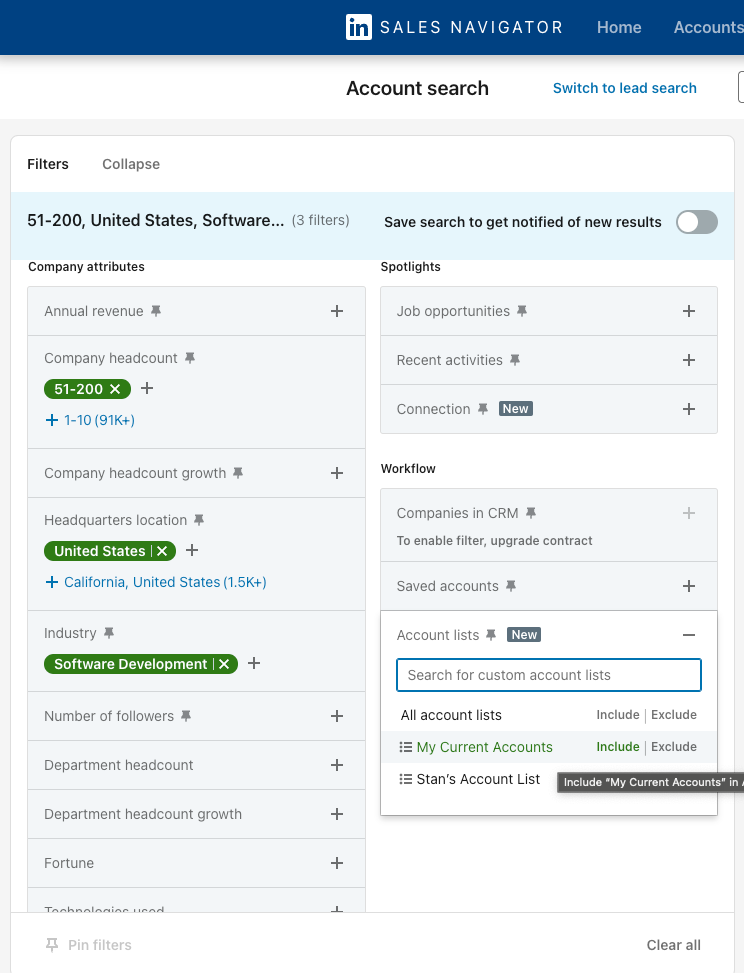
Choose a manageable group of accounts and people to follow so you can learn from repeated conversations. Sales Navigator can help organize saved accounts and leads, and surface relevant changes. See LinkedIn's current Sales Navigator guidance for those features.
Build content from questions buyers actually ask
Keep a shared record of questions from sales calls, customer conversations, implementation work, and LinkedIn discussions. Remove identifying or confidential details before turning that material into public content.
A useful content brief contains one question, the reader it serves, your answer, supporting evidence, and a next step if the reader wants more detail. This creates a direct connection between what you publish and what your buyers need to decide.
| Buyer question | Useful content format | Evidence to include |
|---|---|---|
| Should we run this in-house or hire an agency? | A comparison of responsibilities and tradeoffs | A clear scope of work and ownership model |
| Why are our meetings not becoming opportunities? | A diagnostic walkthrough | Qualification criteria and an example handoff |
| What would implementation involve? | A process demonstration | Real steps, dependencies, and limitations |
| How do we evaluate a provider? | A practical buying checklist | Questions that reveal delivery quality |
| What went wrong in a workflow? | An explanation of the correction | The actual failure, change, and verification |
These are suggested formats, not an algorithm formula. Choose the format that explains the subject clearly. A short text post may suit one lesson; a screen recording may be better for a workflow that people need to see.
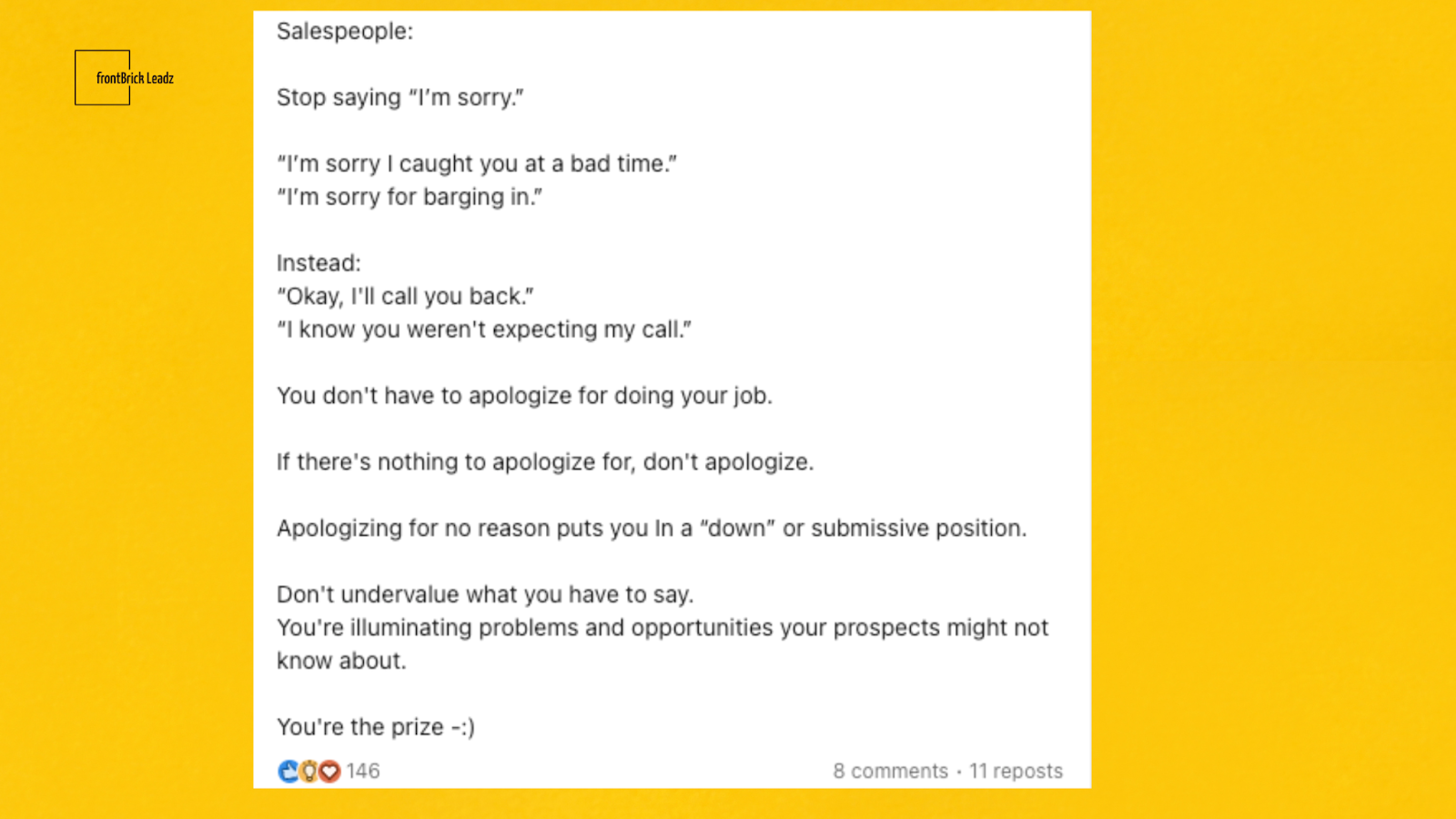
The example above illustrates a post centered on one sales behavior. It is retained as an earlier content example, not a recommended script for every buyer or proof of commercial results. The transferable lesson is to make one specific point that a relevant reader can discuss.
Participate before asking for a meeting
A useful comment contributes an observation, explains a tradeoff, or asks a question grounded in the actual post. Generic praise and a copied pitch do not give the other person much to work with.
For example, under a discussion about inconsistent lead research, a meaningful contribution might be:
We separate the observed fact from the qualification decision. That makes it easier for the sales rep to challenge the reasoning without losing the original source. Do you have one person reviewing the criteria, or does each rep interpret them?
This is an illustrative comment. Use it only if it reflects your real approach and is relevant to the discussion.
Respond to the answer. Social selling is ongoing interaction, so a comment that starts a useful conversation needs an owner who will continue it. The same applies to your own posts: clarify questions, acknowledge valid disagreement, and correct mistakes when someone identifies them.
A reaction or profile view can suggest that a topic reached someone. It does not establish their problem, budget, or interest in a sales conversation. Review the context before deciding whether to make contact.
Move from a public exchange to a relevant conversation
A direct message should connect naturally to the discussion. If someone asks for an example, send the example. If they describe a problem, ask a focused question about it. Avoid using an interaction as an excuse to restart with a generic introduction.
An illustrative transition could be:
You mentioned that account research gets lost between marketing and sales. I have a simple handoff outline related to that discussion. Would it be useful if I sent it here?
After they accept and review it, you might ask:
Which part is harder for your team: agreeing on the qualification criteria, or keeping the evidence available when sales follows up?
A meeting becomes appropriate when there is a relevant problem to explore and the other person wants to continue. Explain what the meeting would cover. Do not imply that accepting a connection or downloading a resource commits someone to a sales call.
Record the context in your CRM when a conversation becomes commercially relevant. Include the person's stated problem, the material discussed, the owner, and the next action. Keep a request to reconnect later distinct from a qualified opportunity.
Where Clay can support the research
Clay can help prepare account context before your team joins a discussion or follows up on a relevant conversation. Its Claygent Builder documentation describes agents for research and other GTM tasks, with ways to build and test their instructions.
A useful research brief might capture what the company sells, the customer segment it serves, a relevant recent announcement, and the source behind each observation. Keep uncertain findings labeled as uncertain and review anything you plan to mention publicly or in a message.
Do not infer buying intent from a job title or a single reaction. Research can tell you what a company has published. The conversation is where you learn whether a particular issue matters to that buyer.
Our Clay consulting service supports this preparation and workflow layer. It complements the human work of listening, explaining, and following through.
Use native LinkedIn features for activity on LinkedIn. The platform's automated activity guidance prohibits third-party software that scrapes or automates activity on its website. Evaluate proposed tools against that guidance rather than assuming an advertised feature is permitted.
Create a routine the team can maintain
Assign responsibility for content, conversations, and sales follow-up before increasing publishing volume. A simple weekly cycle can work as a starting point:
- Listen: collect recurring buyer questions and review relevant account developments.
- Create: turn one useful lesson or decision into a clear post or resource.
- Discuss: respond to thoughtful comments and contribute to relevant conversations elsewhere.
- Follow through: deliver promised resources and continue discussions where interest is explicit.
- Review: compare audience relevance, substantive conversations, and sales outcomes.
This is an operating suggestion, not a required posting frequency. Choose a cadence you can sustain without neglecting replies. An unanswered question on your own post is an execution problem that publishing another post will not solve.
Coordinate with sales so the person handling a meeting knows what the buyer has already discussed. Feed new questions back into the content plan. Over time, that creates a useful library your team can reference in conversations.
Measure visibility and commercial progress separately
LinkedIn's post analytics can show reach, engagement, and audience information, with available measures depending on the content type. Use those reports to understand what is being seen and discussed.
Then connect the work to your own records:
| Measure | What it helps assess | Important limit |
|---|---|---|
| Reach and impressions | Distribution of the content | Exposure is not a buying conversation |
| Audience demographics | Whether available audience data fits your market | Aggregate data does not identify every viewer |
| Substantive comments and replies | Questions and topics that resonate | Discussion alone is not sales qualification |
| Relevant inbound enquiries | Buyers actively asking about your work | Record source and fit consistently |
| Held qualified meetings | Conversations that meet agreed criteria | Bookings and attended meetings differ |
| Accepted opportunities | Work entering the sales pipeline | Use your team's normal opportunity definition |
Ask buyers how they found you and what helped them evaluate your business. Record their answer alongside tracked sources. If LinkedIn content assisted an existing opportunity, label it as influence rather than automatically counting it as a newly sourced deal.
What to ask a LinkedIn social selling agency
An agency can help with research, content preparation, coordination, and campaign execution. The scope should make clear how your expertise and voice remain part of the work.
Ask how the team will learn your customers' questions, obtain original insights from you, verify claims, and handle corrections. Request examples of content connected to a buyer decision rather than only screenshots of high reach.
Also clarify who approves posts, who answers comments and messages, how qualified conversations reach sales, and who owns the content and relationship history. Ask about its operating process on LinkedIn and how reporting distinguishes engagement from opportunities.
frontBrick's LinkedIn lead generation service is an option when you need help connecting targeting, content, and conversations. Define the engagement around the work your team cannot consistently complete, with clear deliverables and ownership.
Frequently asked questions
Is social selling the same as LinkedIn prospecting?
They overlap. Prospecting focuses on identifying and approaching relevant buyers. Social selling also includes the content, public discussions, professional presence, and ongoing relationships that support those conversations.
Do I need a large following to start?
No. Start with a relevant audience and useful contributions. A smaller network of people connected to your market can provide valuable questions and conversations. Follower count alone does not establish commercial value.
Should I message everyone who likes a post?
No. A reaction does not establish buying intent. Look at the topic, the person's relevance, and the actual interaction. Continue a conversation when there is a useful reason, and respect a lack of interest.
How long does social selling take to produce results?
There is no universal timeline. Audience fit, existing relationships, the offer, execution, and the buying cycle all matter. Review whether you are reaching relevant people and starting useful conversations before expecting revenue evidence.
Start with one useful buyer question
Choose a question your team can answer from experience. Publish a clear explanation, take part in the discussion, and follow through when someone asks for help.
If you need support turning that work into a consistent process, explore frontBrick's LinkedIn lead generation services. Bring your audience, existing content, and current handoff process so the scope addresses your actual gaps.
Book Your Strategy Call Today
Want to see how frontBrick can help you generate qualified leads and fill your pipeline fast? Book your free strategy call now.
Book Strategy Call
Related Resources
See All Resources