
AI sales tools / Agents & automation
Grok Bot for GTM: research, routines and review gates
Grok Bot can research accounts and carry work across connected apps. Its value depends on a clear assignment, evidence standards and a review step before business records or campaigns change.
By Stan, Co-Founder & CEO at frontBrick · Reviewed October 18, 2026 · 8 min read
Grok Bot is an agent application from x.ai that can use connected tools and a computer to complete tasks. It fits B2B teams delegating bounded research and preparation work, especially when a person reviews the resulting recommendations.
Where Grok Bot fits in a GTM team
A useful first assignment is preparing tomorrow's account briefs. Give the agent a named account list, the offer, the buyer roles and the evidence you need. Ask for a reviewable file containing facts, sources and suggested conversation angles. That creates a defined output you can judge before connecting more consequential actions.
It is less suitable as the sole control layer for a critical lead-routing process with strict response times. A task agent may need to interpret an unfamiliar page, refresh a login or ask a question. Keep deterministic ownership rules and durable CRM records in systems designed for those jobs. Use the agent where interpretation and varied source material add value.
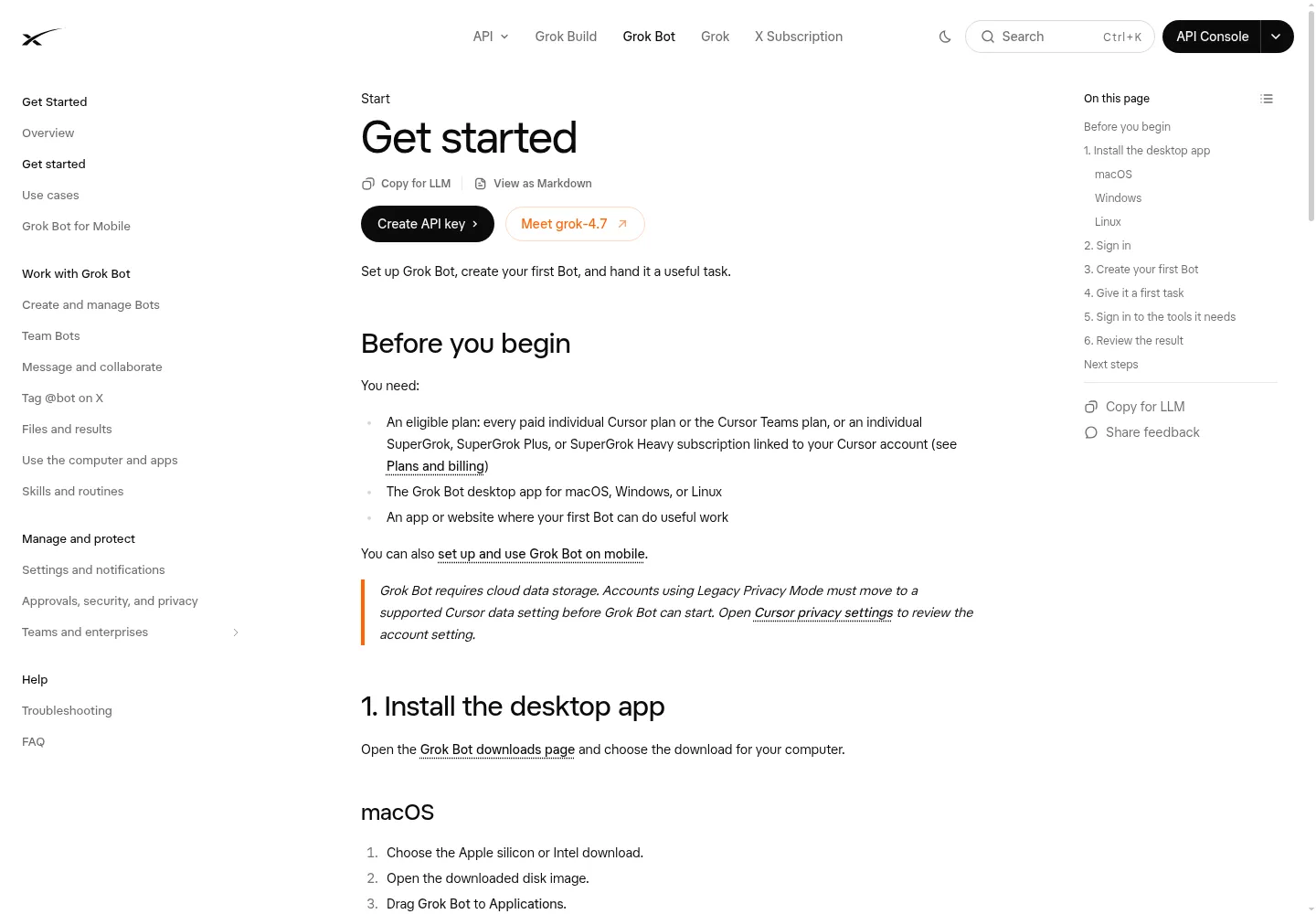
Current official setup documentation lists macOS, Windows and Linux options. The product also provides mobile access. Older launch reviews describing an Apple Silicon-only application should not determine your purchase. Check the current setup requirements for your device and account.
Watch Stan build a Grok Bot + Clay outreach workflow
See how we connect hiring signals, Clay qualification and Grok Bot to prepare relevant outreach. Stan walks through the audience exclusions, job-opening research and the handoff from qualified leads to the agent.
Watch on YouTube or play the walkthrough above. The example shows a specific campaign setup; adapt the audience, offer and review steps to your business.
Understand Bots, skills and routines
Give a Bot one recognizable responsibility, such as account research. A skill describes a repeatable method; a routine determines when work runs. This distinction matters commercially: a good method does not become reliable merely because you schedule it. First review several individual outputs, then schedule the same bounded assignment. Routines can execute while your laptop is closed, but connected services and approvals still affect completion. These capabilities are documented in skills and routines.
For example, the skill can specify how to distinguish a hiring announcement from an unverified repost. The routine can request a fresh report every Monday. Your CRM should retain which account was reviewed, when, what changed and who approved the next action. Do not rely on conversational recollection as the campaign ledger.
A proposed workflow: account changes to reviewed sales briefs
This is an implementation blueprint, not a claim of a tested customer result. Start with 20 target accounts and one narrow commercial question: which accounts have a documented change that makes our offer more relevant this month?
- Load the brief. Supply account domains, target geography, exclusions, offer positioning and approved proof. Identify existing customers and open opportunities so research does not become duplicate prospecting.
- Research approved sources. Prioritize company newsrooms, careers pages and named public sources. Require the original source URL, publication date when available and retrieval date.
- Separate evidence from interpretation. “Three open implementation roles” is an observation. “The company is struggling with onboarding” is an inference. Store them in different fields.
- Recommend one next step. Choose research further, prepare an account-specific angle, update an existing account brief or take no action. Avoid manufacturing an outreach reason for every company.
- Review the batch. A person checks source accuracy, account fit and whether the proposed message follows from the evidence.
- Write approved changes. Only approved fields enter the CRM or campaign preparation workflow. Keep rejected recommendations with a reason so you can improve the method.
| Output field | What it should contain | Reject when |
|---|---|---|
| Account identity | Canonical domain and your CRM ID | The source concerns a different company with the same name |
| Observed change | A concise factual statement with a source | The claim exists only in an AI summary |
| Commercial relevance | A reason linked to your offer | It assumes budget, pain or buying intent without evidence |
| Proposed action | Owner, action and review status | It bypasses an existing account owner or suppression rule |
An example instruction is: “Review these 20 domains for relevant changes in the last 30 days. Return a source-backed brief and a proposed next step for each. Mark missing evidence as unknown. Stop after the report; do not contact prospects or change CRM records.” Treat the numbers as a pilot boundary, then adjust after measuring review effort.
Set up access around the actual job
Connect only the apps needed for the first workflow. Confirm the correct company workspace before granting access. Use a test folder and sample records, then check both the output and the actions taken. An attractive report is insufficient if the agent silently searched an unrelated account or changed a record while collecting context.
Grok Bot has action approval controls and supports explicit ask-first rules. Its official security documentation also states that Bots assigned to one user share a cloud computer, including browser sessions and files. Separate Bot names are therefore not separate security boundaries. Use distinct organizational access arrangements when genuine isolation is required. Enter sensitive login steps through the designated handoff rather than putting passwords in task text. See approvals and shared-computer boundaries.
Record who owns each connection and how to revoke it. When an employee leaves, reassigning the workflow name is not enough: inspect the underlying authorization, shared files and routine destinations.
Grok Bot pricing and the real cost of a useful brief
Reviewed October 18, 2026. Access depends on the subscription and linked account. The current official plans guide lists qualifying X Subscription tiers, eligible legacy Cursor plans and certain linked Grok subscriptions. Usage can involve shared allowances, top-ups or on-demand charges depending on the plan. A trial has a usage allowance as well as a time window. Do not interpret it as unlimited work or assume the old $200-only launch arrangement still applies. Verify eligibility and billing in the official Grok Bot plans guide.
Budget separately for connected data providers, CRM seats and the time spent reviewing outputs. For a pilot, record the account-level cost and reviewer minutes. If 20 briefs take 40 minutes to validate, that review effort belongs in the comparison with your existing process. Expanding to 2,000 accounts before examining rejection reasons magnifies the wrong economics.
Track usage per accepted brief, not per task started. A cheap run that produces unsupported claims is expensive once a senior salesperson must redo it. Long source documents, repeated browsing and retries can also change consumption, so use measured runs before promising a fixed monthly operating cost.
Grok Bot versus other GTM building blocks
| Need | Useful starting point | Decision criterion |
|---|---|---|
| Research across changing websites and apps | Grok Bot | Can the team review and trust the evidence? |
| A configurable agent with portable operating instructions | Hermes Agent | Who will manage hosting, providers and maintenance? |
| Repeatable event routing with explicit branches | n8n or Make | Can failures be replayed without duplicate business actions? |
| Structured account and contact enrichment | Clay and data providers | Which fields and sources are required before outreach? |
These are architectural choices, not a universal ranking. An effective system can use an agent to produce a proposal and a workflow platform to execute approved changes. Avoid asking one product to replace research judgment, CRM governance and campaign delivery at once.
Failure modes and acceptance checks
Test a company with an ambiguous name, an inaccessible source, an old announcement, an existing opportunity and a missing domain. Every case should produce an explicit status. “Could not verify” is preferable to a plausible invention. Re-run the same approved batch and confirm it does not create duplicate records or tasks.
Monitor accepted evidence rate, reviewer corrections, time to a usable brief, abandoned runs and cost per accepted recommendation. Keep commercial outcomes downstream: an accepted brief is not an interested lead. Review which types of observation actually help sales, then retire low-value routines.
What a frontBrick implementation should deliver
The deliverables are the account-research contract, source rules, tested skill instructions, configured connections, approval points, a pilot scorecard and a handover runbook. Your team should know how to change the offer, add exclusions, pause routines and investigate a failed run. Talk to Stan about the workflow; implementation scope and pricing are custom.
Buyer questions
Is Grok Bot the same as chatting with Grok?
The agent application is designed to perform tasks through tools and computer access. Evaluate its permissions and outputs as an operating system component, not only the quality of a conversational answer.
Can it run while my laptop is off?
Cloud routines can run while the laptop is closed. A workflow that depends on an unavailable local resource, expired connection or unanswered approval can still stop. Test the exact unattended path.
Can it automatically send prospect messages?
That depends on the connected service and authorized capabilities. For an initial GTM deployment, keep external sending behind a separate approval and let the campaign platform enforce exclusions and stop conditions.
Should every salesperson have a research Bot?
Only if ownership, access and output consistency are clear. Begin with one shared operating method and decide whether account assignments justify separate Bots after the pilot.
How do we know whether the research is accurate?
Require a source for each consequential claim and audit a sample against the original pages. Track unsupported statements separately from valid facts that are commercially irrelevant.
What should we ask an implementation partner?
Ask for the input/output contract, observed pilot errors, usage calculation, approval design and recovery instructions. A demo should include a failed source and a rejected recommendation, not only the successful path.
Explore the connected tools
- Hermes Agent implementation guide
- n8n implementation guide
- Make implementation guide
- Clay implementation guide
Sources and editorial notes
Product facts and prices were checked against the sources below on October 18, 2026. Workflow recommendations are frontBrick’s implementation guidance. Examples are illustrative unless linked to a named case study. We offer paid implementation, and verified partner relationships are disclosed above.