
Back to Resources
AI Cold Email: A Practical Personalization Workflow for 2026
Author
Stan Stojanovic
Date
December 19, 2024
Read time
8
min.


Last updated: September 29, 2026
AI cold email uses artificial intelligence to research prospects, organize evidence and draft outreach. Its value depends on the quality of the inputs and the decisions around sending. A convincing sentence about the wrong company is still a bad email.
For a B2B team, the useful question is where AI can remove repetitive work while keeping targeting, claims and conversations accountable. This guide shows how to build that process with Clay, evaluate AI cold email tools and decide when an agency makes sense.
What should AI do in a cold email campaign?
Use AI for bounded tasks with outputs that someone can inspect. A researcher can find a public hiring announcement. A classifier can group accounts by business model. A writing step can turn approved facts into a concise message. None of these tasks establishes that a prospect wants to buy.
| Task | Useful AI output | Human responsibility |
|---|---|---|
| Account research | A relevant observation with its source URL | Check the company identity and evidence |
| Qualification | A fit category with supporting reasons | Define the ICP and exclusion rules |
| Personalization | A draft connecting a fact to the offer | Check relevance, tone and factual accuracy |
| Reply classification | A suggested category and next step | Review ambiguity and handle conversations |
| Reporting | A summary of campaign patterns | Verify denominators and decide what to change |
Keep research separate from writing. Otherwise, an attractive draft can conceal an unsupported assumption. Save the original evidence alongside the finished email so reviewers can trace each personalized claim.
How to build an AI cold email workflow with Clay
1. Define the audience before enriching it
Start with one segment, one buyer role and a specific problem your offer addresses. Record exclusions such as existing customers, active opportunities, competitors and people who asked not to be contacted. Decide how those exclusions will be checked again before a send.
For example, a hypothetical sales operations offer might target B2B software companies hiring their first revenue operations lead. The hiring signal creates a research question. It does not prove that the business has poor CRM data or needs outside help.
Use the process in our lead list building guide to establish account and contact quality before generating copy.
2. Build an evidence record
For each prospect, keep the company domain, contact role, relevant source URL, observation, date checked and review status. An observation should be specific enough to verify without reconstructing the whole research process.
An official careers page saying the company is hiring a revenue operations manager is evidence. A model saying the company is probably struggling with pipeline visibility is an inference. Store them separately, and do not present the inference as a known fact in an email.
Clay documents account research, lead scoring and outbound copywriting as use cases for Claygent Builder. It also supports testing and reusing agents across workflows. These capabilities help organize the work, but your team still needs acceptance criteria for the output.
3. Ask a narrow research question
Give the research step a defined scope and an explicit way to report missing evidence. A useful internal instruction might be:
Review the supplied company careers page. Identify any currently listed revenue operations role. Return the role title, exact source URL and date checked. If the page does not establish that a role is open, return unknown. Do not infer hiring plans from old announcements or general descriptions.
This is a suggested workflow instruction, not a guarantee that the model will follow it perfectly. Test examples where evidence is present, absent, outdated and attached to a similarly named company. A system that handles only the easy rows is not ready for unattended use.
4. Turn approved evidence into a relevant message
AI email personalization should explain why you reached out. It does not need to flatter the reader or recap their biography. Ask for one observation, a plausible connection to your service and one easy next step.
Here is an illustrative draft for the hypothetical offer above:
Hi Alex,
Your careers page lists a revenue operations manager opening. Are CRM handoffs part of that person's remit?
We help sales teams document lead routing and ownership before a new hire takes it over. Would a short handoff checklist be useful?
Use that wording only if the role is still listed, the recipient is relevant and the service statement is true. The question leaves room for the prospect to correct your assumption. Avoid replacing it with a claim that their current process is broken.
5. Review before sending
Review company identity, evidence freshness, offer accuracy and the final rendered email. Check missing fields and awkward fallbacks. A blank first name is easy to spot; a source about a different subsidiary can be harder.
For an initial batch, inspect every personalized message. As the workflow stabilizes, define sampling and exception rules based on the consequences of an error. Rows with missing sources, contradictory findings or uncertain contact roles should remain in review.
6. Connect the workflow to sending and reply handling
Export approved records to the sending system with a stable contact identifier. Carry the review status and campaign version into your records. Check exclusions at this handoff so a fresh enrichment run cannot reintroduce an opted-out person.
Assign someone to monitor replies and failures. A working list-to-campaign connection is only one part of automation. You also need a way to stop queued messages, correct a bad row and prevent duplicate outreach across channels. Our Clay and Grok Bot workflow article shows a related implementation approach.
How to choose AI cold email tools
Choose tools for the gap in your process. Research, writing assistance, sending and CRM coordination are different jobs. Buying a writing tool will not automatically solve list quality or reply ownership.
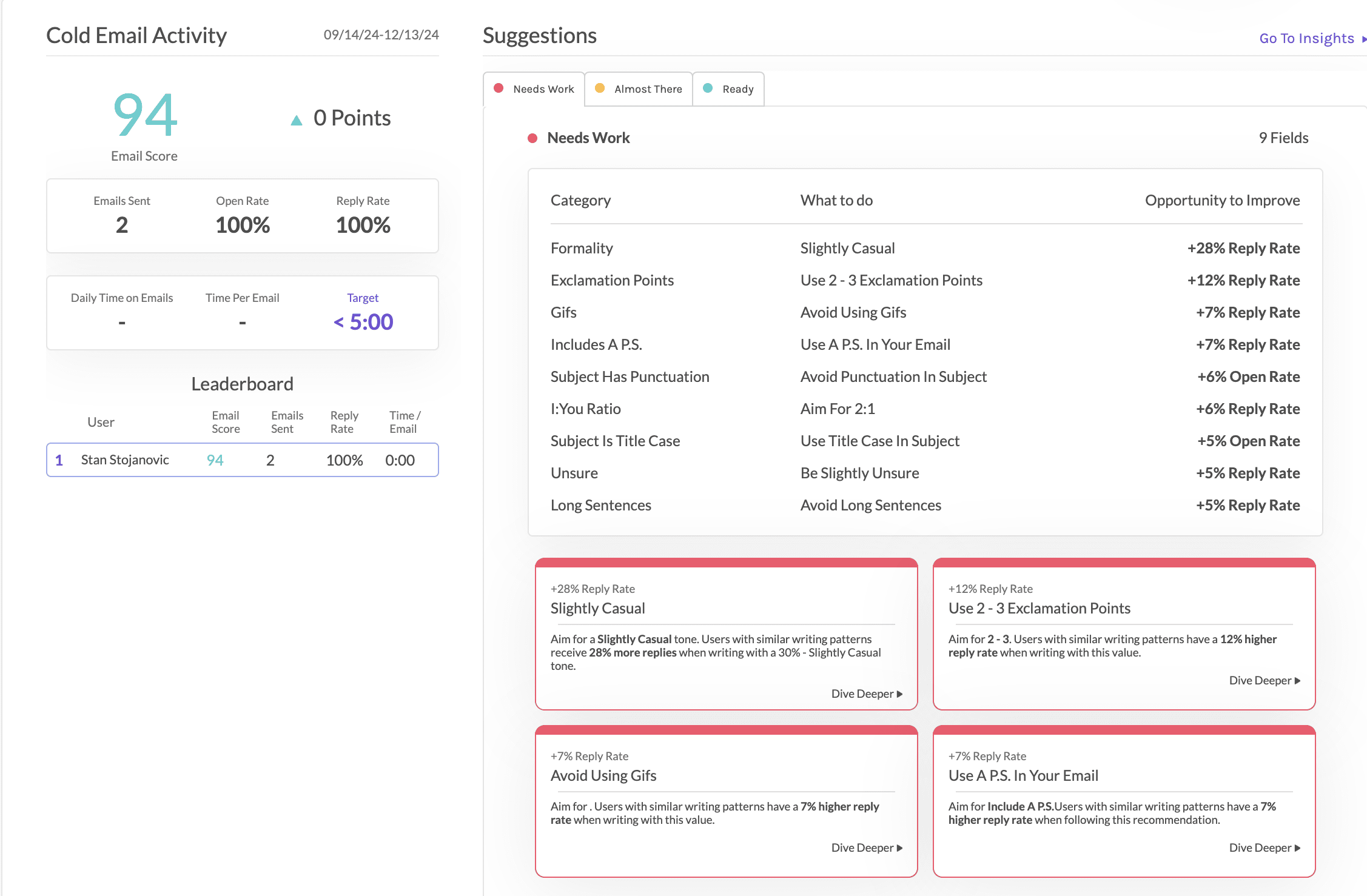
Lavender is an example of an AI email coaching product. Clay supports research and workflow building. Evaluate either against a small set of representative tasks, rather than treating a feature list as proof of better campaign outcomes.
The historical screenshot below illustrates an email coaching dashboard. Its displayed scores and performance suggestions are not current benchmarks or promised results.
Ask each vendor or implementation partner these questions:
- Can we inspect the evidence behind personalized claims?
- What happens when data is missing or conflicting?
- Can we prevent a failed or unreviewed row from being sent?
- How are reply status, opt-outs and duplicates synchronized?
- Which parts of the workflow can we export and retain?
- What are the combined data, model, sending and maintenance costs?
Compare the cost of an approved usable record, not just the cost of generating a draft. A cheap output that needs extensive correction can create more work than it removes.
Does AI improve cold email deliverability?
AI-written copy does not bypass mailbox provider requirements. Authentication, recipient feedback, sending practices and message accuracy still matter. Google's sender guidelines distinguish requirements for all senders from additional requirements for bulk senders to personal Gmail accounts. They also warn against misleading sender information and subject lines.
Check the applicable provider requirements for your program. Do not assume that personalized wording makes unwanted messages welcome or that a warmup tool guarantees inbox placement. Our cold email deliverability guide explains the operational checks separately from copywriting.
How should you measure AI cold email?
Measure research accuracy and business outcomes together. Track the percentage of reviewed rows with correct evidence, the number requiring correction and the time spent approving a usable message. Then connect campaign cohorts to positive replies, qualified meetings held and accepted opportunities.
Keep automated replies, refusals and positive responses in separate categories. Use the same definition of a qualified meeting across comparisons. A faster drafting process is useful, but it does not establish that more pipeline came from AI.
For a practical test, compare a reviewed AI-assisted approach with your existing process in comparable audience segments. Keep the offer and qualification criteria consistent. Avoid declaring a winner from a few replies or changing audience, copy and sending setup all at once.
Should you hire an AI cold email agency?
An agency can make sense when your team needs ongoing ownership of targeting, research, infrastructure, testing and replies. A Clay implementation project may fit better when your internal team already runs outreach and needs a reliable data workflow.
Ask an agency to show an anonymized example from source evidence through approved message to outcome reporting. Clarify who handles errors, who owns the accounts and data, and how handover works. Certification can support a skills assessment, but it does not replace evidence of how the work is managed.
frontBrick's cold email agency service covers campaign execution, while our Clay consulting service focuses on the supporting workflows. If LinkedIn is part of the same program, agree on shared contact ownership with the LinkedIn lead generation team so each channel has a clear role.
Frequently asked questions
Can AI write the entire cold email?
Yes, it can draft a complete message. The draft still needs accurate inputs, a truthful offer and a sending decision. Treat generated text as proposed copy until it passes your review criteria.
What if Clay cannot find a useful personalization signal?
Leave the signal unknown. Use an honest message based on verified segment relevance, route the record for further research or exclude it. Do not ask the model to invent a reason for reaching out.
Is fully automated outreach the right starting point?
Start by automating a bounded research or preparation step. Expand only when you can detect failures, stop sending and assign a human owner. The goal is a repeatable process that produces relevant conversations, with less avoidable manual work.
Book Your Strategy Call Today
Want to see how frontBrick can help you generate qualified leads and fill your pipeline fast? Book your free strategy call now.
Book Strategy Call
Related Resources
See All Resources

%2520%257C%2520frontBrick.webp)