
Back to Resources
Cold Email Follow-Up: Timing, Examples and Stop Rules
Author
Jovana Stojanović
Date
November 16, 2023
Read time
9
min.



Last updated: September 29, 2026
A cold email follow-up should give the recipient a new reason to respond. Briefly connect it to the original message, add a useful detail and ask one clear question. Before sending, check that the person has not replied, opted out or entered a conversation elsewhere.
There is no universal follow-up count or send time that guarantees results. A good sequence combines relevant messages with reliable stop rules. This guide gives you a practical starting cadence, adaptable examples and a way to judge whether each additional step earns its place.
How long should you wait before following up?
For a first test, consider waiting three business days after the initial email. Send a second follow-up four business days later only if you have something useful to add. If there is still no response, close the sequence rather than keep repeating the request.
This is a suggested experiment, not an industry benchmark. Adapt it to the audience, relevance of the offer, local working patterns and responses. A prospect who asks you to reconnect next month should leave the cold sequence and receive the agreed follow-up instead.
| Stage | Example timing | Purpose | Check before sending |
|---|---|---|---|
| Initial email | Day 0 | Explain why the offer may be relevant | Fit, address quality and exclusions |
| Follow-up 1 | Three business days later | Add a useful resource or clarify the problem | Replies, opt-outs and other active conversations |
| Follow-up 2 | Four business days after follow-up 1 | Offer a different relevant angle or close the loop | Whether this message adds value |
| End | After the planned sequence | Stop automated contact | Record status and ownership |
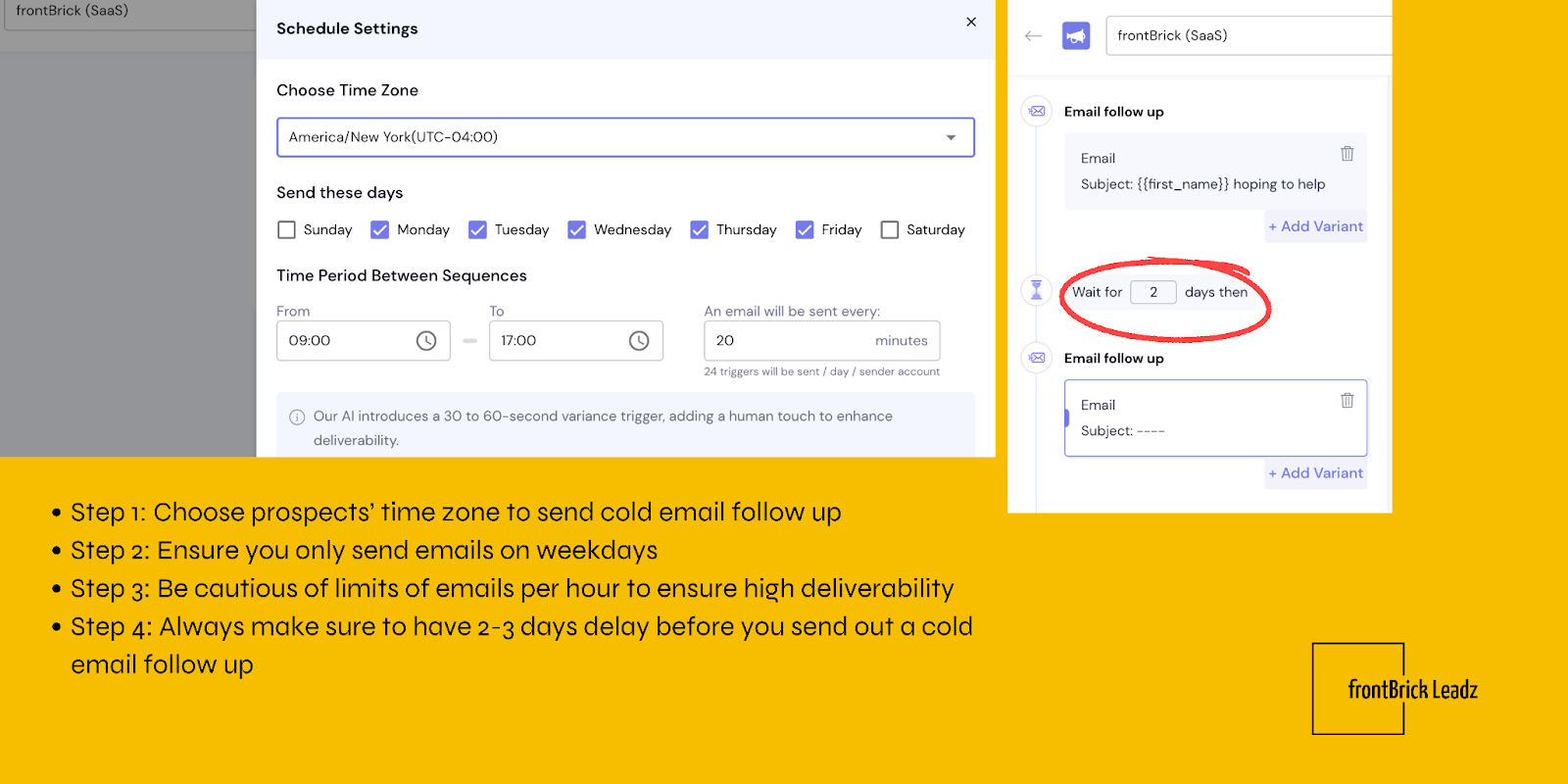
Use the recipient's time zone when defining the sending window. Separate the delay between sequence steps from the interval between individual sends. A campaign may have a three-day follow-up delay and a separate sending schedule that shifts the actual send date.
The retained scheduling graphic below illustrates those controls in an older interface. Its suggested two-to-three-day delay and weekday schedule are examples, not universal deliverability rules.
How to write a cold email follow-up after no response
Keep the context short
The reader should understand the topic without searching for your first message. A sentence such as "Following up on the lead-routing checklist I mentioned" provides context. A long recap usually consumes the space you need for a new point.
Do not assume silence means objection, interest or lack of budget. The person may not have read the email, may not own the problem or may not want the offer. Write in a way that allows a simple correction.
Add something useful
A useful addition might be a specific checklist, an explanation of scope, a relevant question or a verified example. If you include a customer result, confirm that you can substantiate and share it. Never turn a hypothetical example into a claimed client outcome.
For account research, Clay can help organize supporting facts and their sources before writing. Our AI cold email guide explains how to keep evidence and generated copy separate. Research should improve the relevance of the follow-up, not create a new excuse to contact an unsuitable prospect.
Ask for one next step
Choose a question the recipient can answer without doing extra research. Asking whether a checklist would help is a different commitment from requesting a discovery call. Match the request to how much context the person has.
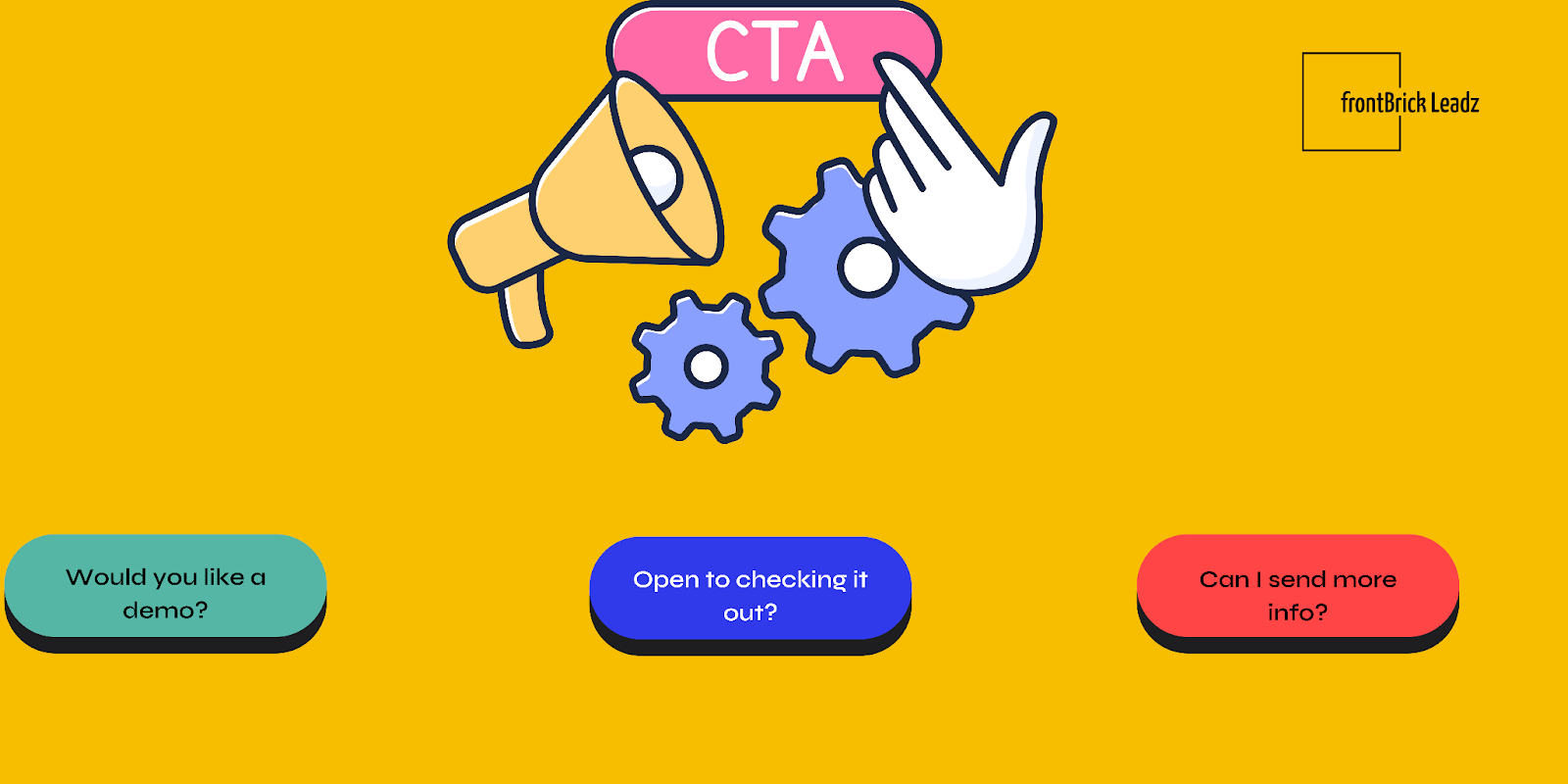
The graphic illustrates different requests. Use one that accurately describes what you can provide. "Can I send more info?" becomes more useful when the reader knows exactly what that information contains.
Four cold email follow-up examples
These are illustrative templates, not tested performance claims. Replace the placeholders with verified facts and an offer you can deliver. Include your normal sender identification and applicable opt-out mechanism in the final message.
1. Offer a specific resource
Hi Alex,
Following up on the lead-routing checklist I mentioned. It covers ownership when a prospect replies, books a meeting or already has an open opportunity.
Would it be useful for whoever manages your CRM handoffs?
Use this when the resource exists and fits the recipient's role. If they ask for it, send the promised resource rather than turning the reply into an unexpected sales pitch.
2. Clarify the scope
Hi Alex,
One detail I missed: the workflow project can focus on research and enrichment while your team keeps control of sending and replies.
Is the data preparation side something you are reviewing this quarter?
Use this when the distinction is true for your service. It gives the prospect useful information without assuming they disliked the first email.
3. Check ownership
Hi Alex,
Is prospect data quality part of your remit, or does another team own it?
I reached out because of the revenue operations role listed on your careers page. Happy to leave it here if it is not relevant.
Use the hiring reference only after checking the current source. A referral is not automatic permission to enroll the suggested contact in every campaign. Reassess relevance and your contact rules first.
4. Close the loop
Hi Alex,
I will close the loop on this. If documenting lead routing becomes a priority later, I can share the checklist.
No need to reply if it is not relevant.
Send this only if you will actually stop the sequence. Avoid false deadlines, guilt or "last chance" language for an offer that will still be available tomorrow.
Should a follow-up use the same email thread?
Use the same thread when the new message continues the same topic. Use a new subject when the subject genuinely changes. Do not type "Re:" into an unrelated first message to imply a previous exchange.
Smartlead's campaign documentation explains that leaving a follow-up subject empty keeps it in the previous thread, while adding a subject creates a new email. Check the behavior in your sending tool with a test message before launching.
Google's sender guidelines require accurate message elements and warn against misleading reply or forward subjects. A clever subject line should never misrepresent the conversation.
When should automated follow-ups stop?
Write stop rules before launching the sequence. Treat them as operating requirements, with someone responsible for checking that they work.
| Event | Recommended action |
|---|---|
| A human replies | Stop the cold sequence and assign the conversation |
| The person opts out or asks not to be contacted | Suppress further outreach and synchronize the exclusion |
| The address hard-bounces | Remove it from sending and investigate the data source |
| An out-of-office reply arrives | Review the return date and pause appropriately |
| A colleague starts a conversation with the same account | Coordinate account ownership before another send |
| The planned sequence ends without a reply | Close it; do not automatically recycle the contact |
Test reply handling with an internal address. Confirm the reply appears in the sending system, the next step is cancelled and the CRM owner receives the conversation. Also test what happens when a contact appears in another campaign.
Instantly's follow-up troubleshooting guide explains why enabling stop-on-reply may not stop people who replied earlier. It also highlights campaign moves, reuploads and subsequences as reasons for unexpected sends. Review the individual activity timeline when diagnosing a problem.
Do not interpret a tracked open as a request for another message. Avoid lines such as "I saw you read my email." They assume more than the signal establishes and add little value for the recipient.
Coordinate email and LinkedIn follow-ups
If your team also uses LinkedIn, maintain a shared record of contact status. A response on one channel should inform the next action on the other. Repeating the same pitch across channels after a reply makes the program look disconnected.
Define who checks cross-channel conversations, who updates suppression records and who owns handoff to sales. A LinkedIn lead generation service should work from those same rules when it supports an email campaign.
Clay can support preparation and data coordination, but do not assume every reply automatically reaches every table or connected system. Map the actual integration, test the events and keep a clear owner. Our Clay consulting service is relevant when those workflow connections need to be built or improved.
How to measure whether follow-ups are working
Measure each step's additional positive replies and the qualified meetings those conversations produce. Separate human replies from automated replies, and distinguish a polite refusal from interest. Review unsubscribes, complaints and bounces alongside outcomes.
Use a clear denominator. A step-level positive reply rate can divide positive replies attributable to that step by the unique recipients who received it. Do not divide by opens and label the result a recipient reply rate. For campaign-level reporting, count unique people so repeated messages do not inflate the audience.
Compare similar cohorts that have had enough time to complete the sequence. If later steps add little qualified interest, first examine their relevance and the original audience. Adding more touches is not the only possible improvement.
What should a cold email agency manage?
A provider should be able to explain the purpose of every sequence step, the stop conditions, reply ownership and qualification rules. Ask how it prevents duplicate outreach and how quickly human replies reach your team. Request reporting that separates scheduled meetings from meetings held and accepted opportunities.
Before signing, clarify whether the service includes list research, data verification, sending infrastructure, copy testing and reply management. Ask what you keep when the engagement ends, including campaign history and suppression records. frontBrick's cold email agency service is the place to discuss that scope.
Frequently asked questions
How many cold email follow-ups should I send?
Start with a short sequence you can justify, such as the two-follow-up test above. Extend it only when the next message adds useful information and the evidence supports continuing. Stop sooner when someone replies or asks you to stop.
Should I send a follow-up the next day?
For an unsolicited first message, give the recipient reasonable time to respond. A next-day message may fit an active conversation or a promised delivery, but that is different from automatically chasing a cold prospect.
What if nobody replies?
Check delivery, audience fit and whether the offer is understandable before increasing frequency. Review the deliverability guide, inspect a sample of prospects and test a clearer offer in a controlled batch. A sequence should end when it has no further useful contribution.
Book Your Strategy Call Today
Want to see how frontBrick can help you generate qualified leads and fill your pipeline fast? Book your free strategy call now.
Book Strategy Call
Related Resources
See All Resources

%2520%257C%2520frontBrick.webp)