
Back to Resources
What Is the Agoge Sequence? A Practical Cold Outreach Guide
Author
Jovana Stojanović
Date
December 9, 2023
Read time
7
min.


Last updated: October 15, 2026
The Agoge sequence is a structured prospecting approach that combines researched outreach with planned follow-ups and sales tasks. Its useful principle is to make relevant, personal contact repeatable without asking a rep to invent every next step from scratch.
A sequence should help you manage a conversation, not force every prospect through every scheduled activity. Replies, opt-outs, wrong-person responses, and changes in account fit all need to change what happens next.
What is the Agoge sequence?
Sam Nelson describes the Agoge sequence in his 2018 overview of sales sequences, connecting it with high-priority prospects and personalization at scale. The history matters because this is a prospecting framework, not a new AI feature or a universal formula for response rates.
In practice, an Agoge-style workflow brings research, email, calls, and relevant social activity into an organized plan. The exact timing and channel mix should reflect your audience and operating capacity. More scheduled touches do not automatically make a campaign more effective.
This guide keeps the original article's focus on research, useful follow-ups, and concrete examples. The sample below is frontBrick's illustrative adaptation, not a reproduction of Nelson's original sequence or a proven performance benchmark.
Benefits of the Agoge sequence
A documented sequence makes the next action clear. It can also help managers review whether a rep is spending time on suitable accounts, offering something useful, and following through on conversations.
Personalization is most useful when it establishes a reason to talk. A verified hiring announcement might support a discussion about onboarding new reps. It does not prove that the company has poor onboarding or is shopping for your product.
Another benefit is consistency of review. When each step has a purpose, you can inspect weak points: an irrelevant first message, a repetitive follow-up, a missed call task, or an interested reply with no owner. That is more actionable than simply adding another email to the end.
How to use the Agoge sequence
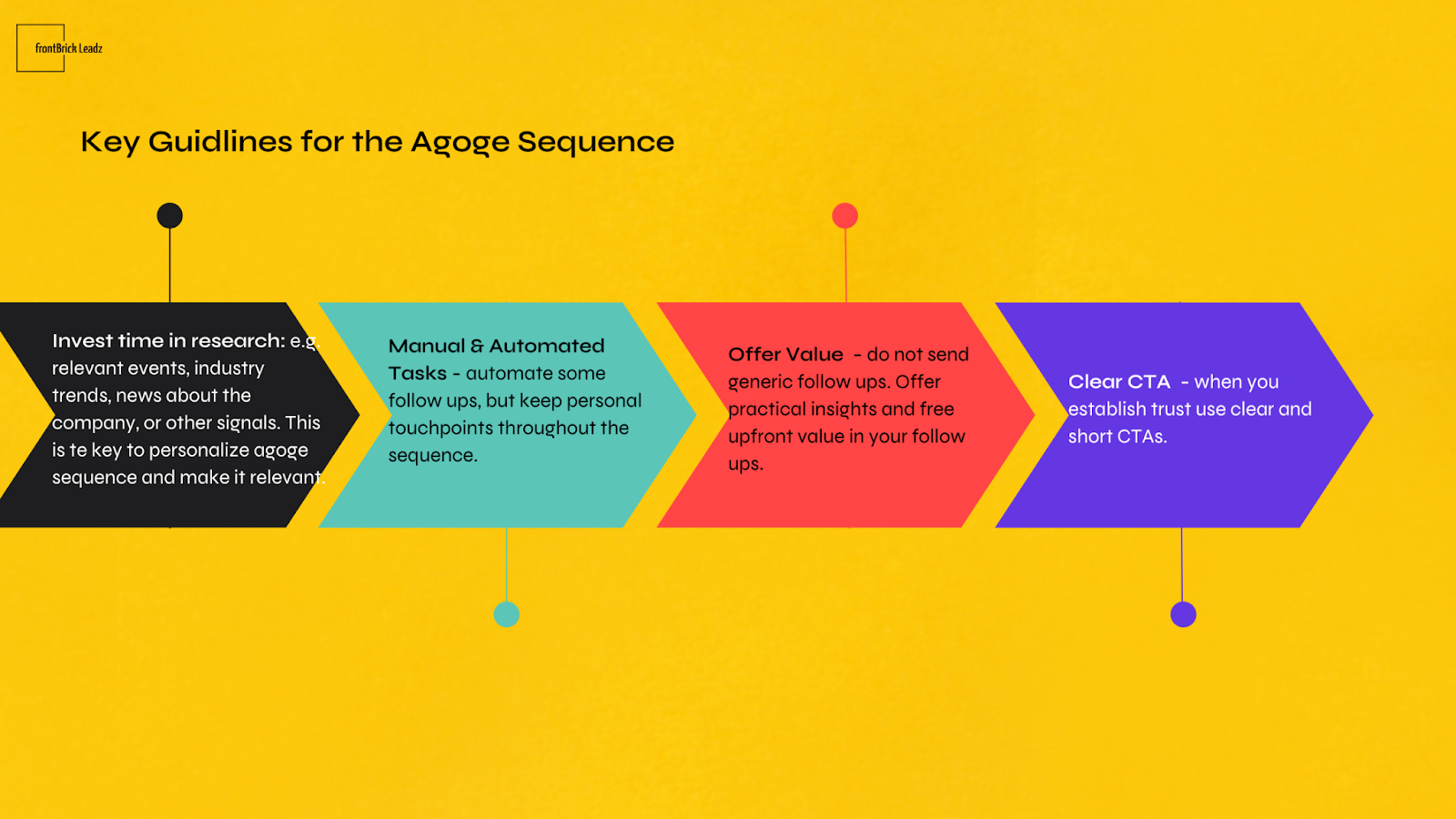
1. Research and prioritize accounts
Start with a defined ideal customer profile. Check company fit, the buyer's current role, and a relevant observation before approving the contact.
Keep the source URL and date with your research. A title alone may not tell you who owns the problem, and an old announcement may no longer be relevant. Flag uncertainty rather than writing around it with invented personalization.
2. Build a useful first message
Connect a verified observation to a plausible topic, then make a small, concrete offer. Avoid claiming knowledge of the buyer's internal problems. The question should be easy to answer without committing to a meeting immediately.
3. Give each follow-up a new purpose
A follow-up can clarify the offer, share a relevant resource, answer an obvious question, or close the loop. It should not restate the opening pitch with a different greeting. See our cold email follow-up guide for practical ways to develop the conversation.
4. Define stopping and handoff rules
Pause automation when a response needs human judgment. Suppress opt-outs, review wrong-person replies, and move interested buyers to an assigned owner. Do not restart the prospect's sequence simply because a contact was uploaded again.
An illustrative Agoge-style sequence
The timing below is a starting point for planning, not a recommended minimum number of contacts or a guaranteed cadence. Skip unsuitable channels and adjust spacing to the context.
| Stage | Activity | Purpose |
|---|---|---|
| Day 1 | Researched email | Introduce a relevant observation and useful offer |
| Day 4 | Manual account review | Check whether new information changes the next step |
| Day 7 | Appropriate call task | Explore the same business topic, where suitable |
| Day 10 | Email follow-up | Add a specific example or resource |
| Day 15 | Relevant LinkedIn interaction | Continue only when context and channel fit justify it |
| Day 20 | Final email | Close the loop without pressure |
Use an account-level activity view when several colleagues are involved. Two reps following individually reasonable sequences can still overwhelm the same company if nobody coordinates their work.
Agoge sequence examples
Example 1: SaaS sales
Suppose you sell onboarding software and verify that a target company is hiring several customer-success roles. An illustrative opening could be:
Saw the customer-success roles on your careers page. We put together a checklist for keeping onboarding handoffs consistent as teams grow. Would that be useful?
Only make this offer if the checklist exists and is relevant. A follow-up could explain one item from it. Do not claim the company has an onboarding problem unless you have evidence.
Example 2: Consulting services
If a consultancy has verified that a company is entering a new market, the offer could be a short market-entry planning checklist. A later message might clarify a specific decision the checklist helps with, such as choosing which buyer roles to interview first.
Keep the example separate from a claim of client success. A hypothetical scenario should never become a fabricated case study in the final message.
Example 3: Web design agencies
Use an observed website issue that affects a relevant buyer journey. For example, a broken inquiry link is a concrete finding; “your website is costing you millions” is an unsupported estimate.
Offer to share the exact page and a concise explanation. Our web design lead generation guide expands on researching suitable accounts and qualifying potential projects.
Where Clay helps
Clay can organize research inputs and message fields before sequence entry. A useful setup stores account fit, evidence, contact status, and approval separately. Our Clay consulting agency can help connect those records to campaign operations.
Keep human judgment in the steps that need it. Research automation should reduce repetitive work, while the rep checks whether the observation is accurate and the offer makes sense. Do not automate a message merely because every field contains text.
Measure conversations and workload
Track positive replies, held qualified meetings, accepted opportunities, and time spent operating the sequence. Separate these from the number of activities completed. A busy task queue does not prove that the outreach is useful.
Review the reasons people decline or redirect you. Those answers can improve targeting and the offer more effectively than changing a subject line repeatedly.
If you need help operating the process, ask a cold email agency or LinkedIn lead generation agency to show its research, stopping rules, and sales handoffs. A sequence diagram alone is not enough to evaluate delivery quality.
Frequently asked questions
Does every prospect need every touchpoint?
No. The sequence is a plan that changes with responses and new information. Stop or adapt when the next activity is no longer appropriate.
Can I use an Agoge sequence without calls?
You can build an email-focused adaptation, but describe it accurately rather than presenting it as an exact original sequence. Use only channels your team can operate responsibly and consistently.
What should stay personalized?
The reason for contacting the buyer, the evidence behind it, and the relevance of the offer deserve the most attention. Decorative references to hobbies or generic compliments do not replace business relevance.
Book Your Strategy Call Today
Want to see how frontBrick can help you generate qualified leads and fill your pipeline fast? Book your free strategy call now.
Book Strategy Call
Related Resources
See All Resources