
AI sales tools / Data & enrichment
BlitzAPI for GTM teams: pricing, workflows and implementation
BlitzAPI is a strong fit when your team needs B2B data inside a repeatable workflow. The important decisions are which accounts deserve enrichment, which persona comes first, and how accepted records reach sales.
By Stan, Co-Founder & CEO at frontBrick · Reviewed October 18, 2026 · 7 min read
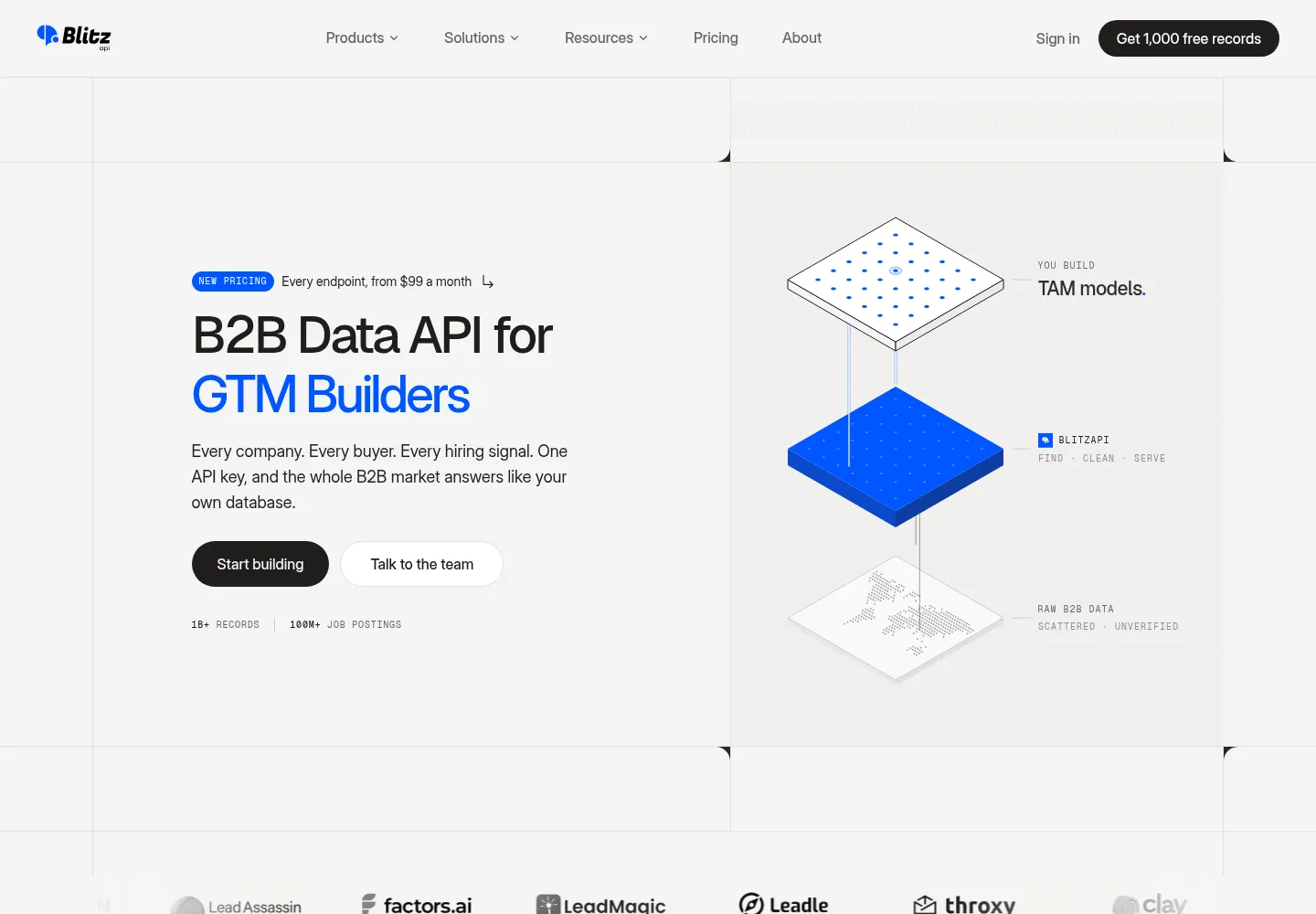
BlitzAPI is a B2B data API for company and people search, profile enrichment, verified work emails, US phone numbers and hiring data. It suits GTM teams building automated prospecting or CRM enrichment, with someone responsible for the integration.
When BlitzAPI is the right choice
Choose BlitzAPI when you want account and contact data to arrive inside a system your team already uses. A revenue operations team can use it to refresh CRM records. An outbound team can move from an approved company list to relevant people. A GTM engineer can combine hiring information, account filters and contact lookup without asking an SDR to export another spreadsheet.
It is less suitable if you mainly want a ready-made sales workspace with messaging, inbox management and reporting included. Access to data does not decide your ideal customer profile, write a credible offer or manage replies. Someone still needs to own those decisions and the connection between systems.
The practical buying question is: can you define a repeatable selection rule? “Find operations leaders at companies matching these conditions” is implementable. “Find us good leads” needs commercial work before API work.
What BlitzAPI actually does
The official documentation separates company discovery, people discovery and enrichment. Company search finds accounts using business attributes. People search finds professionals across accounts. Employee Finder retrieves people within a known company. Waterfall ICP applies a prioritized persona search within that company, so you can try your preferred role before falling back to another.
That last distinction matters. Waterfall ICP is a contact-selection approach, not a promise that multiple email providers will be queried. Keep persona selection and email enrichment as separate stages in your design.
Other documented capabilities include profile enrichment, work-email lookup, US phone numbers and job data. The official Python and JavaScript SDKs handle common integration concerns such as pagination, rate limits and retries. Your workflow still needs business-level safeguards: suppression, duplicate prevention and approval before outreach.
A proposed workflow: hiring signal to an accepted sales account
Consider a company selling onboarding software. Its target account might be a business expanding its customer-success team. Hiring is a useful research trigger, but it does not prove budget or buying intent. The workflow should establish relevance before finding an email.
- Define the account rule. Agree geography, company size, supported business models and exclusions. Separate “must match” conditions from useful indicators.
- Find and normalize companies. Resolve websites to consistent domains. Remove existing customers, active opportunities, competitors and previously excluded accounts before expensive follow-up work.
- Check the signal. Retain the job title, source and observation date. Multiple listings may describe one hiring initiative. Do not count them as several distinct opportunities.
- Select a persona. Try Head of Customer Success first, then a relevant director, then an agreed fallback. Review whether the result still works at the target company.
- Retrieve contact details. Enrich only accepted people. Request US phone data only where calling is actually part of the campaign.
- Write a sales-ready record. Pass the account, person, evidence, relevance hypothesis and owner into the CRM. Route uncertain matches to review instead of a sequence.
This is an implementation example, not a claimed client result. The commercial value comes from the selection and handoff rules, not the number of returned profiles.
The data contract to agree before connecting anything
The following are recommended internal fields, not a replacement for BlitzAPI's response schema. They keep downstream systems understandable when the original builder is unavailable.
| Internal field | Purpose | Acceptance rule |
|---|---|---|
| account_key | Normalized company domain | One account per agreed business entity |
| person_key | Stable provider ID or normalized profile URL | Never use a name alone as the unique key |
| persona_tier | Preferred role or approved fallback | Must match a documented campaign persona |
| signal_source and observed_at | Why this account entered the queue | Evidence must be accessible and recent enough for the offer |
| contact_status | Ready, missing, ambiguous or excluded | Only ready records can progress automatically |
| crm_id and workflow_version | Reconciliation and troubleshooting | Retry updates the same record rather than creating another |
Preserve the original source fields alongside normalized values. If a title is classified incorrectly, you should be able to fix the classification without buying or fetching the record again.
BlitzAPI pricing and the cost that matters
Reviewed 18 October 2026: Start is $99 per month, with 10 requests per second per endpoint and a fair-use allowance of 200,000 returned records monthly. Scale is $499, with 25 requests per second per endpoint and 5 million returned records. Build Your Infra starts at $999 with custom terms. Paid plans include the same endpoints; speed, allowance and support differ.
A record is an item returned, not one API call. A search returning 25 people uses 25 records. Empty results count zero. Allowances reset each billing cycle, unused records do not roll over, and calls pause when the allowance is reached. New accounts can evaluate with 1,000 free records; phone endpoints require a paid plan.
Model your own workflow. For 1,000 accounts, retrieving 20 people each produces 20,000 people records before any separate enrichment. A tighter persona search can reduce downstream work. Budget integration maintenance, CRM licensing and messaging separately. Measure total spend divided by unique, accepted contacts, including review time.
Client delivery, resale and embedding are different commercial uses. Standard plans permit running work for clients; redistribution and customer-facing embedded products require the appropriate agreement.
BlitzAPI, Prospeo, Discolike or Clay?
| Your main problem | Tool to evaluate | Decision test |
|---|---|---|
| Repeatable account and contact API workflows | BlitzAPI | Can the API return your personas with acceptable review effort? |
| Finding verified contact details for known people | Prospeo | Compare coverage and credit cost on the same accepted sample |
| Discovering niche companies from descriptions or lookalikes | Discolike | Does it find net-new relevant accounts beyond your current database? |
| Combining multiple providers and research steps | Clay | Do you need an orchestration workspace around the underlying data? |
These tools can work together. Avoid paying several providers to enrich every row by default. Define which result ends the process and which missing field justifies another lookup.
Launch checks, failure handling and measurement
Start with a mixed sample: known customers, plausible prospects, wrong-fit companies and ambiguous names. Inspect company identity, current employer, persona relevance and returned contact status. A high match rate is not useful if the matches are the wrong people.
- No match: record the reason and continue. Repeating an identical lookup is not a strategy.
- Temporary error or rate limit: retry with backoff and a bounded retry count. Separate these from genuine missing data.
- Partial batch: checkpoint processed identifiers so a restart does not duplicate CRM writes.
- Allowance reached: pause the queue and notify its owner. Do not silently drop remaining accounts.
- Changed employer: review ownership and campaign eligibility before updating an active sales record.
Track accepted-account rate, correct-person rate, contact coverage, duplicates prevented, cost per accepted contact and qualified conversations by segment. Preserve denominators: email coverage among accepted people is different from email coverage across every raw search result.
BlitzAPI implementation with frontBrick
frontBrick connects commercial targeting to technical execution. A scoped implementation can include the account rules, persona cascade, API workflow, CRM mapping, suppression logic, review queue and reporting. Handover should include credentials ownership, field definitions, operating instructions, retry procedures and a way to change targeting without breaking the system.
Talk to Stan about your data workflow. Discovery is complimentary. Implementation pricing is custom to the systems, data volume and ownership you need.
BlitzAPI questions buyers ask
Is BlitzAPI unlimited?
It uses monthly plans with explicit returned-record fair-use limits and per-endpoint request rates. Treat those as operating constraints, even when an older review describes access as unlimited.
Does it include a cold-email platform?
BlitzAPI supplies data. Plan a separate sending and reply-management layer, with clear rules controlling which records enter it.
Can we connect it to Clay or n8n?
It can participate in workflows that make authenticated API requests. Confirm the current connector or HTTP configuration, response mapping and error behavior in your chosen workspace.
Will verified emails guarantee inbox placement?
No. Contact verification addresses one part of outreach quality. Sender reputation, infrastructure, message relevance and recipient response still affect delivery and results.
Should every employee at an account be enriched?
Usually not. Start with the buying roles relevant to your offer. An agreed persona order reduces waste and makes account coverage easier for sales to interpret.
How should we evaluate it before committing?
Use a representative sample and score identity accuracy, persona fit, contact coverage, record consumption and manual correction time. Compare the final accepted records, not vendor database sizes.
Explore the connected tools
- Clay implementation guide
- Prospeo implementation guide
- Discolike implementation guide
- n8n implementation guide
- HubSpot implementation guide
Sources and editorial notes
Product facts and prices were checked against the sources below on October 18, 2026. Workflow recommendations are frontBrick’s implementation guidance. Examples are illustrative unless linked to a named case study. We offer paid implementation, and verified partner relationships are disclosed above.