
AI sales tools / Data & enrichment
Discolike for company discovery: pricing, ICP search and workflows
Discolike is useful when industry labels miss the companies you want. Its real value depends on a clear market definition, representative seed accounts and a validation step before contact enrichment.
By Stan, Co-Founder & CEO at frontBrick · Reviewed October 18, 2026 · 7 min read
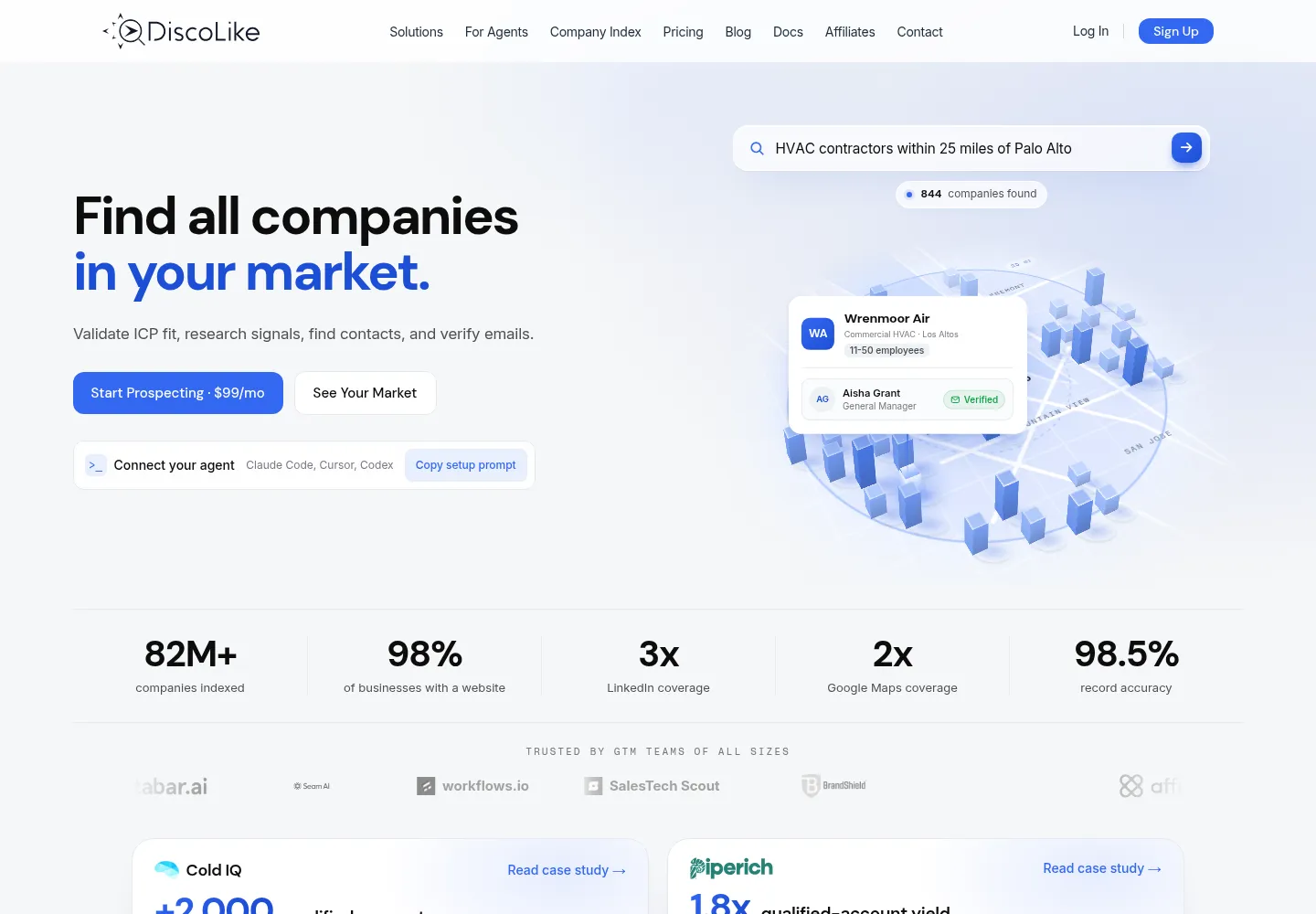
Discolike is a company discovery and data enrichment platform that finds businesses through domain lookalikes, natural-language descriptions, website phrases and filters. It suits GTM teams building niche account lists or expanding beyond familiar database categories.
When company discovery needs more than an industry filter
Your ideal customer may be defined by what it does rather than how a database labels it. “Manufacturers that offer private-label production for cosmetics brands” is more useful than “manufacturing.” “Software businesses serving multi-location healthcare groups” is more useful than “SaaS.” Discolike is worth evaluating for those markets.
It is also useful when your current database keeps returning the same visible companies. Website-based discovery gives you another route into a market. It does not prove that every returned business is relevant, financially viable or ready to buy.
Start elsewhere if you already have the right accounts and only need a missing email for a known person. A contact-enrichment tool may solve that narrower problem with less workflow design.
How Discolike search works
The Discover API supports domain lookalikes, natural-language ICP descriptions, structured filters and website phrase matching. You can supply positive examples and negative descriptions to separate businesses that look similar but sell something different. Search results provide company profiles ranked by relevance.
The Count API lets you inspect result volume before retrieving a full list. That is helpful when a query is too broad or a geographic filter removes most of the market. A count is still a database result, not a verified estimate of every company in your total addressable market.
The wider platform includes company enrichment, contacts, name-to-domain matching and relationship data. Technical teams can use the API, Python SDK, CLI or MCP integration. Choose the interface your team can maintain; the quality of the targeting brief matters more than whether a person or an agent submits it.
Build an ICP brief before building a list
A useful description states the product or service, the customer served, the business model and the exclusions. Avoid adding your desired sales outcome to the search: “companies that need our solution” gives a model less to work with than observable business characteristics.
For example, a proposed audience for a packaging supplier might be: “UK businesses manufacturing skincare products for other brands, including contract and private-label manufacturers. Exclude retailers, beauty salons, packaging resellers and brands that do not manufacture for others.” This is an illustrative search brief, not a completed research result.
| Brief element | What to include | What to avoid |
|---|---|---|
| Positive examples | Several representative customer domains | Only your largest or most unusual customer |
| Business activity | Observable products, services and customers | Broad labels such as innovative or fast-growing |
| Geography | Where the company must operate or be based | Assuming website language proves service territory |
| Exclusions | Retailers, agencies or adjacent models you cannot serve | Relying on positive keywords to remove every false match |
| Acceptance evidence | A relevant service page or explicit business statement | Similarity score alone |
Keep the brief version with the results. When sales rejects a segment, you need to know which definition produced it.
A proposed discovery-to-outreach workflow
- Start with a small reference set. Gather representative good-fit domains and examples that should be excluded. Include smaller customers if they are commercially valuable.
- Preview and refine. Run a bounded query and inspect the count. Review a small sample before requesting the full audience. Adjust one targeting condition at a time.
- Normalize company identity. Resolve redirects and duplicate domains. Decide whether subsidiaries, regional sites and franchises represent separate sales accounts.
- Validate the business model. Inspect evidence for the activity that matters. Discolike offers ICP fit validation; retain a review path for unclear results.
- Apply CRM exclusions. Remove customers, open opportunities, partners and previously rejected accounts. Preserve the reason rather than simply deleting the row.
- Find the relevant buying roles. Add contacts only after company acceptance. Choose roles based on the problem your offer solves.
- Prepare the handoff. Pass the domain, segment, supporting evidence, fit decision and contact owner into the CRM or campaign staging area.
Do not jump directly from lookalike discovery to automated messaging. Similarity is useful for finding candidates. The acceptance step determines whether sales should spend time on them.
How to evaluate discovery quality
Keep a holdout list of known good-fit companies that were not used as seeds. Check whether the search can surface them, but do not treat missing one as proof the whole database is poor. Try alternative descriptions that reflect the vocabulary those companies use.
Review both strong and weak matches. Assign rejection reasons such as wrong business model, unsupported territory, duplicate entity, insufficient evidence or too small. These labels tell you whether to change the query, the seed set or the offer.
Measure three distinct outcomes: accepted accounts divided by reviewed accounts, net-new accepted accounts after CRM exclusions, and qualified sales conversations from contacted accounts. A list can have excellent relevance but little incremental value if every account is already in your CRM.
For a fair comparison with another source, use the same geography, exclusions and acceptance criteria. Combine and deduplicate both outputs before calculating unique contribution. Raw list size is an unreliable winner-selection metric.
Discolike pricing and usage planning
Reviewed 18 October 2026: monthly plans are Starter $99, Pro $199, Team $399, Company $799 and Enterprise $1,599. Annual billing is discounted. The subscription funds usage credits; query submissions and new records consume that allowance at plan-specific rates.
Starter lists $0.18 per query and $3.50 per 1,000 new records. A new record is a company or contact not retrieved in the previous 90 days; retrieving it again inside that window is free under the stated policy. Unused credits can roll over up to one month's subscription value. Confirm the applicable charges for additional research operations before a large run.
Do not interpret an “up to” record allowance as guaranteed export capacity. Query charges also consume credits. Plan for exploration, accepted exports and refreshes separately, then add the cost of contact enrichment, orchestration and sales execution.
API and MCP access are included across plans. Customer-facing software embedding has separate plan requirements. Check those terms if your users will access the data through a product rather than your team using it internally.
Discolike versus other parts of a GTM stack
| Need | Tool to evaluate | Boundary |
|---|---|---|
| Discover companies from what their websites describe | Discolike | Validate relevance before finding contacts |
| Run repeatable company and people API searches | BlitzAPI | Compare coverage and returned-record economics on your market |
| Retrieve contact details for known people | Prospeo | Contact availability does not establish account fit |
| Combine discovery, enrichment and decision logic | Clay | Orchestration still needs a clear targeting brief |
| Read specific website pages for supporting evidence | Firecrawl | Extracted content must be checked and attributed |
You may need two of these layers, but you do not need every tool. Buy the missing capability and retain one accountable owner for the workflow.
Limitations and an operating procedure
Websites can be stale, multilingual, sparse or written to attract several audiences. A business mentioning a product may resell it rather than manufacture it. A large enterprise can look like your ideal customer while its relevant division is too small or inaccessible. These are qualification problems, not just search problems.
Save a query version, run date, normalized domain, evidence URL, decision and rejection reason. Review a sample whenever you change a seed or prompt. Set result and budget limits for agent-driven searches. For asynchronous jobs, retain the job ID and resume status checks rather than starting another paid job after a timeout.
Agree how often each segment needs refreshing. A stable manufacturing market may not need the same schedule as a rapidly changing software niche. Refresh based on the decision you need to make.
Discolike implementation with frontBrick
frontBrick can turn your market knowledge into a working discovery system: ICP brief, positive and negative seeds, validation rules, CRM suppression, contact selection and handoff. Documentation should explain how to revise the audience, interpret uncertainty and measure accepted accounts.
Talk to Stan about your target market. Discovery is complimentary and implementation pricing is custom.
Discolike buyer questions
Is Discolike mainly a contact database?
Its distinctive starting point is company discovery from website signals, descriptions and lookalikes. It also offers contact capabilities, but evaluate company fit and contact coverage separately.
Can it find companies outside familiar LinkedIn categories?
Website-based discovery provides another route into a niche. Test its incremental coverage against your existing account list rather than assuming every result is new or relevant.
Are lookalike companies ready to buy?
No. Similarity indicates potential fit. Timing, need, buying roles and commercial relevance require additional evidence.
Can an AI assistant use Discolike?
Yes, the platform documents MCP access. Give the assistant explicit targeting, exclusion and spending limits, and retain approval before exporting into active campaigns.
Why do my results include the wrong type of company?
Check the business language in your brief and seed websites. Add explicit exclusions, then inspect a sample. A retailer and manufacturer can share product terms while having different buying needs.
What is the best success metric?
Net-new accepted accounts and their downstream qualified conversations. Query volume, database size and exported rows are activity measures, not evidence that the audience is useful.
Explore the connected tools
- Clay implementation guide
- BlitzAPI implementation guide
- Prospeo implementation guide
- Firecrawl implementation guide
- HubSpot implementation guide
Sources and editorial notes
Product facts and prices were checked against the sources below on October 18, 2026. Workflow recommendations are frontBrick’s implementation guidance. Examples are illustrative unless linked to a named case study. We offer paid implementation, and verified partner relationships are disclosed above.