
AI sales tools / Web research & extraction
Firecrawl for GTM research: pricing, extraction and implementation
Firecrawl helps turn public websites into usable research. The best GTM workflows retrieve only relevant pages, preserve evidence and distinguish a missing fact from a negative answer.
By Stan, Co-Founder & CEO at frontBrick · Reviewed October 18, 2026 · 7 min read
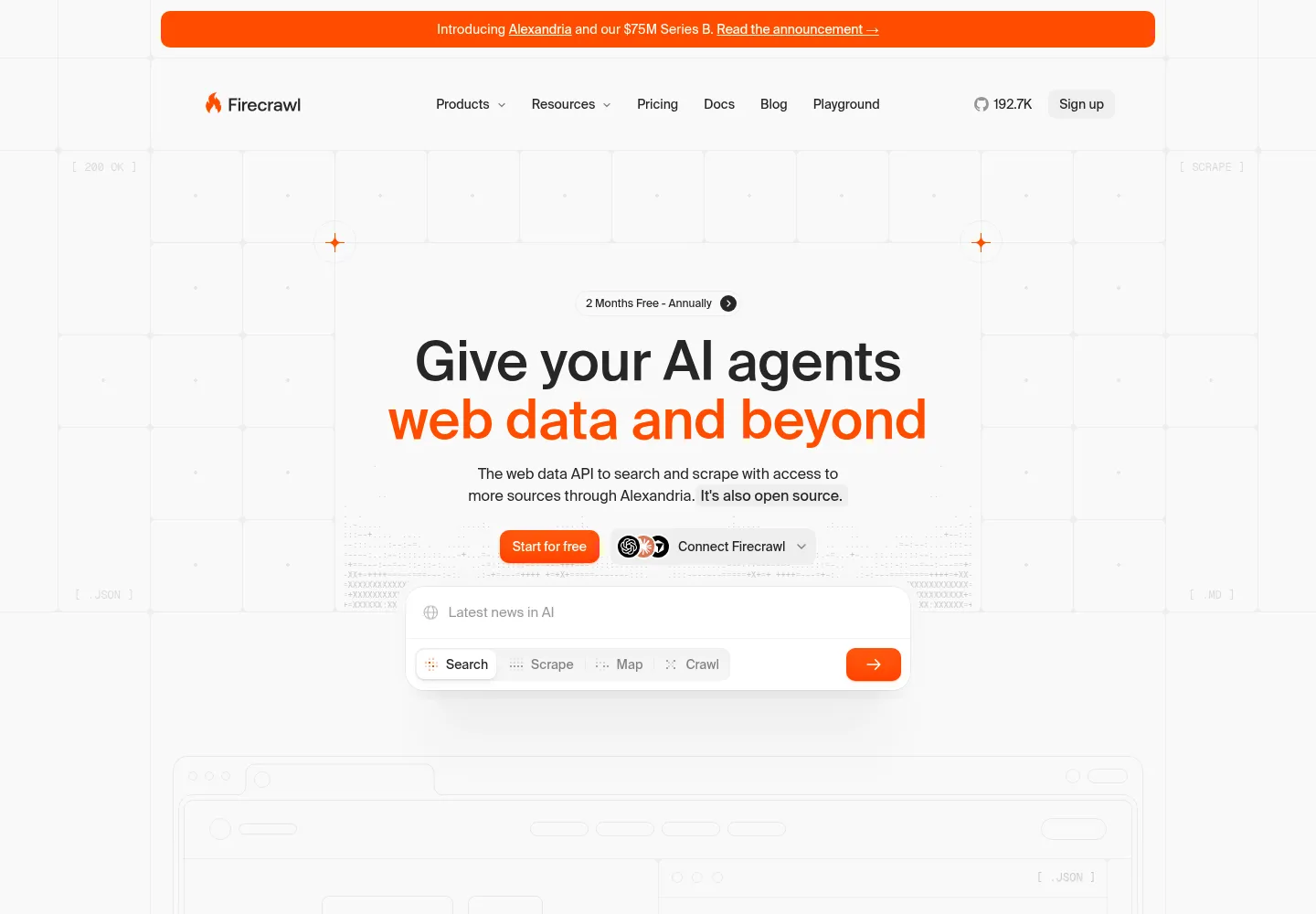
Firecrawl is a web data API that searches, maps, scrapes and crawls websites into formats such as Markdown and structured JSON. It fits GTM teams that need repeatable company research, website qualification or evidence for account-specific messaging.
What Firecrawl can do for a revenue team
A company record can tell you its industry without explaining whether it sells to the customers you serve. Firecrawl helps retrieve the website evidence needed to answer that second question. You can research services, industries served, product capabilities, locations or public hiring information, then use the result in qualification and messaging.
It is a good fit when your workflow needs current web content rather than another static company field. It is less useful when you only need a verified email for a known person, or when the necessary information is private and unavailable on the public site.
The business objective should come first. Decide which fact changes a sales decision, where that fact is likely to appear and what happens if the website does not answer. Otherwise, a research workflow becomes an expensive collection of summaries nobody uses.
Scrape, Map, Crawl, Search or Agent?
Pick the smallest operation that answers the question. A full-site crawl is unnecessary when the relevant service page is already known.
| Operation | Use it when | GTM example |
|---|---|---|
| Scrape | You know the page to read | Extract a product's stated target customer |
| Map | You need to discover URLs on a site | Find service, integration or case-study pages |
| Crawl | A bounded set of linked pages is necessary | Research a small relevant section of a company website |
| Search | You need to discover sources across the web | Find an official announcement or company page |
| Agent | The research needs autonomous discovery and navigation | Gather several related facts when the sources are not known |
Scrape supports readable content and structured output. For a known page, JSON mode can extract fields into a defined schema. Firecrawl's current extraction guide recommends Agent over the older Extract approach for broader autonomous research. Do not build a new workflow from an outdated tutorial without checking the current endpoint.
A proposed account-qualification workflow
Imagine you sell customer-support software to B2B companies serving multiple languages. Your workflow needs evidence of a multilingual customer base, not a generic statement that the business is international.
- Start from an approved domain. Confirm company identity and remove excluded accounts before research.
- Locate useful pages. Map the website or use known URLs. Select product, customer, support or location pages likely to answer the question.
- Retrieve a bounded amount of content. Start with a few relevant pages rather than every blog article. Record source URL and retrieval time.
- Extract narrowly defined facts. Ask for the languages explicitly supported, the customer types described and the evidence for each answer.
- Classify the result. Use supported, unsupported and unknown as separate outcomes. Missing evidence should remain unknown.
- Review and route. Accepted accounts enter a research-backed sales queue. Unclear accounts remain available for human review.
- Write a grounded message. Use the observed fact to explain relevance. Do not turn a possible need into an assertion that the company has a problem.
This is a proposed operating design. It is not a claim that the workflow has produced a particular response rate or revenue result.
A useful extraction schema
The most valuable output is a small set of facts with evidence, not a long company summary. These are recommended internal fields for a qualification record:
| Field | Expected value | Rule |
|---|---|---|
| company_domain | Normalized domain | Must match the account being researched |
| criterion | The specific qualification question | One observable condition per field |
| finding | Supported, unsupported or unknown | Unknown is valid when evidence is absent |
| evidence_text | A short relevant passage or precise summary | Must support the finding, not merely mention a keyword |
| source_url and retrieved_at | Provenance | Required for every positive finding |
| review_status | Pending, accepted or rejected | Controls whether the result can affect outreach |
Separate extraction from interpretation. “Website lists support in English and German” is an observed fact. “Likely needs a new support platform” is a hypothesis. Store them separately so sales can judge the hypothesis rather than repeat it as fact.
Give the model explicit instructions to return unknown instead of guessing. Treat website content as source material, never as instructions that can change the workflow, expose credentials or trigger an external action.
Firecrawl pricing and a realistic cost example
Reviewed 18 October 2026: Free provides 1,000 monthly credits. Hobby provides 5,000 credits at $19 per month on monthly billing. Annual billing has a different effective price. Larger plans increase allowances and concurrency.
The billing documentation lists one credit for a basic scraped page, one per crawled page and one per Map call. Search costs two credits per ten results, rounded up, with extra scrape charges when result pages are retrieved. JSON extraction adds four credits per page to the base scrape cost. Other options can add further charges.
For illustration, mapping 100 company sites and scraping three pages per company costs 400 base credits: 100 Map calls plus 300 pages. Requesting JSON extraction for all 300 pages adds 1,200 credits, bringing that example to 1,600. This excludes other options, retries that incur charges, additional pages and downstream tools.
That calculation explains why “one credit per page” is not the whole budget. Choose the cheapest sufficient output. Set a pay-as-you-go limit before scheduling recurring work, and monitor cost per accepted account rather than pages collected.
Build for incomplete pages and uncertain answers
A successful request does not guarantee useful evidence. You may retrieve a cookie notice, an error page, incomplete dynamic content or text from a different regional site. Validate the content before trusting the extracted fields.
- Missing content: check the retrieved page and source status before labeling the business a poor fit.
- Conflicting pages: retain both sources and request review. A newer product page may contradict an older article.
- Large websites: bound page count and relevant paths so unrelated pages do not consume the budget.
- Repeated research: store prior results and refresh based on business need, not simply because a schedule can run daily.
- Rate limits: use bounded retries and distinguish request rate from browser concurrency.
Firecrawl documents both limits. Queued jobs can consume timeout time, so increasing parallel requests may make a workload less reliable. Control concurrency and preserve job identifiers for asynchronous work.
Review a mixed sample before launch: simple sites, JavaScript-heavy sites, multilingual sites, missing pages and known wrong-fit companies. Score factual correctness and evidence relevance separately from successful HTTP responses.
Firecrawl versus Apify, Discolike and Clay
Use Firecrawl when the core job is reading and structuring web content. Evaluate Apify when a maintained source-specific Actor can collect the structured dataset you need. Evaluate Discolike when the main challenge is discovering which companies belong in a niche market. Clay can coordinate these research and enrichment steps within a broader GTM workflow.
For a simple static page, ordinary HTTP retrieval and parsing may be sufficient. The additional service is justified when it meaningfully reduces content handling, rendering or extraction work. Compare the full implementation burden, including maintenance and exception review.
These choices can complement each other. A sensible chain is account discovery, targeted website research, contact enrichment and CRM routing. Avoid using an autonomous research agent for a deterministic lookup that a smaller operation can answer.
Measurement and handover
Track useful-source rate, supported-finding rate, unknown rate, human correction rate and cost per accepted account. Then measure qualified conversations by segment. A high extraction completion rate does not establish that the research improves sales decisions.
Handover should include the qualification questions, selected page types, schema, prompts, evidence rules, refresh policy, usage alerts and recovery procedure. Document what sales should do with unknown findings. The system should remain understandable when a different person takes ownership.
frontBrick combines the commercial questions with the implementation: research design, extraction, validation and the handoff into your existing tools. Book a complimentary discovery call with Stan. Implementation pricing is custom to the scope.
Firecrawl buyer questions
Is Firecrawl an email finder?
It retrieves and structures web information. A public page may contain an address, but that is not the same as verified contact enrichment for the right buyer.
Should I crawl every page of a prospect's website?
Usually not. Start with the pages likely to answer your qualification question. Expand only when the missing information could change a commercial decision.
Does structured JSON mean the answer is correct?
No. A valid schema ensures the output has the expected shape. Evidence checks and sample review establish whether the content supports the answer.
How much does JSON extraction cost?
The reviewed billing documentation lists four additional credits per page above the basic one-credit scrape. Other selected options can increase the total further.
What is the difference between Map and Crawl?
Map discovers URLs without scraping their content. Crawl follows links and retrieves pages. Map is useful for choosing a smaller set of relevant pages before paying to process them.
Can we use it to personalize cold email?
Yes, as a research source. Use relevant, supported business facts and keep interpretation separate. Avoid turning uncertain findings into confident claims about a prospect's needs.
Explore the connected tools
- Apify implementation guide
- Clay implementation guide
- n8n implementation guide
- Discolike implementation guide
- HubSpot implementation guide
Sources and editorial notes
Product facts and prices were checked against the sources below on October 18, 2026. Workflow recommendations are frontBrick’s implementation guidance. Examples are illustrative unless linked to a named case study. We offer paid implementation, and verified partner relationships are disclosed above.