
AI sales tools / Agents & automation
Freckle.io: an implementation guide for agent-driven GTM workflows
Freckle now positions itself around GTM workflows operated from coding agents. This guide explains what to evaluate, how to design a reusable enrichment process, and what to confirm before committing production data.
By Stan, Co-Founder & CEO at frontBrick · Reviewed October 18, 2026 · 8 min read
Freckle.io is a GTM workflow and enrichment platform whose current product emphasizes terminal and coding-agent operation, reusable workflows, and connected data providers. It is best evaluated by teams comfortable owning both the workflow logic and its operating controls.
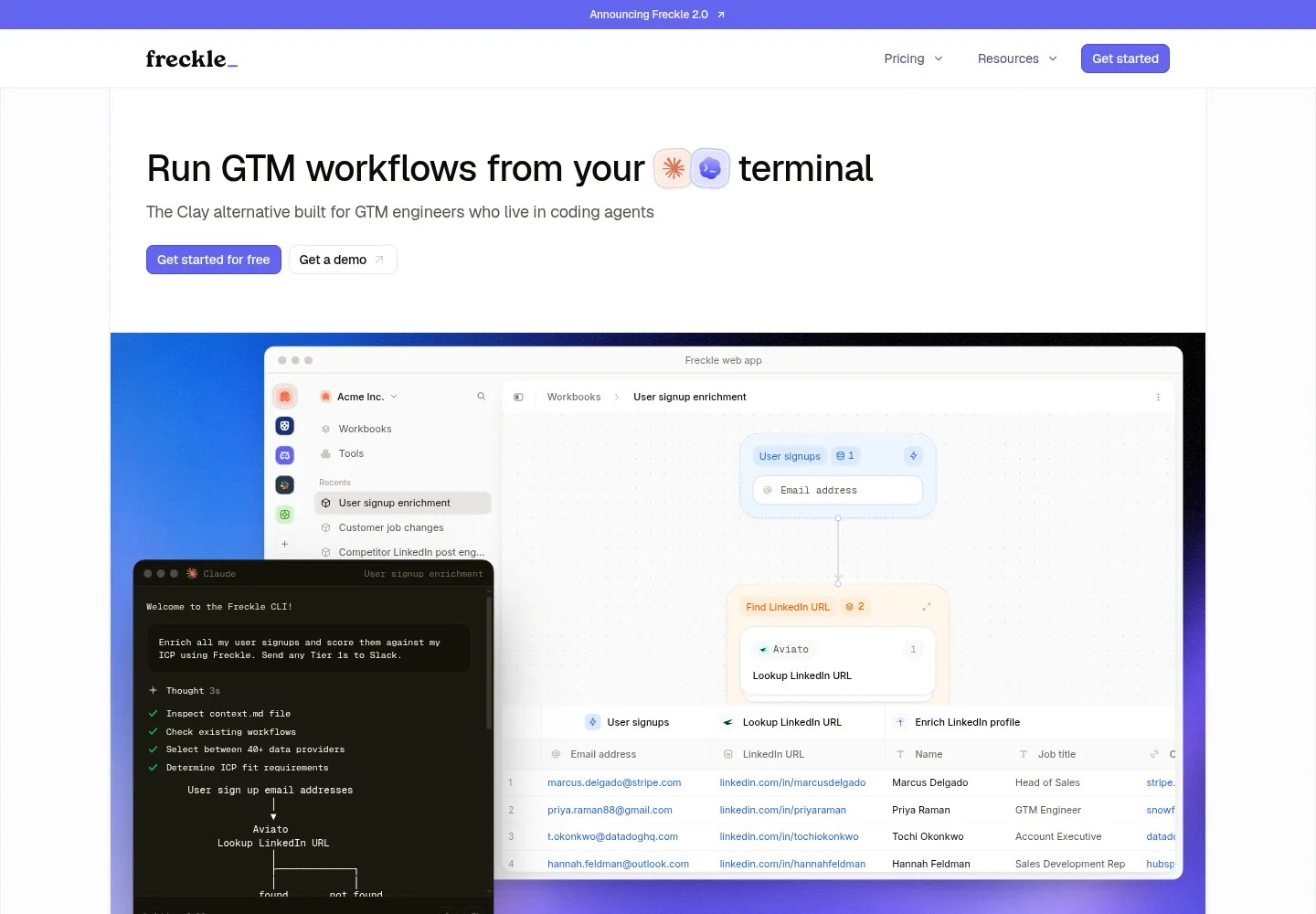
Reviewed October 18, 2026. This guide covers Freckle.io, the GTM product, not the education software with the same name. The workflow below is a proposed implementation design based on current public product information, not a claim of tested production performance.
What Freckle does now
Freckle’s current positioning centers on running GTM workflows from a terminal and working with coding agents. Its public product examples include enrichment waterfalls, company and person research, signals, and reusable workflows. This is a broader direction than the spreadsheet-style enrichment description found in older guides.
The appeal is straightforward: keep a repeatable process around data and decisions while an agent helps build or operate it. The important question is whether your team can understand, approve, and maintain that process after the initial build.
Freckle is worth evaluating for a GTM engineer or technically comfortable operations team that wants reusable research and enrichment workflows. It needs a more careful pilot if the people inheriting the system expect to manage everything through a conventional CRM interface.
The May 28, 2026 CLI announcement described a beta release. The current homepage emphasizes this workflow model; confirm availability, access, and the supported actions in your workspace before making it a production dependency.
What to verify before choosing it
Ask for a demonstration using your own workflow requirements. A provider logo does not establish that every endpoint, field, permission, or sync direction you need is supported. Likewise, an agent generating a workflow is not proof that the workflow has appropriate budget limits or a reliable recovery path.
| Requirement | Evidence to request |
|---|---|
| Provider coverage | The exact action, required inputs, returned fields, and current cost. |
| CRM handoff | How existing records are matched, updated, and associated. |
| Reuse | How one workflow runs with different campaign configurations without copying customer data. |
| Agent control | What the agent may read, change, spend, and launch. |
| Recovery | How a partial run is inspected and resumed without repeating completed actions. |
| Ownership | Whether another team member can operate the process and revoke access. |
These are acceptance criteria for the implementation. They should be verified in the workspace rather than assumed from the marketing page.
A proposed reusable workflow: qualify and enrich inbound accounts
Start with an operationally contained use case: a new business inquiry has a company domain, a role, and an email address, but the sales team needs context and routing. This lets you evaluate identity, research, and handoff before connecting a larger outbound program.
- Validate the input: require a source event ID, timestamp, contact identifier, and company domain when available. Route missing identity to review.
- Match the CRM: check for the existing contact, company, customer relationship, and open opportunity. Keep their IDs.
- Research the account: collect only the facts needed for your offer and qualification criteria. Retain the source and date for material claims.
- Fill necessary gaps: use an enrichment waterfall for missing fields. Do not re-buy contact information already verified recently.
- Assess fit: output a recommendation with a reason. Distinguish “does not fit” from “insufficient information.”
- Review exceptions: resolve conflicting companies, uncertain role matches, or contradictory evidence before updating production records.
- Hand off: write approved context, assign an owner, and create the next action. Keep outreach enrollment as an explicit separate decision.
This design does not require every available provider. Start with the minimum set that fills a real gap, then add fallbacks only when a measured failure justifies them.
Define inputs and outputs before asking an agent to build
| Contract | Suggested contents |
|---|---|
| Input | Event ID, CRM IDs, domain, role, original source, campaign or business unit. |
| Configuration | Fit criteria, excluded accounts, allowed providers, budget, routing owner. |
| Output | Approved facts, evidence, fit status, missing fields, recommended next action. |
| Run record | Workflow version, timestamps, costs, completed steps, errors, approval state. |
A useful build brief might read: “Research these accounts for our stated fit criteria. Use only the approved providers. Return evidence and an uncertainty flag. Stop at the agreed budget. Produce a reviewable result before changing CRM ownership or enrolling anyone.” This is a suggested instruction, not a Freckle command or a claim about a built-in approval feature.
Design the waterfall around a stopping rule
A waterfall should continue only while an important field remains unresolved. Define what counts as acceptable before adding another provider. For a work-email lookup, that might include the correct person and employer, a usable result status, and no conflict with a more recent verified value.
Keep three outcomes: accepted result, no result, and unresolved conflict. A second provider returning a different address does not automatically make its answer better. Store enough provenance for the reviewer to understand the disagreement.
Budget the whole route. A cheap first lookup can be followed by research, validation, retries, and downstream processing. Compare cost per approved record rather than a single provider’s headline lookup price. If a person is already disqualified at the company stage, stop before paying to enrich their contact details.
Freckle pricing and total operating cost
The official pricing page reviewed October 18, 2026 advertises a $0 plan with 250 free credits and a 500-row limit, plus unlimited seats and tables. Build starts at $99/month and lists unlimited table rows, HTTP API access, and bring-your-own API keys. Enterprise uses custom pricing. Confirm the credit package and billing interval that match your intended workload.
Freckle publishes a provider breakdown with individual output costs and some bring-your-own-key actions. Its comparisons use a stated plan assumption. Treat those figures as a vendor’s pricing illustration, not an independently measured saving for your workflow.
Build a budget with four lines: platform subscription, platform-billed outputs, charges on your own provider keys, and implementation or maintenance. A bring-your-own-key operation may move the charge to another vendor rather than make it free.
Before signing, confirm refresh charges, retry behavior, rollover, expiry, top-ups, and which actions consume credits. Do not use an older directory’s credit allowance or rollover formula as the contract for the current product.
Freckle versus Clay, n8n, and direct APIs
| Approach | What to evaluate |
|---|---|
| Freckle | Agent and terminal workflow, provider actions, reuse, and the operational controls your team needs. |
| Clay | Your required research, enrichment, and workflow capabilities in its current product, plus team familiarity. |
| n8n with direct APIs | Integration control and flexibility against the responsibility for credentials, retries, monitoring, and maintenance. |
| A single data provider | Whether one dependable lookup solves the problem without an orchestration platform. |
Run the same small business case through the shortlisted approaches. Compare accepted outputs, total cost, time to diagnose an error, and whether a colleague can change the criteria. Avoid choosing on the assumption that only one product can support agents or reusable logic. Product capabilities evolve, and the better choice depends on your exact process.
If your team already operates a stable Clay workflow, migration should have a measurable reason. If you are building a new agent-led process, Freckle’s current direction makes it relevant to the evaluation.
Agent safeguards that belong in the implementation
Keep credentials outside prompts and exported datasets. Separate read access from write access where your integration supports it. An agent researching companies does not automatically need permission to send messages, change customer ownership, or process the whole database.
For multiple clients or business units, separate configuration, credentials, and destinations. Reuse the logic while keeping customer records and proof isolated. A copied workflow containing the previous client’s account IDs can produce a serious mistake even when every individual action succeeds.
Have the agent report what it plans to change, then compare the actual result with that plan. Treat downloaded pages as untrusted research material. They should never be allowed to redefine the task, expose credentials, or authorize additional actions.
Acceptance tests and ongoing measurement
- Sending the same source event twice does not create duplicate records or tasks.
- A missing domain produces a review item, not an invented company match.
- A disqualified account stops before unnecessary enrichment.
- A provider failure is visible and does not silently become “no match.”
- A successful step is not needlessly repeated after a later failure.
- A changed client configuration cannot write to the previous client’s destination.
- The final cost can be reconciled with the processed records and provider actions.
Measure approved records, unresolved conflicts, provider yield, cost per approved result, processing failures, and time to repair. When outreach is downstream, measure qualified conversations separately. The enrichment workflow’s success should not be confused with a claim that it created all resulting revenue.
Implementation and handover
frontBrick can help define the commercial use case, choose the data steps, build the workflow around your tools, and document how your team operates it. A useful handover contains the input/output contract, provider choices, client configuration, budget assumptions, test set, permissions, and recovery instructions. Implementation pricing is custom. Talk to Stan in a complimentary discovery call.
Buyer questions about Freckle
Is Freckle.io a Clay alternative?
It is positioned that way, with a current emphasis on terminal and coding-agent workflows. Evaluate the actual providers, actions, handoff, and maintenance needed for your process. A lower advertised lookup cost alone does not establish a better overall system.
Can a nontechnical team operate it?
That depends on the workflow and handover. Have the intended operator demonstrate a routine change, an error review, and a safe pause before committing. Agent assistance does not eliminate the need to understand the business rules.
Does Freckle send the outreach itself?
Its public examples show workflows connected to sales engagement tools. Confirm the exact delivery integration for your channel and plan. Treat message enrollment, sending, and reply handling as explicit parts of the wider system.
Are bring-your-own API keys free to use?
They can mean charges occur on your own provider account. Include those invoices in the budget and verify whether the orchestration platform also charges for the action. Avoid counting only the Freckle subscription.
Can one workflow support several clients?
Freckle emphasizes reuse. For a multi-client implementation, separate each client’s criteria, credentials, data, and destination, then test that isolation. Reusable logic should not mean shared customer records.
What should a pilot prove?
It should produce useful, source-backed output at an acceptable cost and survive ordinary failures. Require a colleague to operate the process from the documentation. That is a more meaningful test than watching an agent generate a workflow once.
Explore the connected tools
- Clay implementation guide
- n8n implementation guide
- Apollo implementation guide
- Apify implementation guide
- Twain implementation guide
Sources and editorial notes
Product facts and prices were checked against the sources below on October 18, 2026. Workflow recommendations are frontBrick’s implementation guidance. Examples are illustrative unless linked to a named case study. We offer paid implementation, and verified partner relationships are disclosed above.