AI Search Optimization: The GTM Engineering Workflow That Grew Our AI Visibility 4,000%
Last updated: November 13, 2026
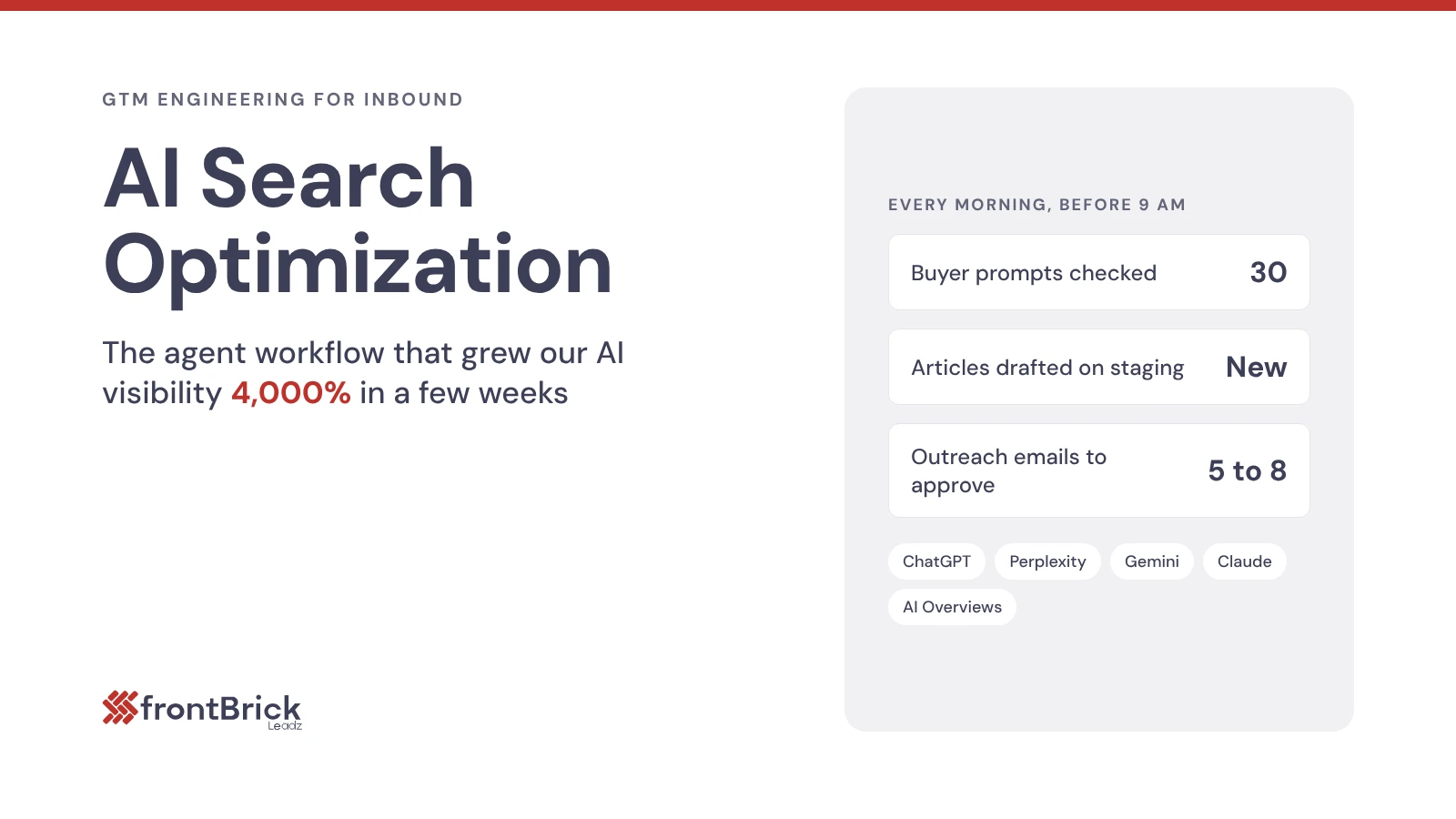
AI search optimization is the work of getting your brand mentioned and cited when buyers ask ChatGPT, Perplexity, Gemini, Claude or Google AI Overviews for help. We do it with a GTM engineering workflow. An AI agent checks about 30 buyer prompts every day, then drafts the content and outreach that close the gaps. A human approves every step.
In a few weeks, our AI visibility grew 4,000%. It keeps climbing, and it keeps bringing us discovery calls, even with low organic website traffic.
This guide walks through the whole system: the stack, the daily loop, an article the agent wrote, how it compares to AI visibility tools and agencies, and how to build your own version.
What is AI search optimization?
AI search optimization means shaping what AI engines say about your category, so your brand shows up in the answer. You may also see it called generative engine optimization (GEO) or answer engine optimization (AEO). All three names describe the same goal.
Classic SEO gets your page ranked in a list of links. AI search optimization gets your brand named inside the answer itself. Often the buyer never clicks anything. They read the answer, see three or four names and build a shortlist from there.
| Classic SEO | AI search optimization | |
|---|---|---|
| Goal | Rank a page in the top 10 links | Get your brand mentioned and cited in the AI answer |
| What you measure | Rankings, clicks, organic traffic | Mentions, citations and share of voice across buyer prompts |
| Where wins come from | Your own pages and backlinks | Your pages plus third-party pages AI trusts: listicles, reviews, Reddit, YouTube |
| How you track it | Keyword rank trackers | A fixed list of buyer prompts, checked on each engine |
The third row matters most. AI visibility is not about one page. It is about how often your name comes up across all the sources an engine reads. That is why both AI citation visibility (being cited as a source) and AI brand visibility (being named as an option) count.
Why GTM engineering belongs in inbound, not just outbound
Most people think GTM engineering is all about cold emails and lead lists. Plenty of people with a technical background join the GTM engineering bubble just by building outbound lists. We do that too. Outbound is one of our core services.
But GTM engineering is much bigger than outbound. At its core, it means building systems that connect data, AI agents and automation to a revenue goal, with people reviewing the output. That works just as well for inbound.
AI search optimization is a perfect fit for this kind of system:
- The work repeats every day: check the prompts, find the gaps, act on them.
- It needs data from several tools stitched together.
- Most of it can be automated, but quality still needs a human eye.
If you are new to the role, our guide on what a GTM engineer does covers the basics.
What changed: from 1 or 2 mentions to 4,000% growth
When we started, frontBrick was barely visible. Across about 150 AI answers to our buyer prompts, we showed up only once or twice.
A few weeks after the agent went live, our AI visibility was up 4,000%, and the trend is still going up. The number matters less than what it brings: discovery calls. Buyers find us in AI answers even though our organic website traffic is still low.
| Before | After a few weeks |
|---|---|
| 1 or 2 mentions in about 150 AI answers | AI visibility up 4,000% and still climbing |
| No tracking, no system | About 30 buyer prompts checked every day |
| Missing from most listicles in our category | 5 to 8 outreach emails a day, 2 or 3 replies a day |
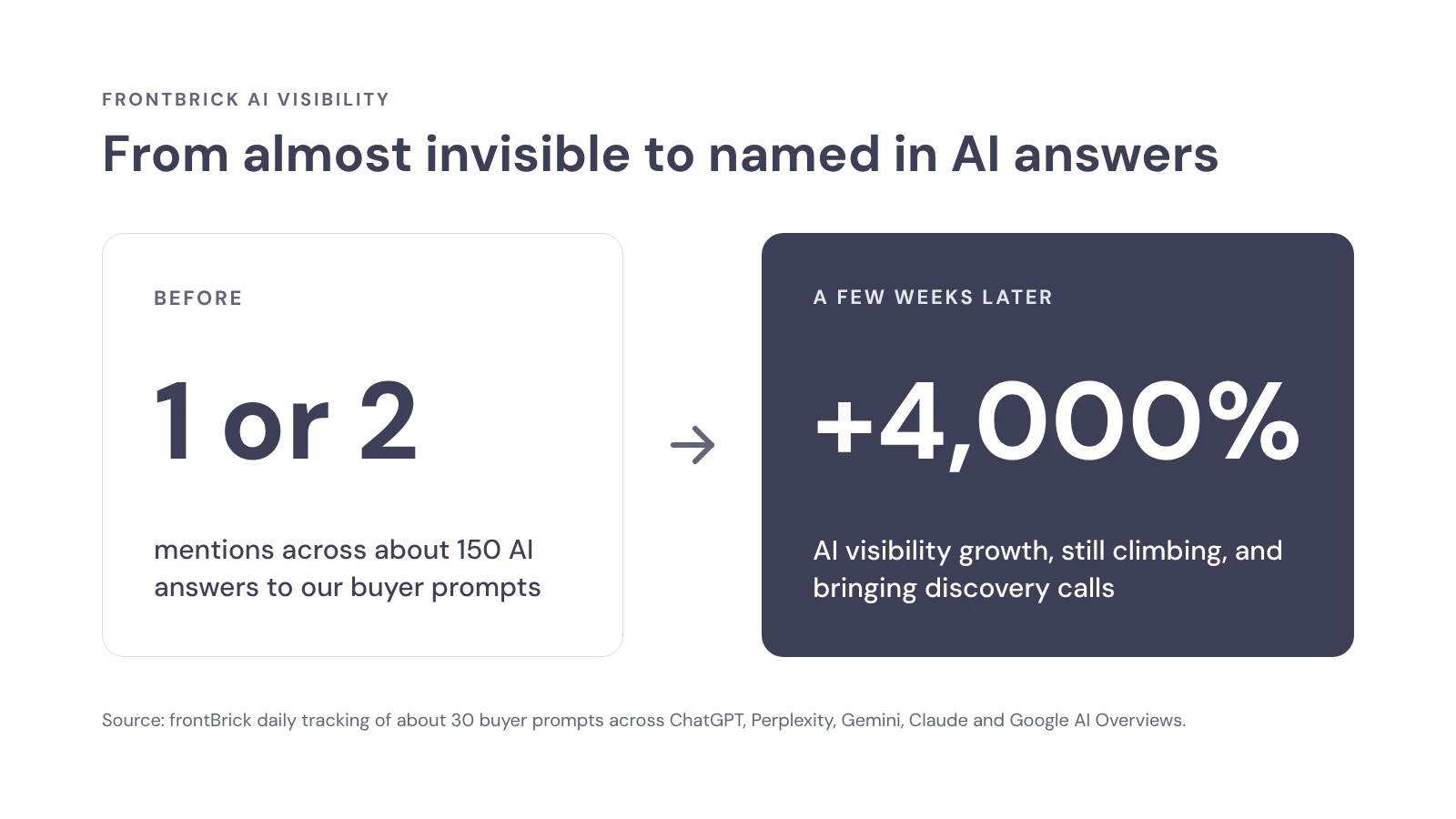
A quick note on the number. A 4,000% jump is easier when you start near zero. The point is not the percentage. The point is that a small team went from invisible to named in AI answers, fast, with a system that runs every day.
The AI visibility agent and its stack
The system has four parts: an AI agent, a website the agent can write to, a few data tools and a human who approves the output.
| Tool | Job in the workflow |
|---|---|
| Grok Bot | The AI agent. Runs the daily loop, drafts content and outreach, sends the report |
| DataForSEO | One endpoint that returns the AI answers for every tracked prompt |
| n/CMS | Our website, a custom build by our friend Stefan at nube.agency, so the agent can draft articles on staging |
| Google Sheets | The dashboard: visibility trend, sources, cost, prompts, daily log and ideas |
| Blitz API and BetterContact | Find and verify contact emails for outreach |
| Slack | Where the team gets the daily report |
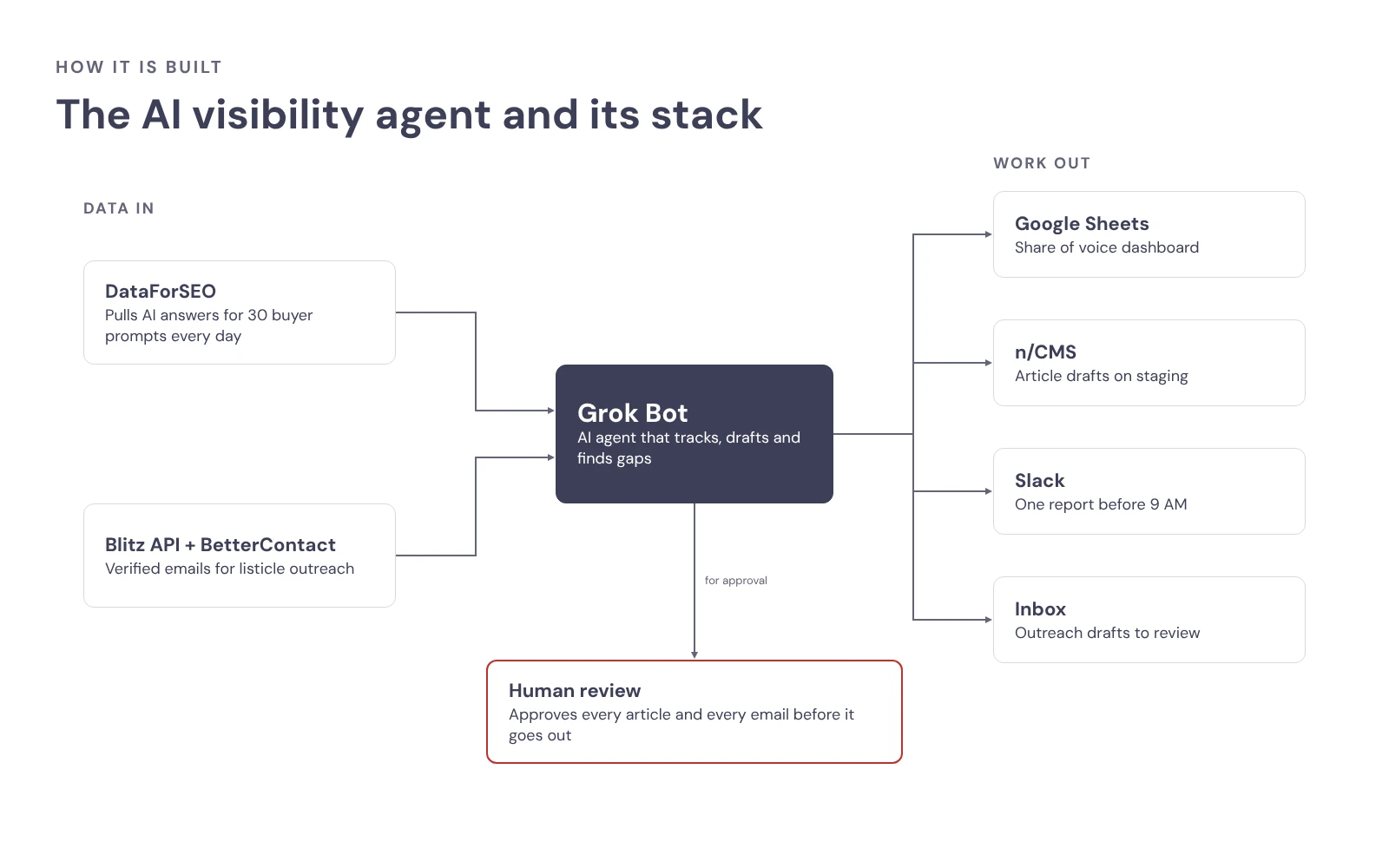
The website piece matters more than it looks. An agent can only draft articles if it can write to your site safely. That is why we moved off Webflow to n/CMS, where every change waits on staging until someone approves it.
This is also what separates the setup from most AI visibility tools. They give you a dashboard and a list of recommendations. This agent does the work. It could do 100% of it. We keep the last 1% with a human on purpose, to check that the content matches our expertise and that every outreach message says what we want to say.
How the daily AI search optimization loop works
The loop runs on a schedule, every day, in the same order. Here is each step and how to copy it.
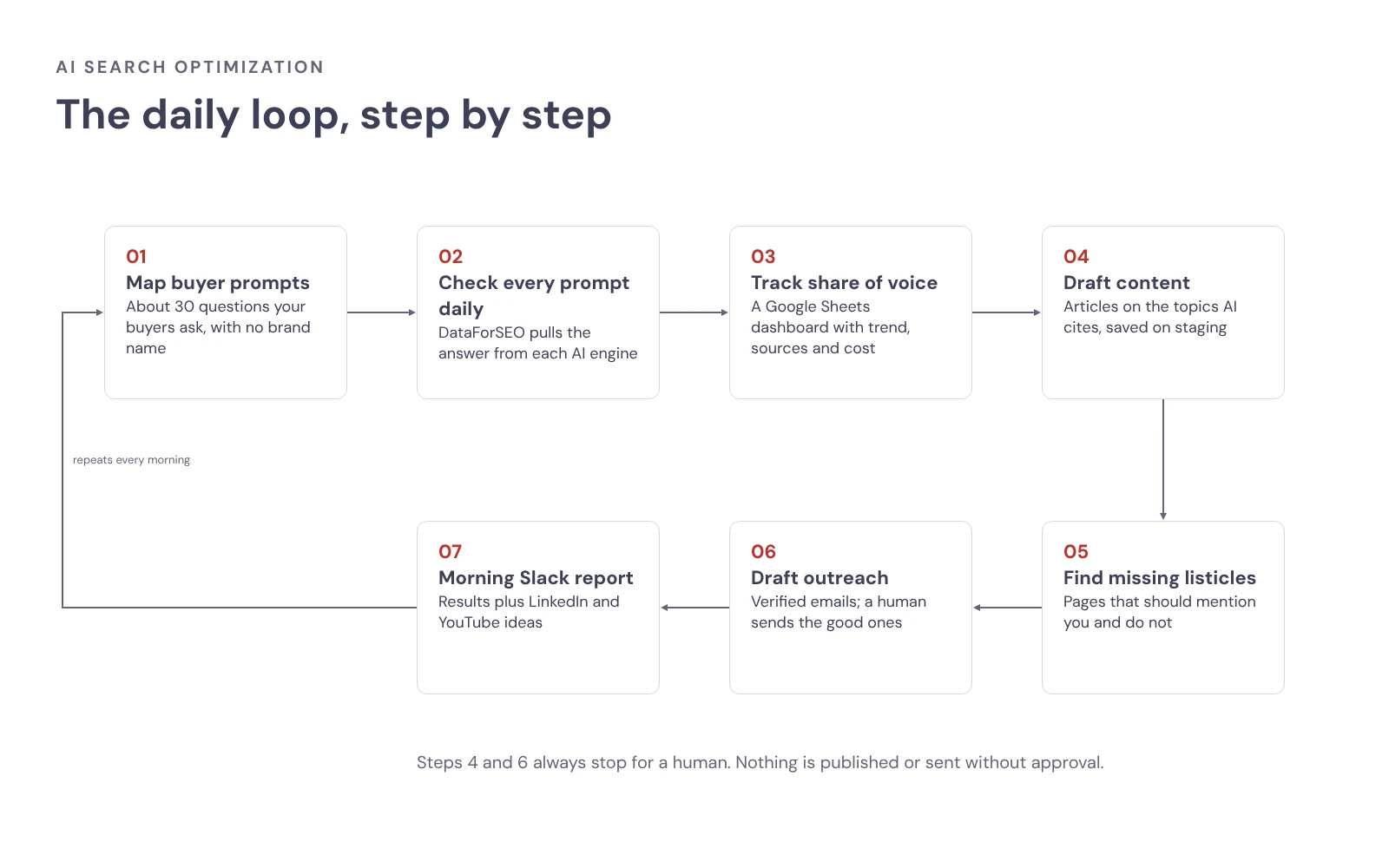
Step 1. Map the prompts your buyers actually ask
We mapped about 30 buyer prompts: questions we believe our ICP asks ChatGPT, AI Overviews, Perplexity and Claude every day. Leave your brand name out of them. If you only ask "Is [your brand] any good?", you will always show up, and you learn nothing.
Good prompts cover:
- "Best" and "top" questions in your category
- How-to questions your service answers
- Comparisons and alternatives
- Cost and "is it worth it" questions
Keep the list fixed. AI visibility tracking only works when you ask the same questions over time.
Step 2. Check every prompt every day
Grok Bot calls DataForSEO every day with a single endpoint and gets all the answers back. That shows how many times we appear for each prompt, on each engine. Daily matters because AI answers change often. A weekly check misses most of the movement.
Step 3. Track share of voice in one dashboard
The agent built a Google Sheet that works as our dashboard. Share of voice is how often you are named compared with competitors across all tracked prompts. It is the clearest single number for AI brand visibility.
| Tab | What it shows |
|---|---|
| Visibility | How many answers mention us, and the trend over time |
| Sources | Which pages and domains AI engines cite |
| Cost | What the system spends to run |
| Prompts and daily log | Every tracked prompt and what changed each day |
| Keyword gaps and drafts | Topics to cover and the articles already drafted |
| Ideas | LinkedIn post and YouTube video ideas |
Step 4. Draft content for the topics AI keeps citing
The agent looks at which topics keep coming up and are consistently cited, and from which sources. Then it drafts content to cover them. It works from detailed skills and guidelines we gave it, so it writes in our tone and with our expertise. It already has a lot of context on us.
Every draft lands on staging. Nothing is published until our team approves it.
This is the most practical answer we know to how to get cited by ChatGPT: publish the clear, well-structured page AI is already looking for, on a topic it already cites.
Step 5. Find the listicles where you are missing
AI engines lean on third-party "best of" lists. So the agent also surfaces every website and listicle where our brand name is not present and should be. That list tells us exactly who to reach out to and where our name belongs.
Step 6. Draft outreach a human approves
For each gap, the agent drafts an email. Blitz API and BetterContact supply verified contact details. The drafts sit in Stan's inbox. He reviews them every morning and sends the ones that are good enough, which is about 98% of them.
The ask is simple: would you include frontBrick in your article or listicle, wherever it is most relevant. Sometimes we are already included and ask to expand the mention. In one reply, the editor said they were happy to update the article.
On average we send 5 to 8 messages a day and get 2 or 3 replies a day from people who want to work with us on content.
Step 7. Get one Slack report before 9 AM
Everything lands in one Slack message every morning before 9 AM, with the same structure each day: AI visibility, new drafts, outreach, spend and organic traffic from Google Search Console.
It also brings two bonus lists: ideas for LinkedIn posts and ideas for YouTube videos. Each idea is based on content AI engines actually cite, with the reasoning for why it was picked. YouTube is one of the top sources in Google AI Overviews, so video feeds AI visibility directly. The video at the end of this article came from that list.
Example: an article the agent drafted
One of the agent's drafts became our guide to the 10 best B2B sales agencies in 2026. The agent:
- Designed the cover image
- Wrote the article and formatted it with tables, internal links and external links
- Built a genuine comparison table of agencies that fit the criteria, not one of those lists where the author sits at number one next to agencies that do not fit
- Took screenshots of each agency's homepage
It sat on staging until our team approved it. About 95% of a draft is right the first time. The team still adds a few touches every time, so it says exactly what we want it to say.
That is the right split. The agent does the research and the heavy lifting. People add judgment and the details only we know.
How AI engines choose what to cite
When we asked ChatGPT and Gemini how they pick sources, both gave a similar answer. In plain English, here is what they reward and where our loop covers it:
| What AI engines reward | Where the loop covers it |
|---|---|
| Pages that answer the exact question asked | Step 1 prompts and Step 4 content |
| Answers that are easy to lift: answer first, short chunks, tables | Step 4 writing guidelines |
| Trusted third-party sources that agree about you | Steps 5 and 6, listicle outreach |
| Fresh content on what people ask about now | Steps 2 and 4, run daily |
| Pages their crawlers can actually reach | A website built for it (n/CMS) |
The platforms say much the same. Google's guide on optimizing for generative AI features in Search says SEO best practices still apply, because those features run on its core ranking systems. OpenAI's crawler documentation explains that sites blocking OAI-SearchBot will not appear in ChatGPT search answers. And the original GEO research paper found that the right content changes can boost visibility in generative engine answers by up to 40%.
So how do you rank in ChatGPT? You do not rank in a list of links. You become the source that keeps getting picked, on your own site and on the sites AI already trusts.
AI visibility tools vs an agent workflow vs an agency
There are three ways to do AI search optimization. Here is how they compare.
| AI visibility tools | Agent workflow (ours) | AI search optimization agency | |
|---|---|---|---|
| What you get | Dashboards, tracking and recommendations | Tracking plus drafted content, a gap list and drafted outreach | Strategy and execution by a team |
| Who does the work | Your team | The agent, with a human approving | The agency |
| Cost | A monthly software subscription | A fraction of tool cost, mostly data and API fees | About $2,000 to $12,000 a month, based on what ChatGPT and Gemini quote |
| Best for | Teams with people free to act on the data | Teams that want the work done daily without new hires | Teams that want it fully done for them |
Most AI visibility tools stop at the recommendation. That leaves the hard part, doing the work, with you. Our agent tracks and then acts. The dashboard even tracks what we spend, and it is a fraction of what those tools cost.
The honest trade-off: an AI SEO agent like this takes real GTM engineering to build. Someone has to connect the data, write the skills and guidelines, and set the review gates.
Where humans stay in the loop
The agent does about 99% of the work. The last 1% stays with us on purpose.
| The agent does | A human does |
|---|---|
| Checks prompts and tracks visibility | Decides which buyer prompts matter |
| Drafts articles on staging | Approves them and adds the final touches |
| Finds missing listicles and drafts emails | Reviews and sends each email |
| Sends the daily report and content ideas | Chooses which ideas become posts and videos |
Why keep a human in the loop? AI cannot yet judge whether a piece truly reflects your expertise. And outreach goes out under your name, so every message needs to sound like you.
How to start your own AI search optimization workflow
You do not need the whole system on day one. Build it in this order:
| Week | Build | Done when |
|---|---|---|
| 1 | Write 20 to 30 buyer prompts without your brand name | The list is fixed and agreed |
| 1 | Run them on ChatGPT, Gemini, Perplexity and AI Overviews | You have a baseline of mentions |
| 2 | Automate the daily check and log results in a sheet | The sheet updates every day without you |
| 2 | Add share of voice and cited sources | You can see who AI names instead of you |
| 3 | Draft one article for your biggest content gap | It is approved and live |
| 3 | List the listicles that cite competitors but not you | You have your first outreach targets |
| 4 | Draft outreach with verified emails, review it, send it | A few good emails go out every day |
| 4 | Send one daily summary to Slack | The team reads it every morning |
For the agent side, see how we connect Clay and Grok Bot for outbound. The same pattern works here: data in, the agent drafts, a human approves.
Watch the full walkthrough
In this video, Stan walks through the agent, the dashboard, an article draft and real outreach replies.
Watch: GTM Engineering for Inbound: My AI Visibility Workflow
Frequently asked questions
What is AI search optimization?
AI search optimization is the work of getting your brand mentioned and cited in answers from ChatGPT, Perplexity, Gemini, Claude and Google AI Overviews. It is also called GEO or AEO.
How do I get my company mentioned in ChatGPT?
Make sure ChatGPT's crawler can reach your site. Publish clear, answer-first pages on the questions your buyers ask. Then get included in the third-party lists ChatGPT already cites. Track a fixed set of prompts so you can see what works.
How do I track AI visibility?
Pick 20 to 50 buyer prompts without your brand name. Check them on each AI engine on a schedule, and record mentions, citations and share of voice. You can use an AI visibility tool, or automate it with an API like DataForSEO, as we do.
How much does AI search optimization cost?
When we asked ChatGPT and Gemini, they put agency retainers at about $2,000 to $12,000 a month. Running your own agent workflow costs much less in data and API fees, but it takes GTM engineering time to build.
Can you automate AI search optimization with AI agents?
Yes. Our agent tracks prompts daily, drafts articles, finds missing listicles and drafts outreach. A human still approves every article and email before anything goes out.
Is GEO the same as AEO?
In practice, yes. Generative engine optimization (GEO), answer engine optimization (AEO) and AI search optimization all describe getting your brand into AI-generated answers.
Get an AI visibility workflow built for your team
We build GTM workflows like this one for B2B teams every day, for inbound and outbound. AI visibility work has also been part of client builds such as Prediction Guard and Skale.
If you want this system, or a workflow for a different use case, see our fractional GTM engineering service or book a call. We will map out what your team needs and how to build it.
What Is a GTM Engineer? Role, Skills and When to Hire One
What a GTM engineer does, the skills to hire for, and when to hire full time vs fractional.
 Stan Stojanovic
How to Evaluate a Clay Agency: 5 Questions to Ask
Evaluate a Clay agency with five practical questions on strategy, workflows, certification, ownership and AI agents. Includes a partner checklist.
Stan Stojanovic
11 Best Clay Agencies in 2026: Pricing, Proof and Fit
Compare the 11 Clay agencies buyers shortlist most in 2026, with delivery model, published pricing, attributed proof and who each firm fits.
Stan Stojanovic
9 Best GTM Engineering Agencies in 2026: Pricing, Proof and Fit
Compare 9 GTM engineering agencies in 2026 on what each builds, published pricing, attributed proof and what you keep when the engagement ends.
Stan Stojanovic
10 Best Go to Market Consulting Firms in 2026: Pricing, Proof and Fit
Compare 10 go to market consulting firms in 2026 on what each one delivers, published pricing, attributed proof and which B2B teams each firm fits.
Stan Stojanovic
Clay Lead Generation: Automate Outbound with Grok Bot
A practical Clay + Grok Bot workflow for finding companies, qualifying decision-makers, personalizing outreach, and reviewing interested replies.
Stan Stojanovic
B2B Data Enrichment with Clay: A Practical Workflow
Build useful B2B records with Clay: qualify accounts, research evidence, validate contact data, control costs, and evaluate implementation partners.
 Petar Stojadinovic