

Back to Resources
How to Build an Outbound Sales Team in 2026
Author
Jovana Stojanović
Date
January 26, 2024
Read time
10
min.



Last updated: September 29, 2026
An outbound sales team proactively identifies potential customers, starts relevant conversations, and develops qualified opportunities for the business. Building one requires more than hiring an SDR and buying a prospecting tool. Someone must own targeting, research, outreach, qualification, follow-up, and the systems connecting those activities.
Start by defining the audience and offer, then assign responsibilities, choose an internal or agency delivery model, and test the complete process with a manageable campaign. Expand when the team can produce and progress useful sales conversations, not simply when it can send more messages.
This guide covers team structure, hiring, onboarding, AI-supported research, and the measurements needed to decide what to improve next.
Define the job before deciding who to hire
Your first planning document should describe the sales problem you are solving. “We need more leads” leaves too much undefined.
Specify the companies you can help, the people involved in buying, the problem your offer addresses, and the evidence that supports it. Include exclusions such as existing customers, active opportunities, unsuitable markets, and people who have opted out.
Then describe the handoff you need. Are you looking for researched accounts, interested conversations, held qualified meetings, or opportunities accepted by a closer? Those outcomes require different amounts of work.
For example, a founder who can run discovery calls but cannot maintain consistent prospecting has a different staffing need from a sales director whose representatives book meetings that rarely qualify. The first may need execution capacity. The second needs to inspect targeting, qualification, and handoff quality before adding capacity.
Give each part of the outbound process a clear owner
Job titles vary between companies. SDR and BDR can describe different scopes, so define the work rather than relying on the title alone. Salesforce's overview of sales roles distinguishes prospecting roles, account executives, sales leadership, and sales operations.
A practical ownership map might look like this:
| Responsibility | Accountable owner | Expected output |
|---|---|---|
| Audience and offer | Founder or sales leader | Targeting criteria and a credible campaign hypothesis |
| Research and data quality | Researcher, SDR, or operations specialist | Reviewed accounts, contacts, and supporting evidence |
| Initial outreach and replies | SDR or campaign operator | Relevant conversations with clear next steps |
| Discovery and opportunity acceptance | Account executive or founder | Qualified opportunities and recorded reasons for rejection |
| Infrastructure and workflow maintenance | Sales operations or GTM specialist | Reliable data flow, suppression, monitoring, and reporting |
| Coaching and improvement | Sales leader | Feedback that changes execution |
These responsibilities do not require six separate employees. In a small team, one person may cover several functions. What matters is that no task falls between roles and no person is expected to do more than the available time permits.

AEs may also prospect, particularly in smaller teams or named-account selling. The split should reflect your sales motion. The ownership map is more useful than a rigid rule that one title can only book meetings and another can only close them.
Choose between an internal team, an agency, and a hybrid model
There is no universally cheapest or fastest model. Compare the complete scope, the management work required, and what your company needs to retain.
| Model | Consider it when | Management requirement | Main tradeoff to examine |
|---|---|---|---|
| Internal outbound team | You want the capability embedded in the company and can coach it | Recruiting, onboarding, tools, supervision, and ongoing development | Control and retained learning versus the commitment required to build the function |
| Managed agency | You need defined execution capabilities that you cannot currently operate consistently | A clear brief, timely feedback, and an internal sales owner | Available expertise versus dependence on the provider's scope and process |
| Hybrid | You want to retain discovery and customer knowledge while delegating selected work | Explicit ownership and shared records across both teams | Flexible specialization versus more handoffs to coordinate |
A hybrid arrangement could put account research and campaign operations with an agency while an internal founder or AE owns discovery and closing. Alternatively, an internal SDR team could use an external specialist to improve data workflows.
Compare costs over the same period and for the same deliverables. Include compensation or agency fees, recruiting, management time, onboarding, software, data, and implementation. Do not compare an agency's full service fee with only an employee's base salary.
If cold email execution is the gap, review the scope of a cold email agency. If the campaign also needs a presence and conversation process on LinkedIn, define the role of LinkedIn lead generation separately. Confirm which work is included instead of assuming every provider covers every channel.
Hire for judgment, communication, and follow-through
A useful hiring exercise resembles the work without becoming an unpaid campaign. Give candidates a small fictional brief or a sanitized example and ask them to explain their decisions.
For an SDR, review how they select an account, check the contact's relevance, write a concise opening message, and respond to an ambiguous reply. Ask what they would exclude and what they still need to learn.
For a workflow specialist, ask how they would handle a duplicate record, missing data, a failed integration, and an opt-out. A successful demonstration should include failure handling as well as the ideal path.
Use a consistent scorecard:
- Can they explain why an account fits the offer?
- Do they separate observed facts from assumptions?
- Can they ask a useful question and listen to the answer?
- Do they keep records that another person can act on?
- Can they revise their approach when given feedback?
Onboard around readiness, not a calendar promise
Use milestones to decide when someone is ready to work independently. The pace depends on the complexity of your market, product, and sales process.
Understand the customer and offer
Review the product, the situations it fits, its limitations, and the evidence behind your claims. Listen to real customer or sales conversations where permission and access allow. Ask the new team member to explain the offer in their own words.
Practice targeting and messaging
Have them review a small account sample, justify inclusion and exclusion, and draft messages for distinct situations. Correct misunderstandings before expanding the audience. Practice common objections and unclear replies without encouraging invented answers.
Test the operational handoff
Create a test record and move it through research, approval, outreach status, response, booking, and opportunity review. Confirm that an opt-out stops future contact and that an existing opportunity cannot accidentally reenter prospecting.
Launch with supervision
Start with a manageable campaign and review actual work. Use the first conversations to refine qualification, not just the message. Expand responsibility when the person can execute reliably and recognize situations that need help.
Give AI and Clay a defined support role
AI can help organize research, classify records, and prepare drafts. It should not be treated as evidence that an account qualifies or that a person is ready to buy.
Clay's enrichment documentation describes adding company or contact information and controlling when enrichments run. In an outbound sales team, that can support a repeatable research process around the audience your team has defined.
A sensible division of work is:
| AI or workflow support | Human responsibility |
|---|---|
| Gather and structure company information | Verify the source and decide whether it supports account fit |
| Draft a research summary | Check accuracy and remove unsupported inferences |
| Suggest message variations | Approve the claim, tone, and relevance |
| Route records using explicit rules | Set the rules and handle exceptions |
| Summarize a conversation | Confirm the meaning and own the next step |
Keep source links and review dates with important research. If the data is missing, mark it as unknown. A recent hiring announcement may justify further research, but it does not prove that a company needs your service.
Our Clay consulting service supports research, enrichment, and workflow implementation. That work complements sales judgment and conversations rather than replacing them.
Build the workflow around one shared record
Before adding tools, decide where the authoritative account and contact status will live. Your CRM should make the owner, latest conversation, qualification, and next action clear.
An operating workflow needs a way to research prospects, manage approved outreach, handle responses, preserve exclusions, and report sales progression. Choose tools around those tasks and their integration requirements.
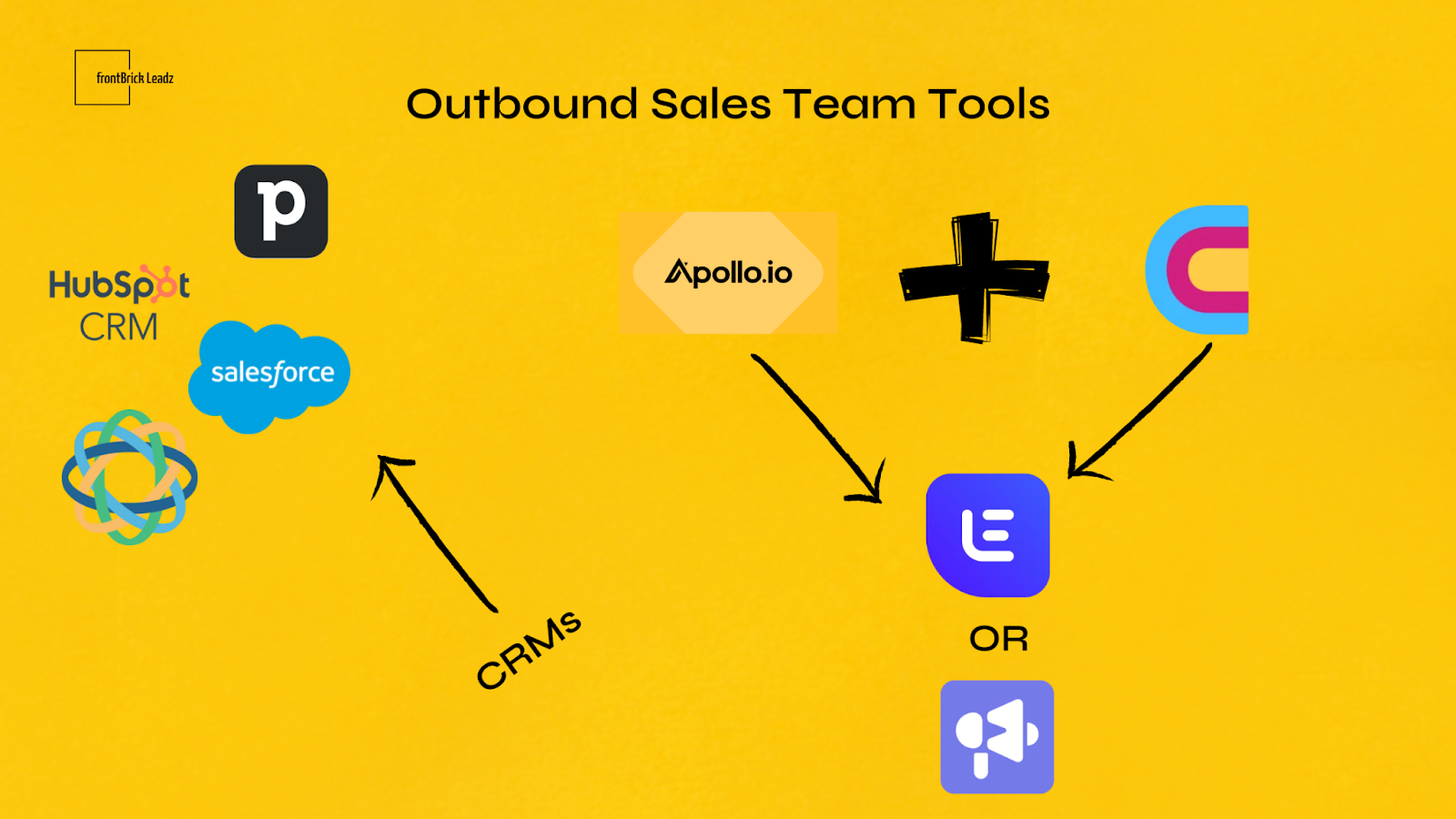
Test the connections that matter. Can a prospect who replies be removed from later outreach? Can an AE see why the meeting was booked? Can an operations owner identify a failed update? Can the company retain records and workflow documentation if a provider changes?
Define qualification before launching outreach
Agree what makes a meeting useful to the sales team. At minimum, specify account fit, the relevant person's involvement, the stated reason for the conversation, and any disqualifying conditions.
A handoff note should capture:
- Who the prospect is and why the account fits.
- What the prospect actually said about the problem.
- What was promised or sent during the conversation.
- The purpose of the scheduled meeting.
- Open questions and the next owner.
The closer should return feedback on rejected opportunities. “Bad lead” is not actionable. “Outside our target geography” or “Asked only for a free resource and did not request a sales discussion” can improve future selection and messaging.
Measure the outbound sales team through the full funnel
Activity measures help identify capacity and execution issues. They are not sufficient evidence of pipeline quality.
| Measure | Definition | Use it to examine |
|---|---|---|
| Positive conversations | Relevant interest under a shared definition | Audience and offer fit |
| Held qualified meetings | Attended meetings meeting agreed criteria | Whether prospecting creates useful sales conversations |
| Meeting-to-opportunity rate | Accepted opportunities divided by held qualified meetings | Qualification and discovery quality |
| Cost per accepted opportunity | Relevant outbound costs divided by accepted opportunities | Efficiency beyond bookings |
| Opportunity-to-customer rate | Won customers divided by accepted opportunities in the same mature cohort | Commercial conversion |
| Sales cycle | Time between consistently defined sales stages | How opportunities progress |
Use campaign cohorts and consistent dates. Recent opportunities may not have had time to close, so comparing them directly with older campaigns can mislead. Record reasons for lost or rejected opportunities as well as totals.
When results weaken, investigate the stage that changed. Few conversations may point to targeting, reach, or message relevance. Meetings that rarely become opportunities call for a qualification review. Accepted opportunities that stall need closer examination of discovery, fit, and the buying process.
Frequently asked questions
How many people does an outbound sales team need?
There is no universal headcount. Start with the responsibilities and capacity required to run a complete campaign and handle the resulting conversations. One person may cover several functions initially, with specialist support added where work is bottlenecked.
Should I hire an SDR or an outbound agency first?
Hire internally when you can define, manage, and coach the role. Evaluate an agency when specific execution capabilities are missing. In either case, your company needs to supply customer knowledge, approve the offer, and own sales follow-through.
Can AI replace an outbound sales team?
AI can support defined research and workflow tasks. Your operating plan still needs accountable owners for claims, qualification, customer conversations, exceptions, and commercial decisions. Evaluate automation by the work it performs reliably, not by a replacement promise.
What should an agency hand over if we stop working together?
Agree this before starting. Specify access ownership, account and contact data, suppression records, conversation context, campaign assets, reporting, and workflow documentation. Check the contract and any platform constraints governing export or transfer.
Start with ownership and a complete pilot
Choose one audience and offer, assign each responsibility, and test the whole path from research to accepted opportunity. Use the evidence to decide whether the next investment should be a hire, a specialist, or a process correction.
If your team needs help operating the prospecting and campaign layer, explore frontBrick's cold email lead generation service. Bring your audience, current process, and sales capacity so the scope addresses the work you actually need done.
Book Your Strategy Call Today
Want to see how frontBrick can help you generate qualified leads and fill your pipeline fast? Book your free strategy call now.
Book Strategy Call
Related Resources
See All Resources