


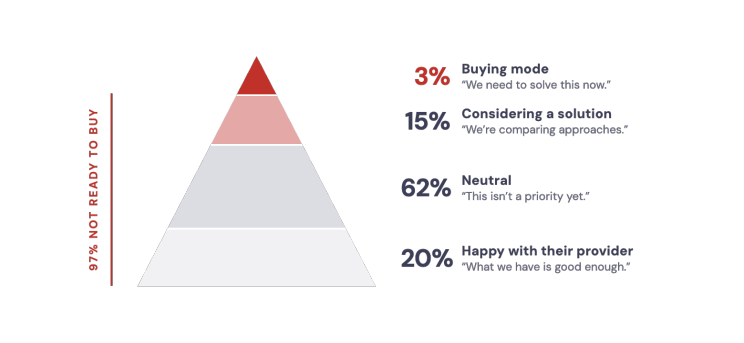
Most of your ABM list is not actively shopping. In our planning model, 3% is in buying mode, 15% is considering a solution, 62% is neutral, and 20% is happy with its current provider. These are workshop benchmarks, not a measured distribution for every market. A direct pitch treats all 100 accounts as if they have the same reason to respond. They do not.
TL;DR
- In our planning model, 3% of the ABM list is in buying mode at a given moment.
- Another 15% in the model is considering a solution, but is not ready for a sales conversation.
- The remaining 82% in the model needs useful context, proof, and repeated exposure before a direct pitch becomes relevant.
- The Pain Triangle® turns those buying states into a content and activation plan.
- The Content Engine® maps Awareness, Consideration, and Conversion content to the right account segment.
- We use LinkedIn content, LinkedIn Ads, Clay, and outbound as one account-level system, not as isolated channels.
- Each channel gets a specific job
- Measure account movement and pipeline, rather than activity volume alone.
The answer is not to abandon the 97%. The answer is to give each segment a different next step. Buying-mode accounts need a clear path to a conversation. Considering accounts need proof and a practical way to compare options. Neutral accounts need to recognize the problem before they evaluate a vendor. Happy accounts need a reason to reconsider the status quo.
This is the operating logic behind our account-based marketing work at frontBrick. We build the account list first, then match the message to the account's current state.
What is the Pain Triangle® in account-based marketing?
ABM segmentation means grouping target accounts so their context changes the content, outreach and next step they receive. The Pain Triangle adds buying readiness to the fit and value decisions in your ICP research. A high-fit account can still be neutral about buying.
The Pain Triangle® is a frontBrick framework for separating target accounts by buying readiness. It prevents the common mistake of sending conversion content to accounts that first need education, evidence, or a reason to change. The percentages are planning benchmarks from our ABM Engine workshop deck, not a promise about every market.
What the Pain Triangle® actually controls
The percentages are planning benchmarks, not a claim that every market has the same distribution. Their job is to force a better operating decision: what does this account need next, based on the evidence we have now?
Treat each assignment as a hypothesis. Store the signal that supports it, such as a comment, a post, a CRM note, a hiring event, or a change in account activity, and update the state when stronger evidence appears. Our buying signals guide shows how to look for changes that justify a different next step.
Buying mode: 3%
The account is saying, “We need to solve this now.” It needs a clear, low-friction path to action: a focused audit, a scoped implementation conversation, or a plan with inputs, outputs, and timing. Content supports the decision, but coordination matters more: confirm fit, check the CRM, identify the buying committee, and give the seller a specific reason to reach out.
Considering a solution: 15%
The account knows the problem and is comparing approaches. It needs proof, process, tradeoffs, failure modes, and implementation detail. The best content helps the buyer evaluate without forcing a sales conversation too early.
Neutral: 62%
The account is saying, “This is not a priority yet.” It needs to recognize the operational cost of the problem before it evaluates a provider. Use practical, low-friction, non-gated content distributed through LinkedIn Ads to the named audience. Make one failure visible: stale data, a broken handoff, a list with no validation owner, or a workflow that cannot route the right person at the right time.
Happy with the current provider: 20%
This is not a bad account. It is an account with a high switching threshold. Reconsideration begins when something changes: new leadership, a new region, a hiring plan, a product launch, a coverage gap, or a data-quality failure. The content should demonstrate a meaningful gap or a better operating model. It should not pretend the incumbent relationship does not exist.
The six-station LinkedIn ABM workflow
A static segmentation exercise does not create pipeline. The system has to keep finding evidence, applying the same judgment, warming the right people, reading the response, and feeding that response back into the next cycle.
At frontBrick, LinkedIn lead generation runs as six connected stations. Leads enter through social monitoring, and nothing truly ends. Engagement from the last station creates new people and signals at the first. The model below is a LinkedIn-focused implementation; our multi-channel ABM workflow shows how the same account context can coordinate a broader campaign.
1. Source from social monitoring
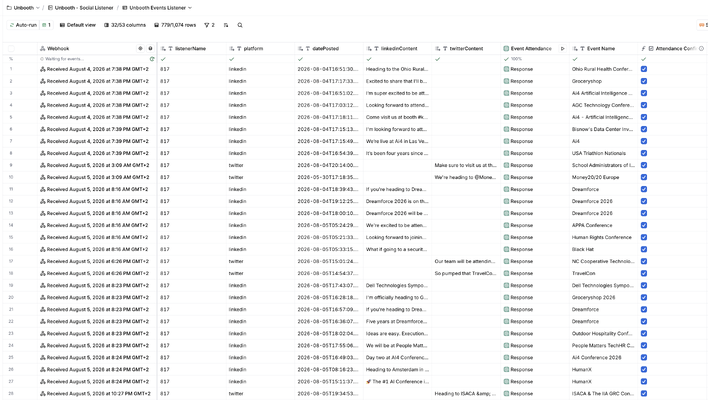
Apify monitors LinkedIn activity throughout the day and passes fresh signals to Clay . We look for comments and reactions on our posts and relevant competitor posts, posts from ICP profiles that match our keywords, and activity around events or webinars.
This changes the starting question from “Who exists in the market?” to “Who is showing relevant behavior this week?” The market tells us where attention is forming.
2. Score every signal with one standard
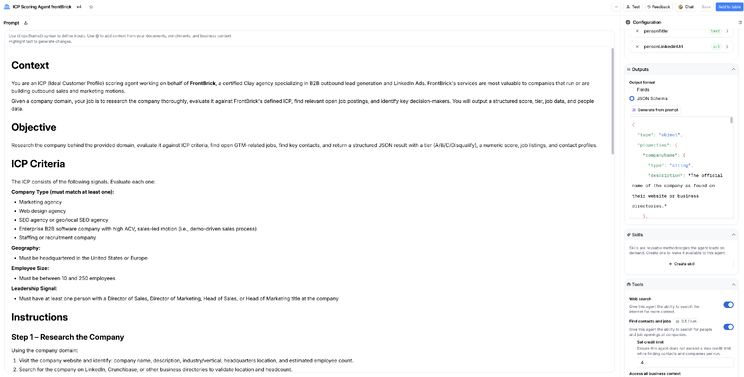
Every source goes through the same scoring agent in Clay. A comment, a reaction, and a webinar post do not receive different standards. The output includes a 1–100 fit score, a Tier A/B/C classification or disqualification, the contact, a short analyst summary, and a recommended next action.
One scoring agent creates a common bar. It prevents source-specific enthusiasm from turning a weak signal into a sales handoff.
3. Maintain one active CRM segment
Qualified people are added to one active HubSpot list. As a working rule, people scoring 80+ enter the segment, with Tier A and B prioritized. The list is additive by design: someone sourced in week one can still be in the audience in week nine, with the score and tier updated in place.
We supplement the segment; we do not rebuild it every time we publish a post or launch an ad. That continuity is what makes the system compound.
4. Warm the same people with ads and invitations
The HubSpot segment becomes the source for a LinkedIn Ads matched audience, while HeyReach sends connection invitations to the same eligible people. Audience matching is not guaranteed for every contact. The profile they see in the feed is the profile that appears in their invitations.
There is no direct-message sequence yet. First we earn recognition and a reply surface. Ads and invitations are coordinated around one account list, one message, and one buying-state hypothesis.
5. Read engagement before sending anything
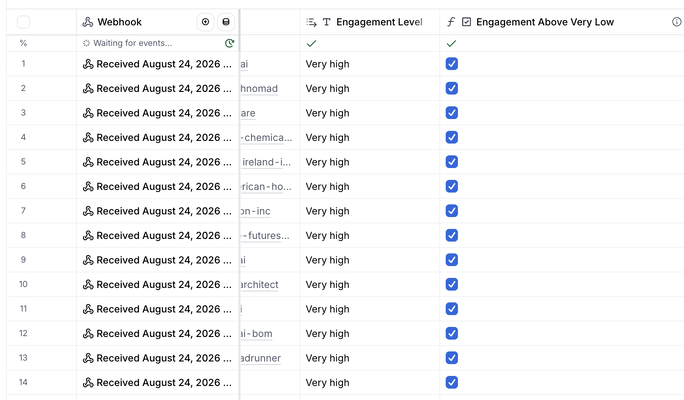
Organic and paid LinkedIn engagement syncs back to Clay. The system ranks who is warm and also surfaces engagers who were not already in the segment.
This is the compounding step. Attention we paid for once becomes a sourcing signal. A new engager re-enters the scoring process instead of disappearing into an analytics dashboard.
6. Run outbound with the most engaged people first
HeyReach direct messages are sequenced by engagement rank. The warmest prospects go first. People who engaged but were never sourced return to station one, where they are scored before outreach.
The motion stays focused on LinkedIn. There is no email layer added merely to increase volume. One channel, operated with shared context and disciplined timing, is more useful than several disconnected sequences.
What makes the loop compound
The loop becomes denser because every station improves the next one:
- Social monitoring finds real behavior instead of relying only on a static list.
- A common scoring standard protects the segment from weak-fit activity.
- The additive CRM audience preserves learning over time.
- Ads and invitations create repeated recognition among the same people.
- Engagement changes ranking and reveals people we did not source initially.
- Outbound outcomes create new evidence for scoring, segmentation, and future content.
The list is not a campaign input that expires. It is a living audience with memory.
How content changes by buying state
The Content Engine® answers the question an account is already asking. It does not publish random formats and hope that one of them lands.
Awareness content for neutral accounts
Answer: “Why is this problem worth fixing?” Use short LinkedIn posts, carousels, research breakdowns, and founder points of view. Name a specific operational cost. A strong example is “Why your outbound list decays before the first send.” The goal is recognition, not a meeting.
Consideration content for evaluating accounts
Answer: “How would this work in our team?” Use playbooks, process diagrams, teardown posts, comparison guides, and proof-led case studies. Show the checks, data handoffs, tradeoffs, and failure points. The goal is to help the buyer compare approaches.
Conversion content for buying-mode accounts
Answer: “Why should we choose this approach now?” Use an audit, workshop, implementation plan, or case study tied to a direct next step. The goal is to remove the final risk from starting a conversation.
Reconsideration content for happy accounts
Answer: “What changed enough to justify switching?” Use a benchmark, competitive analysis, trigger-led message, or migration plan. The goal is to make the cost of staying put visible without manufacturing urgency.
Build chains, not isolated posts
A neutral account may first see a problem-framing post, then engage with a process breakdown, then receive a case study after its behavior changes. A direct call to action appears only when the evidence supports it.
Build the conversion asset first. If you cannot explain what a qualified account should do next, the awareness idea is probably too broad. Then work backward:
- Awareness names the cost of the problem with a concrete example.
- Consideration shows the workflow, decision criteria, and failure points.
- Conversion offers a review, audit, or implementation conversation tied to the same problem.
One long-form article can supply the chain: a carousel, several founder posts, an ad sequence, a sales-enablement note, and the message context for warm outbound.
One signal is not buying intent
A like is evidence of attention, not evidence of budget. The system keeps the original signal, timestamp, source URL, score, classification, and CRM context so a seller can understand why an account was routed.
A useful handoff does not say, “This person liked our post.” It includes the account, the person, the exact content, the relevant trigger, the current buying-state hypothesis, the CRM status, and a suggested question.
Example: Northstar Software · VP Revenue commented on a post about stale outbound data · the company is hiring two SDRs · no open opportunity · suggested question: “How are you checking whether new contacts are safe to route into sequences?”
That gives the seller a reason to start a conversation without pretending one interaction equals purchase intent.
The weekly operating rhythm
- Review new LinkedIn signals collected by Apify.
- Run every new person through the same Clay scoring agent.
- Add or update qualified people in the active HubSpot segment.
- Refresh the LinkedIn Ads audience and coordinate HeyReach invitations.
- Sync organic and paid engagement back to Clay and update the rank.
- Start HeyReach messages with the warmest qualified people.
- Return new engagers and outbound outcomes to the top of the loop.
The system should preserve history. When a score, tier, or buying-state label changes, store the prior value and the signal that caused the change. A weekly review works for active programs; the important part is that no label changes without evidence.
What to measure
Measure account movement and pipeline, not activity volume alone.
Reach: target-account reach, frequency, and persona coverage. This tells you whether the right audience saw the message.
Attention: repeat engagement, comments, profile visits, and return visits. This tells you whether the problem is becoming relevant.
Qualification: signal type, account fit, persona seniority, score, tier, and CRM status. This tells you whether engagement deserves action.
Activation: positive replies, qualified conversations, meetings, and opportunities created. This tells you whether the message produced a next step.
Economics: cost per qualified account, pipeline created, and revenue influenced. This tells you whether the program deserves more budget.
For each cohort, record the starting state before distribution. Then measure which accounts gained a new signal, which entered a conversation, which moved into or out of a buying state, and which remained neutral. The goal is not to force every account forward. It is to see where the system works and where the message or routing logic is wrong.
Common failure modes
- Starting from a scraped TAM list and treating existence as intent.
- Using a different scoring standard for each signal source.
- Rebuilding lists for every campaign and discarding prior learning.
- Advertising to one audience while sending invitations or messages to another.
- Launching direct messages before the account has any context.
- Sending sellers raw activity alerts with no account, trigger, or suggested question.
- Calling one click buying intent.
- Adding more channels before the LinkedIn loop works end to end.
- Measuring impressions, clicks, or message volume without account movement and pipeline.
Frequently asked questions
Is the Pain Triangle® a funnel?
No. It is a state model. An account can move from neutral to considering, return to neutral, enter buying mode after a trigger, or become happy after choosing another provider. The system must preserve those changes and the evidence behind them.
Do we create different content for every account?
No. Start with a shared problem for a meaningful segment, then add account-specific context when the signal and account value justify it. One-to-one content belongs with high-value accounts and active opportunities, not the whole market.
Why not send outbound as soon as someone engages?
Because engagement is only one input. Check fit, score, tier, persona, CRM status, and the nature of the signal first. The most engaged qualified people go first; weak-fit engagers can be nurtured or disqualified.
Can paid ads replace outreach?
No. Ads create repeated context. Invitations create familiarity. Outreach creates the direct conversation. Their power comes from using the same audience, problem, and signal history.
What is the first asset to build?
Build a short diagnosis of one operational problem for one segment. Then create the process breakdown and the conversion offer that follows it. If the diagnosis cannot guide the next two assets, narrow the cohort or the problem.
The operating principle
Your ABM list is not a queue of accounts waiting for the same pitch. It is a changing distribution of buying states.
The Pain Triangle® tells you what each state needs. The LinkedIn loop tells you how to keep learning: monitor behavior, score with one standard, maintain one audience, warm the same people, read engagement, start with the most engaged, and feed every outcome back into the system.
That is how the 97% stops being dead weight. It becomes the audience from which future demand is detected, developed, and activated.
Build the segmentation into your ABM system
We connect account research, Clay scoring, CRM audiences and outreach around the same buying-state evidence. Explore frontBrick’s ABM implementation if you want help putting this workflow to work in your team.
Originally published by Stan in The ABM Engineer on LinkedIn on August 31, 2026. Read the original article. Adapted for frontBrick with clearer benchmark context and links to the related guides.
Book Your Strategy Call Today
Want to see how frontBrick can help you generate qualified leads and fill your pipeline fast? Book your free strategy call now.
Book Strategy Call