


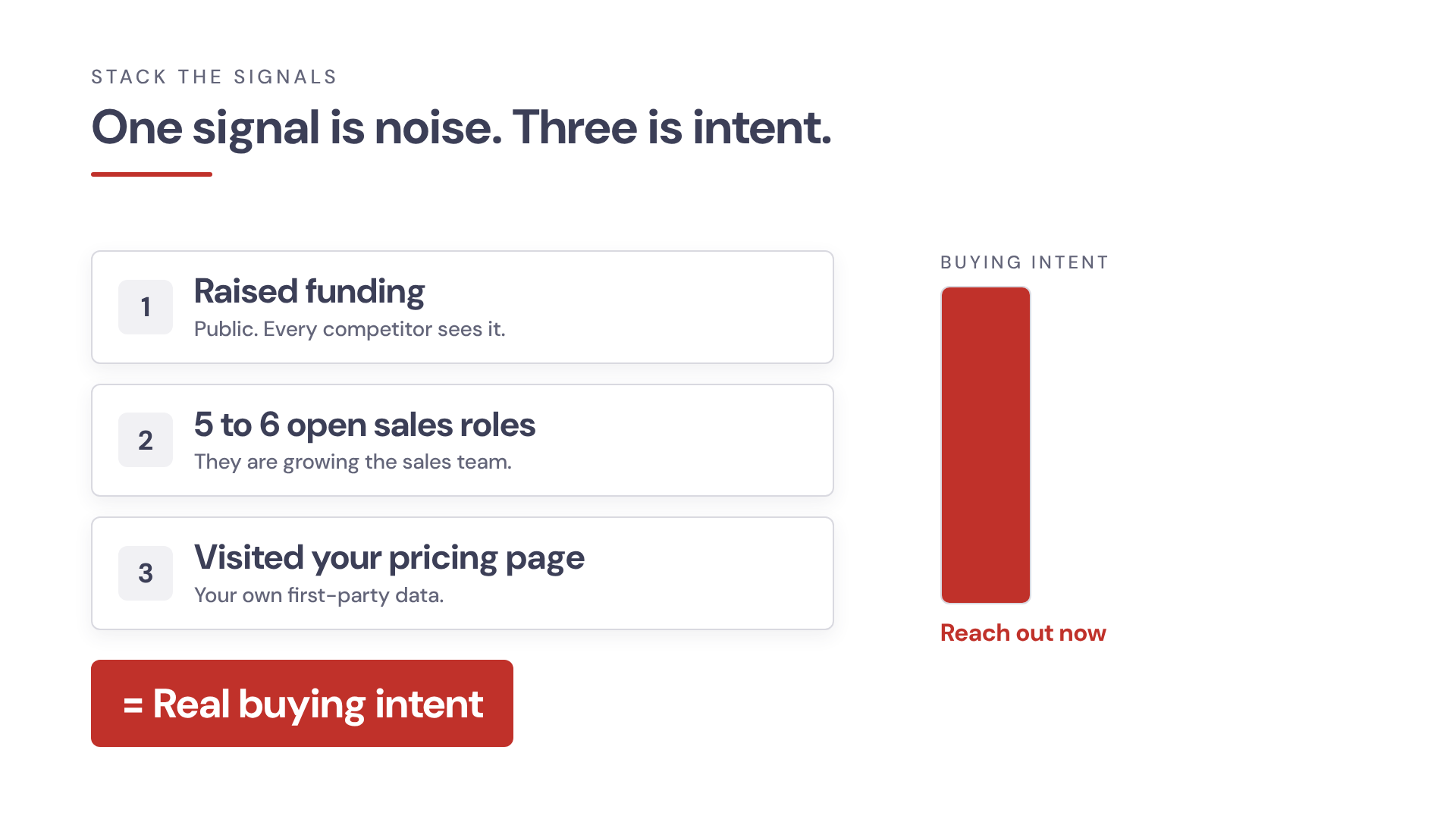
B2B buying signals are events that show a company may be ready to buy. Think funding, hiring, website visits, or a new leader joining. One signal on its own rarely means much. Real buying intent shows up when you stack two or three signals on the same account.
Here is a quick example. A company just raised money. Should you reach out? Maybe. But that funding round is public, so every sales team sees it too. Now picture the same company hiring 5 or 6 sales reps, and someone from it just visited your pricing page. That is a much stronger reason to reach out today.
Below, I rank 19 B2B buying signals from C tier to S tier and show how we monitor them in Clay so the system runs on its own. This ranking is built for companies that sell sales, marketing, or RevOps services. If you sell something else, the order may shift a little.
Free download: Get the full list of 19 buying signals, with where to get the data for each one.
Key takeaways
| Question | Short answer |
|---|---|
| What is the strongest buying signal? | A stack: website visit + headcount growth + recent funding on one account. |
| Best single signals? | Hiring for relevant roles, website visits, decision maker job changes, LinkedIn engagement. |
| Is funding a good signal? | Useful, but crowded. Never open with "congrats on your funding." |
| Should I mention the signal? | Only when it doesn't feel like spying. Never mention website visits or likes. |
| How many should I track? | Start with two or three. Add more once they work. |
What are buying signals in B2B sales?
A buying signal is any sign that a company has a problem you solve, at a moment when it is likely to care. A signal only matters if it connects to that problem. A funding round means nothing to you unless the money creates a need for what you sell.
It helps to split signals by what they tell you:
| Signal type | What it tells you | Examples |
|---|---|---|
| Fit signals | Who belongs on your list | Lookalikes, tech stack, industry |
| Timing signals | Something just changed | Funding, hiring, new leader, product launch |
| Intent signals | They are looking at you or your topic now | Website visits, ad engagement, topic intent |
The best accounts show all three. That is the whole idea behind signal based selling.
How do the buying signal tiers work?
| Tier | What it means | What to do |
|---|---|---|
| S | Two or three signals stacked on one account. Real buying intent. | Send to a sales rep right away, with a human in the loop |
| A | A strong reason to reach out, with good timing | Build a campaign around it |
| B | Something changed at the company | Research it, or pair it with another signal |
| C | Good for building a list, weak reason to reach out | Use it to pick who goes on the list |

List of 19 B2B buying signals, ranked
| # | Buying signal | Tier | Mention it in outreach? |
|---|---|---|---|
| 1 | Website visit + headcount growth + funding | S | No, lead with the problem |
| 2 | Website visit + sales team growth | S | Growth, yes. Visit, no. |
| 3 | Website visit + recent funding | S | No |
| 4 | Hiring for relevant roles | A | Yes |
| 5 | Website visits | A | Never |
| 6 | Decision maker job change | A | Yes |
| 7 | LinkedIn comments and likes | A | No |
| 8 | Using competitor technology | B | Softly |
| 9 | Website traffic changes | B | No numbers |
| 10 | Running ads | B | Yes |
| 11 | Department headcount changes | B | Growth, yes |
| 12 | Attending relevant events | B | Yes |
| 13 | New product launch | B | Yes |
| 14 | Trending on Product Hunt | B | Yes |
| 15 | Recent funding | B | Not in the opener |
| 16 | Accelerator funding | B | Not in the opener |
| 17 | Bad online reviews | B | Carefully |
| 18 | Company lookalikes, competitor followers, agencies on Clutch, local businesses | C | No |
| 19 | Multiple contacts per company | C | Yes, name the colleague |
Want this as a checklist? Download the free buying signals list.
C tier: signals for building your list
C tier signals tell you who to target, not when. Use them to build your lead list, then wait for a timing signal.
| Signal | Why it is C tier | How to use it |
|---|---|---|
| Company lookalikes | Only works with strong social proof. Most companies don't have it. | If you worked with a big name like HubSpot, it can jump to A tier |
| Competitor followers | Shows interest in a topic, not a need | Build a list of people with shared interests. Never say "I saw you follow X." |
| Agencies on Clutch | Great starting list, no timing | Start a list if agencies are your ICP |
| Local business targeting | Cheap, easy data with no intent | Scrape Google Maps with Apify or RapidAPI. Pair with a fresh bad review to reach B tier. |
| Multiple contacts per company | Adds relevance, says nothing about timing | Try: "Not sure if I should send this to you or Josh, your head of sales." |
B tier: ads, funding, events, and headcount
B tier signals show something changed inside the company. They are worth a closer look, but most need a second signal before you have a clear reason to reach out.
| Signal | Why it matters | How to use it |
|---|---|---|
| Running ads | Many live ads means real spend | Check Meta, Google, and LinkedIn ads with AdIntel in Clay. Pitch CRO, SEO, or landing pages. |
| Recent funding | They have money, and everyone knows it | Keep it in the background. Pair it with another signal. |
| Accelerator funding | Momentum, and less crowded than funding rounds | Pull batches from Y Combinator's company directory |
| Bad online reviews | A live reputation problem | Best for reputation management offers. Recent reviews only. |
| Trending on Product Hunt | Fresh attention, growth mode | Reach out that week. Fine to mention it. |
| Attending relevant events | Easily A tier, but hard to get the data | Scrape the event app, then enrich in Clay |
| Department headcount changes | Growth means more work. Layoffs mean fewer people for the same work. | Growth: mention it. Shrinking: lead with a lower cost way to get it done. |
| New product launch | Scalable and timely | Confirm it is fresh in Clay, then use it as your opener |
| Website traffic changes | Drops show pain. Spikes show growth. | Pull Semrush, Ahrefs, or DataForSEO data into Clay. Never paste their numbers in an email. |
| Using competitor technology | They already pay for the category | Position as the better fit: lower cost, no annual contract |
Why "congrats on your funding" fails
Funding is a high intent trigger, but it is public. The day a round is announced, the founder's inbox fills with the same opener from dozens of sellers. Yours gets buried or marked as spam.

Keep funding as a background filter and lead with something only you noticed. A good example for running ads: "You're driving traffic from 50+ active ads. If those landing pages aren't optimized, you're losing money. Want me to show you where?"
A tier: hiring, website visits, and job changes
A tier signals give you a strong reason to reach out and point to good timing.
| Signal | Why it is A tier | How to use it |
|---|---|---|
| Hiring for relevant roles | They described the exact work they need done | Best when the role has been open a long time. Quote duties from the job post. |
| Website visits | They are looking at you right now | Match the offer to the page they viewed. Never say you saw the visit. |
| Decision maker job change | New leaders want early wins | Reach out in their first 3 months with a low friction offer |
| LinkedIn comments and likes | Shared interest, sometimes urgent intent | Track posts with SnitchFeed, send to Clay, reach out on LinkedIn. Never mention the like. |
Example: our GTM engineer hiring campaign
One of our best campaigns targets companies hiring a GTM engineer. GTM engineers are hard to hire, so these roles stay open. We offer a fractional GTM engineer who joins for 3 months, builds and documents the system, and hands over the keys. We use the job description to call out the most relevant duties. That campaign keeps bringing us long term clients. See the full build in our Clay lead generation workflow.
S tier: stack signals for real buying intent
Single signals rarely work alone. Stacked signals do. These three combinations sit at the top.
| Signal stack | What it tells you | What to do |
|---|---|---|
| Website visit + recent funding | They have budget and are looking at you | Route to a rep the same day |
| Website visit + sales team growth | They are scaling and researching help | Lead with how you support a growing team |
| Website visit + headcount growth + funding | The best signal you can get | Act now. Rep writes a personal message. |
You won't get many S tier accounts. That is why I keep a human in the loop. Send the account to a rep, for example through a Slack alert, and let them write the message.
How to create the website visit
The visit is the part you can create. Build a list of companies that match a third party signal, like a recent Series A. Upload it to LinkedIn Ads as a company list audience. Some of those companies will start visiting your site. When they do, that is your signal to reach out.
This connects first party data (visits, ad engagement) with third party data (funding, hiring). We run it for almost all of our ABM and outbound clients.
How to respond to buying signals
Finding the signal is half the job. How you use it decides if you get a reply.
| Signal | Say it out loud? | Lead with this instead |
|---|---|---|
| Website visit | No | An offer that matches the page they viewed |
| Funding | Not in the opener | The problem their growth creates |
| Competitor follow or LinkedIn like | No | A useful idea on the topic they care about |
| Traffic drop | No numbers | "You may be seeing fewer leads from search lately" |
| Job post | Yes | The duties in the post and how you cover them |
| New leader | Yes | A quick win for their first 90 days |
Need help with the copy? See our guides on AI cold email personalization and cold email follow-ups.
How to identify buying signals in Clay
Here is how we set up real-time buying signal monitoring in Clay, so the system runs on its own.
| Step | Clay feature | What it does |
|---|---|---|
| 1. Build your TAM | Audiences | One deduplicated list of companies and people from your CRM and Clay |
| 2. Add signals | Signals | Watches for job posts, new hires, news, funding, job changes, and topic intent. You pay credits only when a signal fires. |
| 3. Catch site visitors | Web intent | Shows which companies visited and which pages they viewed |
| 4. Tier accounts | Segments | Groups like "A and B tier companies with active jobs" |
| 5. Route leads | Tables and workflows | Sends scored accounts to your CRM and outreach sequences |
| 6. Sync to ads | Ads audience sync | Pushes A and B tier accounts to LinkedIn Ads and pulls engagement back |
Each record holds its own account data: fit score, tier, tech stack, open jobs, intent topics, linked people, and open CRM deals. If you need to fill gaps first, start with B2B data enrichment in Clay and a clear ideal customer profile.
Routing website visitors into sequences
When a company visits your site, Clay enriches it and shows the pages it viewed. Check it against your block list. If it passes and the company is already in your audience, you already have the right people. Score it (a visit plus open jobs is S tier), write the message, push to your CRM, and add to a sequence.

Syncing signal tiers to LinkedIn Ads
For one client, we synced all A and B tier companies into LinkedIn Ads. When those companies engage, the data flows back into a Clay table and gets matched to the audience. If 3 people from one company show high engagement, we reach out to them. Want to turn engagement into a score? See our guide to lead scoring models.
Best tools for tracking buying signals
You don't need all of these. Pick the tools that match the signals you care about most.
| Tool | What it tracks | Best for |
|---|---|---|
| Clay | Job posts, new hires, funding, news, job changes, and website visits | Pulling many signals into one place and acting on them |
| RB2B | Which people from US companies visit your website | Website visit alerts sent to Slack |
| Common Room | Activity across your community, product, website, and social | Product led and community led teams |
| UserGems | Job changes of your past customers and champions | Decision maker job change campaigns |
| SnitchFeed | Posts and comments on LinkedIn, Reddit, and X | LinkedIn engagement and social listening |
| 6sense | Account level intent and buying stage | Larger ABM teams with bigger budgets |
| Bombora | Topic intent from research on other websites | Adding third party intent to your data |
Our setup uses Clay as the hub, with website visits, LinkedIn engagement, and job signals flowing into it. Need help picking the right stack? See our Clay consulting services.
Common buying signal mistakes
| Mistake | Fix |
|---|---|
| Tracking all 19 signals at once | Pick two or three that tie to your offer |
| Treating one signal as intent | Stack signals before you prioritize an account |
| Calling out creepy signals | Use them for timing, not in the copy |
| Fully automating S tier | Keep a human in the loop for your best accounts |
| Using stale data | Check launches, reviews, and job posts are recent |
| Weak offer behind a good signal | Make the offer low friction and specific |
Frequently asked questions
What are buying signals in sales?
Buying signals are events that suggest a company may be ready to buy, like hiring, funding, website visits, or a new leader. They help you choose who to contact and when.
What is the strongest B2B buying signal?
A stack. A website visit plus headcount growth plus recent funding is the best signal in our ranking. As a single signal, hiring for a relevant role or a website visit from an ICP account is strongest.
How do you identify buying signals?
Start with the problem you solve. List the events that show a company has that problem right now. Then track them with a buying signals tool like Clay, which watches web visits, job posts, funding, news, and job changes across your whole market.
Is intent data the same as a buying signal?
Not quite. Topic intent data says a company is researching a subject. It is a gray area and works best as a leading hint. Buying signals like a job post or a pricing page visit are more concrete.
What is buyer intent data?
Buyer intent data shows that a company is researching a topic, product, or problem. First party intent comes from your own channels, like website visits, ad clicks, and email replies. Third party intent comes from research on other websites, from providers like Bombora. Intent data works best when you pair it with a timing signal like hiring or funding.
Which buying signals matter most for ABM?
In ABM you already know your target accounts, so the best signals show which of them are active right now. Watch for website visits from target accounts, LinkedIn ad engagement, and several people from the same account engaging. Then add a timing signal like hiring, funding, or a new leader to decide who to contact first.
How do you score leads using buying signals?
Give each signal points based on its tier, for example 3 points for A tier, 2 for B tier, and 1 for C tier. Add those points to a fit score based on your ICP. Accounts above your threshold go to sales. Lower the score as signals get older, because a funding round from 6 months ago means much less than one from last week. Our guide to lead scoring models goes deeper.
Should I mention the buying signal in my email?
Sometimes. Job posts, launches, and Product Hunt launches are fine to mention. Website visits, competitor follows, and LinkedIn likes are not. Those feel like surveillance.
How many buying signals should I track?
Start with two or three. Build your first list, learn what works, then add more. More ideas in our outbound lead generation strategies guide.
Watch the full ranking and Clay walkthrough
The video walks through all 19 signals, the tier list, and the full Clay setup. Get the free list of all 19 signals, with how to get the data for each one.
Watch: B2B Buying Signals, 19 Ranked From C to S Tier
Want a signal system built for you?
We set up this signal system in Clay as a one time, 3 week project. We find the best signals for your business, build the process, document it, and hand it over. You own it, and it runs on autopilot.
Book a free strategy call, or explore our Clay consulting services and fractional GTM engineering.
Book Your Strategy Call Today
Want to see how frontBrick can help you generate qualified leads and fill your pipeline fast? Book your free strategy call now.
Book Strategy Call