


The short version
- A B2B buyer can encounter your brand repeatedly before booking a demo, across ads, content, outreach and search. The client example below suggests 15+ touches. That is a useful illustration, not a universal benchmark.
- Marketers obsess over "ROI per channel." Buyers don't buy per channel. They buy because the entire system kept showing up.
- The three reasons B2B GTM keeps breaking in 2026: attribution obsession, the ads-to-pipeline gap, and sales running its own outreach in isolation from marketing.
- Connected ABM engines link ads, signal-driven outbound and content around the same accounts. The channel mix should follow the buyer, not an agency’s service menu.
- For B2B GTM teams done renting pipeline: build a connected system, then measure whether the target accounts progress.
A client of ours got a demo request last week. The CMO who booked it told the AE on the call:
"I've been seeing your ads for months. Read your blog twice. Got a LinkedIn DM from someone on your team. Then a cold email last week. I finally Googled you yesterday."
That's five channels. Probably 15+ touchpoints across five months.
The "ROI" sat in none of them individually. It sat in the sequence.
This is the part of B2B that most teams still get wrong. They run like it's 2019. One campaign, one channel, one attribution model, one quarterly fight about "what's working." Meanwhile the actual buyer journey looks like a five-month zigzag across every channel you have, ending in a Google search of your brand name once they're already sold.
This guide is about engineering for the zigzag.
Why does a connected B2B buyer journey matter for ABM?
Three shifts explain why we connect channels instead of treating them as separate campaigns.
Cold email needs more than volume. Authentication, sender reputation and relevance matter. Google’s email sender guidelines set requirements for senders to personal Gmail accounts, with additional requirements for bulk senders. Compliance is a baseline, not a guarantee of inbox placement. In our own operation, we have reported 95%+ inbox placement across 30 active domains and 150 mailboxes. That is our operational snapshot, not an industry benchmark or a promised result.
LinkedIn can be a research channel before a sales conversation. Buyers may see your team’s posts before they see your website. Thought Leader Ads put content under a real person’s name and can build familiarity before outbound lands.
AI agents commoditized "personalization at scale." When everyone can ship a personalized first line, none of them count. The new differentiator is the system underneath: signal-driven account entry, multi-channel sequencing, and the connective tissue between ads, outbound, and CRM.
The teams we build for connect LinkedIn ads, LinkedIn DMs, cold email, PPC and content where those channels fit the audience. We measure the motion at the account level as well as the channel level.
What's actually broken in most B2B GTM motions?
Three problems show up in almost every team we audit.
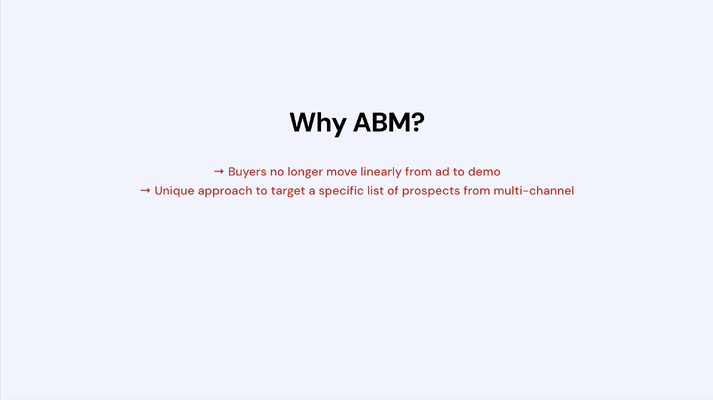
1. The attribution obsession. Marketers measure ROI per channel. They want to know if “LinkedIn ads worked” or “cold email worked.” But in an ABM buyer journey, channels can reinforce each other. Repeated exposure to a useful ad may make the later email feel familiar. Last-touch attribution alone cannot show the whole sequence or prove which touch caused the reply.
2. The ads-to-pipeline gap. Most teams don't have a scalable way to tie ad dollars to influenced pipeline. They watch impressions in LinkedIn Campaign Manager and revenue in HubSpot, and have no system bridging the two. Without a bridge, the CFO eventually asks why you're spending on ads "that don't convert," and the program gets cut.
3. The sales-marketing silo. Sales runs its own outreach campaigns. Marketing runs its own ads. Neither sees what the other is doing. The result: prospects get cold-emailed by an SDR on Tuesday and served a brand-awareness LinkedIn ad on Wednesday with messaging that contradicts the email.
Fix any one of these and you remove a constraint. Fix all three and you have a system you can measure and improve together.
P.S. with Fibbler you can actually measure influenced pipeline, thanks to Adam Holmgren and his team for creating this product.
A historical snapshot of influenced pipeline
| Metric | Value | Deals |
|---|---|---|
| Influenced pipeline | $14.5M | 46 deals |
| Influenced revenue | $1.385M | 6 won deals |
Historical figures from the original June 2026 article, restyled by frontBrick. Influence records engagement associated with opportunities. It does not establish that ads alone created these outcomes.
How is engineered ABM different from traditional marketing?
Traditional B2B marketing inverted the funnel: broad targeting at the top, gated lead capture in the middle, deal creation at the bottom. The entire model assumes anonymous prospects who fill out a form when they're ready.
That model leaves a gap when buyers research without submitting a form. Anonymous visits and broad targeting make it hard to connect activity to the accounts you want. ABM starts with named accounts and builds a coordinated experience around them.
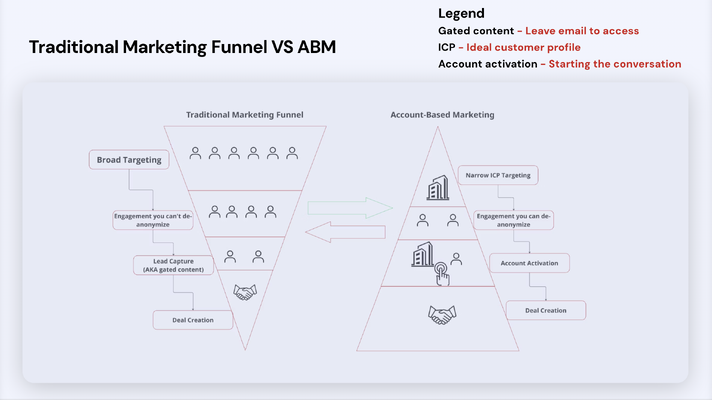
You cannot understand that experience with channel-level ROI alone. Use account-level engagement, opportunity progression and blended CAC. Blended CAC is total acquisition cost across sales and marketing divided by new customers acquired, using a consistent period and allowing for the sales cycle. Cost per qualified meeting is a separate metric with qualified meetings as its denominator.
Build the next part of the ABM system
Start with ICP research beyond firmographics. Use the Pain Triangle for ABM segmentation to decide which accounts need education and which are ready for a conversation. Then connect the steps in our ABM workflow.
A practical buyer journey review
- Choose a recent won account and a comparable lost account. Reconstruct the known touches from CRM activity, campaign engagement and the buyer’s own recollection.
- Separate what you observed from what you inferred. An account seeing an ad does not tell you which buying committee member saw it or why they bought.
- Find the handoff that breaks: inconsistent messaging, no next step after engagement, or sales missing the account context.
- Change one handoff and track account progression, qualified meetings and new customers. Keep channel costs visible without assigning the whole outcome to the final click.
FAQ
What's the difference between ABM and traditional B2B marketing?
Traditional B2B marketing optimizes for lead capture across a broad funnel. ABM optimizes for account engagement across a narrow target list. ABM uses signal-based outreach to know when an account is ready, whereas traditional marketing relies on gated content and form fills. Both can run inside one company, but they're measured differently. ABM at the account level, traditional at the lead level.
Can a single channel still work?
Yes. A focused single-channel motion can work for the right audience and offer. The problem is assuming the channel operates in isolation from everything a buyer already knows about you. Connect the available signals and give sales the context. Add channels because they help the buyer, not because more channels automatically mean more pipeline.
How many touches does a B2B buyer need before booking a demo?
There is no universal number. Our opening example suggests roughly 15+ touches across several months, based on what the buyer reported. Deal complexity, familiarity and the buying committee change the journey. Use your own won and lost deals to understand the patterns, rather than treating 15 touches as a quota.
What does "blended CAC" mean in ABM?
Blended CAC is total sales and marketing acquisition cost divided by new customers acquired for a consistent measurement period. Include the relevant people, tools, media and content costs. If you divide by qualified meetings instead, you are measuring cost per qualified meeting. Neither metric proves that a particular touch caused a purchase.
Should I hire a GTM Engineer or an agency to build this?
It depends on how stable your ICP is, the expertise you already have, your implementation capacity and who will maintain the system. In-house ownership can make sense when you can support it. A specialist partner can help when you need the system built and transferred to your team. Our ABM implementation service connects the strategy, data and activation; our Clay service covers the orchestration behind it.
Originally published by Stan in The ABM Engineer on LinkedIn on June 21, 2026. Adapted for frontBrick with clarified measurement definitions and historical results.
Book Your Strategy Call Today
Want to see how frontBrick can help you generate qualified leads and fill your pipeline fast? Book your free strategy call now.
Book Strategy Call