
How to Qualify Sales Leads in 2026: A 7 Step Process, Frameworks and a Scorecard
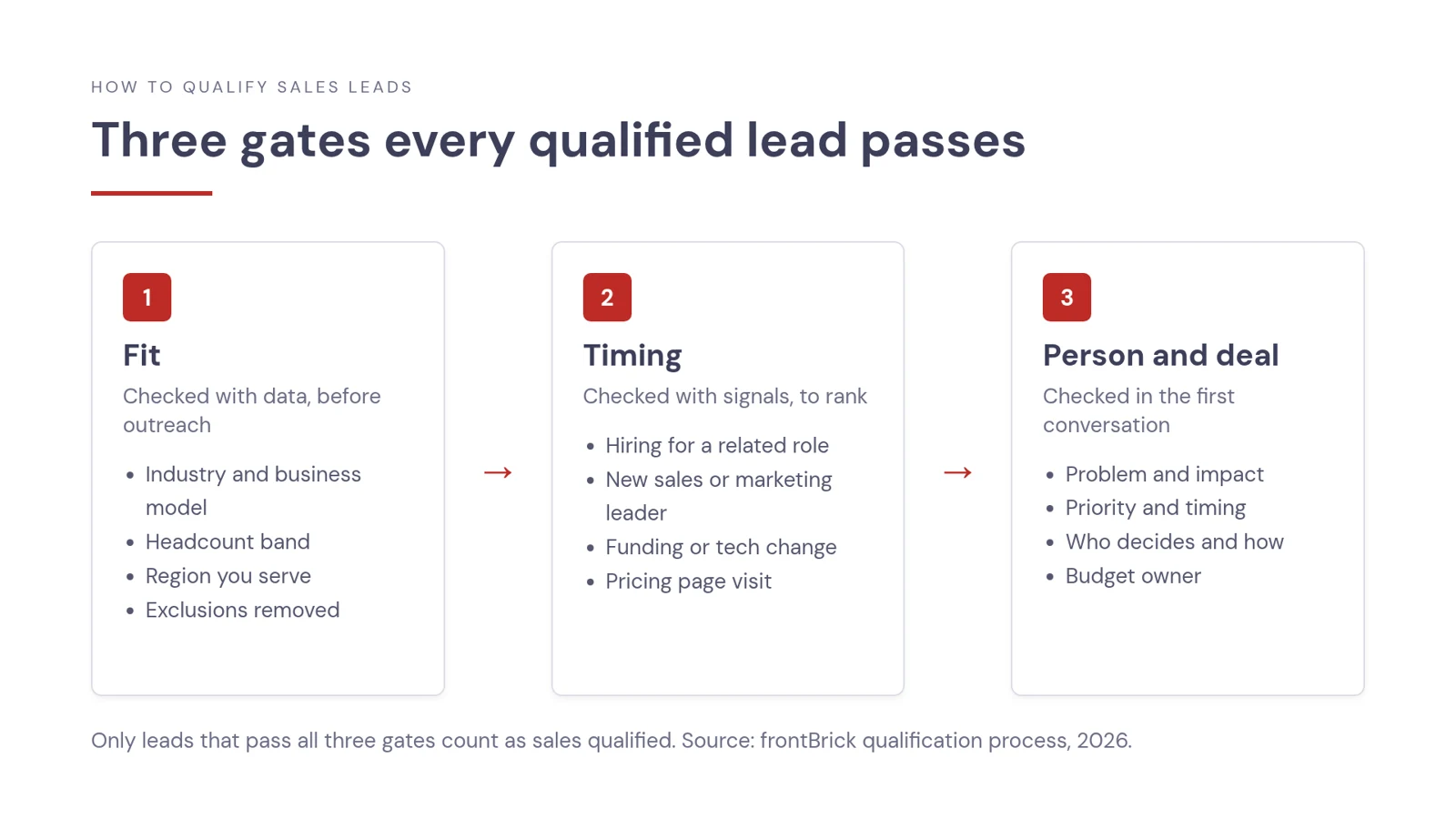
To qualify sales leads, check three things in order: does the company fit your ideal customer profile, is there a reason to buy now, and is the person you are talking to part of the buying decision. Fit is checked with data before anyone writes a message. Timing is checked with signals. The person and the deal are checked in the first conversation with a short set of questions such as BANT or MEDDICC. A lead is qualified only when it passes all three, and your sales team should agree in writing on what that means before a single lead is passed over.
I run frontBrick, an outbound and GTM engineering agency. We qualify leads every day for B2B SaaS companies, agencies and our own pipeline, mostly in Clay, with email verification and AI scoring in the loop. This guide shows the 7 step process we use, a scorecard you can copy, the qualification frameworks worth knowing, the questions to ask at each stage and the mistakes that fill calendars with meetings that never turn into pipeline. Where I use our own numbers, they come from our published case studies or from our own website visitor data, checked on 24 November 2026.
Key takeaways
| Question | Short answer |
|---|---|
| What does it mean to qualify a lead? | Deciding, with evidence, whether a contact is worth sales time: the company fits, there is a reason to buy and the person can move a deal |
| What should you check first? | Fit. If the company is too small, too large, in the wrong industry or a competitor, no amount of interest makes it a good lead |
| Which framework should you use? | BANT for simple, fast deals. MEDDICC or MEDDPICC for larger deals with several decision makers. Most outbound teams use a light BANT in the first call |
| When does a lead become sales qualified? | When it meets a written definition both teams signed off, for example: fit company, right role, confirmed problem and a booked next step |
| What is the most common mistake? | Qualifying on interest alone. A friendly reply from a company that can never buy is still an unqualified lead |
| How do you know it works? | Track meetings to opportunities and opportunities to closed deals per source. If those rates drop, your definition is too loose |
What is lead qualification?
Lead qualification is the process of deciding whether a lead is likely to become a customer, and how much time your team should spend on it. Salesforce puts it simply: a lead is qualified when your product will meet their needs and they can afford it (Salesforce on lead qualification). LinkedIn's sales team describes the goal as making sure reps are not wasting time on the wrong prospects and are nurturing the ones likely to become long term customers (LinkedIn Sales Solutions).
In practice, leads move through a few stages. The names differ between companies, but the logic is the same.
| Stage | What it means | Who decides | Typical evidence |
|---|---|---|---|
| Lead | Any person or company you could contact | Nobody yet | A name in a list, a form fill, a website visit |
| Marketing qualified lead (MQL) | Fits the profile and showed some interest | Marketing or RevOps | Fit score above your bar plus a content download, a pricing page visit or a reply |
| Sales accepted lead (SAL) | Sales agrees it is worth working | SDR or AE | Fit confirmed by a person, contact details verified |
| Sales qualified lead (SQL) | A real potential deal | SDR or AE after a conversation | Problem confirmed, decision maker involved, next step booked |
| Opportunity | A deal in the pipeline with a value | AE | Scope, value and timeline agreed with the buyer |
The point of the stages is not paperwork. It is to stop expensive people, usually account executives, from spending time on leads that a list filter or a two minute call could have ruled out.
Why qualifying leads matters more than generating them
Salesforce's State of Sales research found that reps spend only 28% of their week actually selling (Salesforce). Every unqualified lead that reaches a rep takes time from the share that is left.
The problem is bigger than most teams think, because most of the people who notice you are not buyers. We see it on our own website. Of the 1,279 companies our visitor identification tool has matched to frontBrick's site so far, only 34.7% fit our ideal customer profile when scored against written rules. Here is why the rest did not qualify:
| Reason a visiting company did not qualify | Companies |
|---|---|
| Too small (under 10 employees) | 96 |
| Too large (over 1,000 employees) | 87 |
| Education or university | 47 |
| Recruiting or staffing firm | 36 |
| Government or non-profit | 31 |
| Consumer (B2C) business | 28 |
| Competitor (lead generation or outbound agency) | 3 |
| Sales or marketing software vendor | 2 |
Another 474 companies were a partial fit: B2B, but outside our core size band or industry. If we treated every visitor as a lead, roughly two out of three follow ups would go to companies that cannot or will not buy. Qualification is the filter that makes the rest of your sales process efficient.
How to qualify sales leads in 7 steps
These are the steps we run for clients and for ourselves. Steps 1 to 5 happen before anyone talks to the lead. Steps 6 and 7 happen in and after the first conversation.
Step 1: Write down what a qualified lead is
Before you score anything, write a one paragraph definition that sales and marketing both sign. It should name the company profile, the roles, the problem and the next step that counts. For example:
A qualified lead is a B2B software company with 20 to 250 employees in North America or Europe, where we are talking to the founder, VP Sales or Head of Growth, who confirms they want more outbound pipeline in the next two quarters and agrees to a second call with the decision maker.
This sentence does three jobs. It tells your list builder what to pull. It tells your SDRs when to stop pushing. It also settles arguments later, because a meeting either matches the definition or it does not. If you work with an outside team, this definition is the most important line in the contract. We cover how to write it for paid meetings in our guide to pay per appointment lead generation.
Step 2: Turn your ICP into hard filters and exclusions
Your ideal customer profile should become filters you can apply to a list, not a slide. Start with the exclusions, because they remove the most waste for the least effort. Using the table above as a guide, write down:
- Size limits: the smallest and largest company you can serve well.
- Industries you do not sell to, such as education, government or consumer brands.
- Business models you exclude, such as competitors, recruiting firms or resellers.
- Regions and languages you cannot support.
Then add the positive fit fields: industry, headcount band, funding stage, tech stack and the roles you sell to. If you have not written your profile yet, start with our guide on what an ICP is in sales and come back. A good test: two people on your team should get the same answer when they check the same company.
Step 3: Score fit before you spend money on enrichment
Most teams enrich every row, then filter. That is backwards and expensive. Score fit first with cheap or free data (company website, LinkedIn company page, headcount), drop the misfits, and only then pay for contact data and verification on the companies that pass.
We do this with an AI step in Clay that reads the company's website and description and answers a narrow question, for example "Is this a B2B software company that sells to other businesses, yes, no or unknown, and why?" The model must answer "unknown" when the evidence is missing, never guess. Anything marked "unknown" goes to a person or to a second data source. This one change usually removes a large share of a raw list before a single credit is spent on emails.
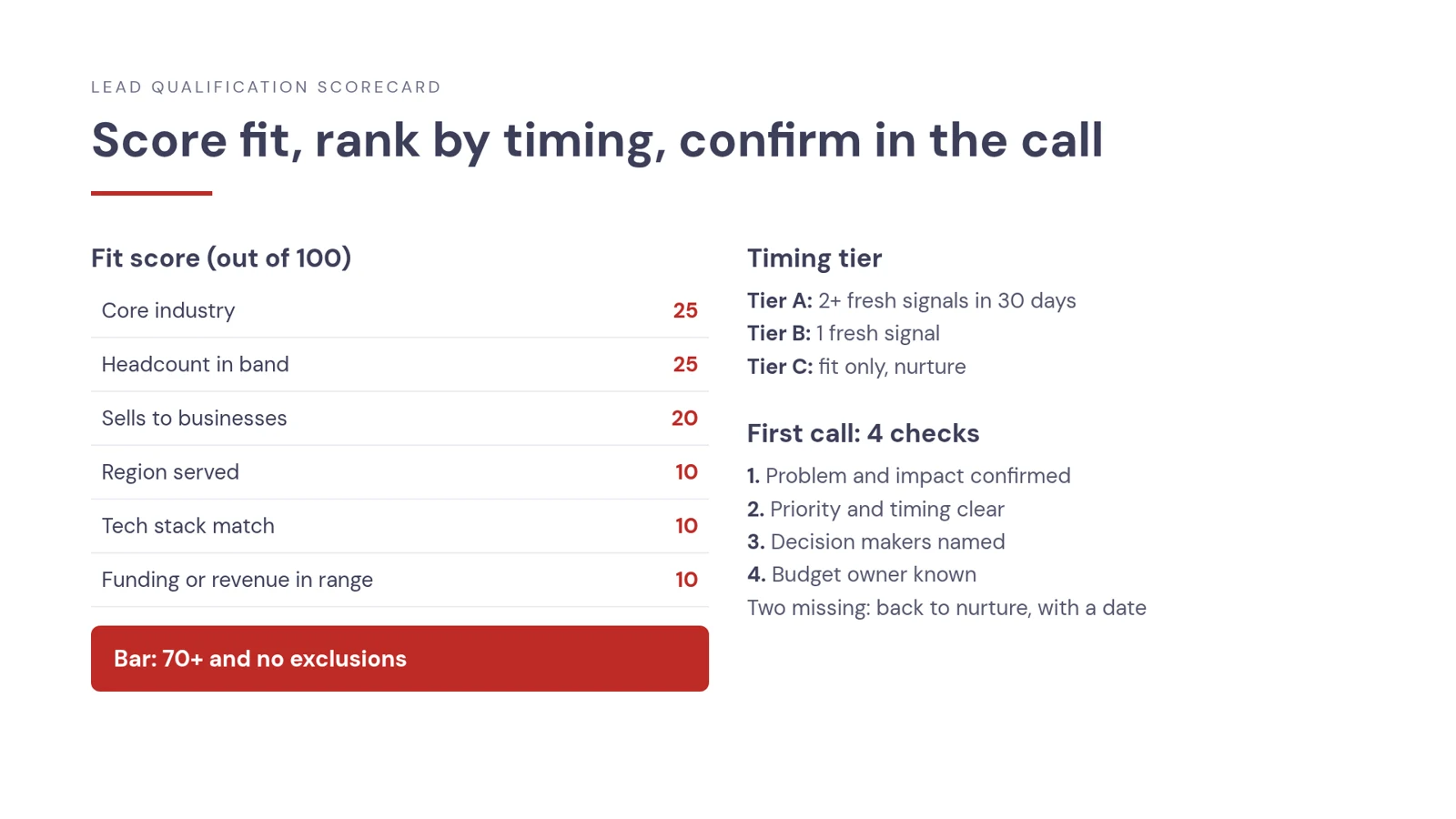
A simple fit score you can copy:
| Fit criterion | Points | How to check |
|---|---|---|
| Industry is in your core list | 25 | LinkedIn industry plus a website read |
| Headcount inside your core band | 25 | LinkedIn or a data provider |
| Sells to businesses (B2B) | 20 | Website read by a person or an AI step |
| Region you serve | 10 | Company HQ |
| Tech stack or tool you integrate with | 10 | Technographic data or job posts |
| Funding stage or revenue band in range | 10 | Funding data or estimates |
| Any exclusion applies | Remove | Exclusion list from step 2 |
Set your bar, for example 70 out of 100. Companies under it do not get contacted this quarter, however interesting they look.
Step 4: Add timing signals to rank the companies that fit
Fit tells you who could buy. Timing tells you who might buy soon. Useful timing signals for B2B include hiring for a related role, a new sales or marketing leader, a funding round, a tech change, a visit to your pricing page and research activity on your topic. Rank fit companies by how many fresh signals they show and contact the top tier first.
Two rules keep this honest. First, signals only rank companies that already fit, they never add companies to the list. Second, signals decay. A pricing page visit from yesterday is worth far more than one from last month. Our step by step guide on how to use intent data includes a scoring and decay model you can reuse.
Step 5: Qualify the person and the channel
A great company with the wrong contact is still a weak lead. For each company that passes, find two to four people in the buying group: the person who feels the problem, the person who owns the budget and, for larger deals, the person who will use the product every day.
Then check you can actually reach them. We only put an email address into a sequence when a verification tool marks it as deliverable. Risky or unknown addresses are dropped from email and the person is contacted on LinkedIn instead. It sounds strict, but sending to bad addresses hurts deliverability for every other lead in the campaign. This is also the step where we drop anyone without a real first name, because a message to "Hi there" is not a qualified touch.
Step 6: Qualify the deal in the first conversation
Now a person has replied or booked a call. This is where frameworks help. You do not need to read questions off a script, but you should leave the first call knowing the answers to four things:
- Problem: what are they trying to fix and what happens if they do nothing?
- Priority and timing: why now, and what else is competing for the same budget or attention?
- Decision: who else is involved, and how do they usually buy something like this?
- Budget: do they have money set aside, or would this need a new budget?
If two of the four are clearly missing, the lead is not sales qualified yet. That does not make it a bad lead. It means it goes back to nurture with a date to check in, not into the pipeline report.
Step 7: Hand off, track outcomes and re-score
A qualified lead needs a clean handoff: the notes from the call, the reason it qualified, and a next meeting already in the calendar. Agree on a response time between the SDR and the account executive, for example 24 hours.
Then track what happens. Every month, look at meetings to opportunities and opportunities to closed deals by source, by segment and by signal. When one source produces meetings that never become opportunities, tighten the definition for that source. When a segment keeps closing, widen it. Lead qualification is not a one time setup. It is a feedback loop, and our guide to lead scoring models shows how to turn those results back into points.
Lead qualification frameworks compared
Frameworks give your team a shared language. Pick one that matches the size and complexity of your deals, then use it consistently.
| Framework | Stands for | Best for | Watch out for |
|---|---|---|---|
| BANT | Budget, Authority, Need, Timeline | Simple deals, short cycles, high volume first calls | Budget is often not set yet in early calls, so it can disqualify good leads too fast |
| CHAMP | Challenges, Authority, Money, Prioritization | Teams that want to lead with the problem, not the budget | Needs good discovery skills to uncover challenges |
| ANUM | Authority, Need, Urgency, Money | Outbound where reaching the decision maker is the hard part | Can over focus on titles |
| MEDDIC / MEDDICC / MEDDPICC | Metrics, Economic buyer, Decision criteria, Decision process, Paper process, Identify or implicate pain, Champion, Competition | Larger B2B deals with several stakeholders and long cycles | Too heavy for a 15 minute first call |
| GPCTBA/C&I | Goals, Plans, Challenges, Timeline, Budget, Authority, Negative consequences and Positive implications | Consultative selling and complex services | Long, so teams often use only part of it |
HubSpot describes BANT as a method for qualifying prospects at the start of the sales cycle and recommends logging each answer in CRM fields so it is tracked over time (HubSpot on BANT). MEDDPICC is a B2B sales qualification methodology that grew out of MEDDIC, which was created at PTC in 1996 (MEDDICC).
Our practical advice: use a light BANT or CHAMP in the first conversation, and switch to MEDDICC once the deal is an opportunity with more than one stakeholder. Trying to run full MEDDICC in a first cold call usually ends the call.
Lead qualification questions to ask at each stage
Good questions are open, specific and easy to answer. Here are the ones we use most, grouped by what they qualify.
| What you are qualifying | Question to ask | What a good answer sounds like |
|---|---|---|
| Problem | "What made you look at this now?" | A specific trigger: a missed target, a new hire, a channel that stopped working |
| Impact | "What happens if this stays the same for another six months?" | A number or a clear cost: lost pipeline, a hire they cannot justify |
| Current approach | "How are you handling this today?" | Something you can improve on, such as founder led outbound with no system |
| Priority | "Where does this sit against your other projects this quarter?" | Top three, with a named owner |
| Decision | "Who else would want a say in this?" | Names and roles, not "just me" for a five figure purchase |
| Process | "How did you buy the last tool or service like this?" | A clear path: trial, security review, sign off by the CEO |
| Budget | "Have you set money aside for this, or would it come from somewhere else?" | A range, or a clear owner of the budget |
| Timing | "If this works, when would you want to start?" | A date or a quarter |
Keep it to five or six questions in a first call. The rest can wait until there is a real opportunity.
Lead qualification in practice: three examples from our work
Numbers make the process concrete. These come from our published case studies.
| Client | What qualification looked like | Result reported in the case study |
|---|---|---|
| Tymely (AI customer support) | The ideal customer was about 1% of the retail landscape: companies with at least 15,000 support tickets, reached at C level. That left a total market of 2,000 to 4,000 accounts, so fit filtering came before everything else | $1.2M in pipeline through an ABM program |
| Skale (organic growth agency for AI search and SEO) | Thousands of prospect accounts were researched in Clay for how they showed up in AI answers, so each account got an offer based on its own visibility | 83 outbound leads, 63 of them outbound MQLs, and €13,200 in outbound monthly recurring revenue won between 29 March and 31 May, from a single email per sequence |
| Hire with Jarvis (staffing and recruiting agency) | Outreach targeted senior talent acquisition leaders and founders at enterprise companies, timed with hiring signals | 138 replies, 35 positive replies (25.4%), 35 enterprise opportunities and $700,000 in qualified pipeline in 2.5 months |
The pattern is the same in each one: the fit and timing work happened before the first message, so replies came from companies that could actually buy. Tymely is the extreme case: with a market that small, every account had to qualify on fit before it was contacted.
How to qualify leads when you work with an agency
If an outside team books meetings for you, qualification becomes a contract question. Before you sign, agree on these points in writing:
- The qualified meeting definition from step 1, word for word.
- Who checks each meeting against it, and how quickly you can reject one that does not match.
- Whether you pay for meetings that are booked, held or accepted, and what happens with no shows.
- Which accounts are excluded, for example current customers, open deals and competitors.
- That you keep the lists, the copy and the data at the end.
When you compare providers, ask each one to show you a real meeting they counted as qualified for another client, with the details removed. You will learn more from that than from any case study. Our lists of B2B lead generation companies and B2B appointment setting companies show how each provider defines and prices a qualified meeting.
Common lead qualification mistakes
- Qualifying on interest, not fit. A warm reply from a company outside your profile still will not close.
- No written definition. If sales and marketing disagree on what qualified means, they will argue about every lead.
- Enriching everything first. Paying for contact data on companies you will never sell to is the most common waste we see.
- Treating signals as a list. A funding round at a company that does not fit is still not a lead.
- Disqualifying too early on budget. Many good buyers do not have budget set when you first talk. Ask how they buy, not only if they have money.
- Talking to one person only. In B2B, a lead with one contact and no access to the decision maker is fragile.
- Never reviewing outcomes. If you do not check which qualified leads became deals, your definition will drift.
FAQ
What is the fastest way to qualify a sales lead?
Check fit with data first: industry, size, region and business model. That takes seconds per company and removes most unqualified leads. Then use three or four first call questions about the problem, timing, decision makers and budget.
What is the difference between an MQL and an SQL?
A marketing qualified lead fits your profile and showed some interest, such as a download, a pricing page visit or a reply. A sales qualified lead has been checked in a conversation: the problem is confirmed, the right people are involved and there is a booked next step.
Is BANT still useful in 2026?
Yes, as a light first call checklist. Its weak spot is budget, because many buyers have not set one when you first speak. Many teams now lead with the problem and priority, as in CHAMP, and keep budget for the second conversation.
What are good lead qualification criteria for B2B?
Industry, company size, region, business model, the role of the contact, a confirmed problem, a reason to act now, access to the decision maker and a next step. Write them down, give fit criteria points and agree on a minimum score.
How many questions should you ask to qualify a lead?
Five or six in a first call is enough. Cover the problem, its impact, priority, who decides, how they buy and timing. Save detailed process and paperwork questions for when the deal is an opportunity.
Can AI qualify leads?
AI is good at the fit step: reading a company website and answering a narrow yes, no or unknown question at scale. It should be told to answer unknown when evidence is missing. The conversation step still needs a person, because buyers rarely share priorities and politics with a form.
How do you know if your lead qualification is working?
Track meetings to opportunities and opportunities to closed deals by source and segment every month. If a source books many meetings but few become opportunities, the definition for that source is too loose and needs tightening.
Pay Per Appointment Lead Generation in 2026: Costs, Risks and How to Choose a Partner
How pay per appointment lead generation works, what it costs in 2026 with published prices, booked vs held meetings, and a 6 step way to choose a provider.
 Stan Stojanovic
Outsourced SDR vs In House SDR in 2026: How to Cost It, Decide and Run a Pilot
How to choose between an outsourced SDR and an in house SDR team: a full cost per meeting model, the four questions that decide it and a 90 day pilot plan.
Stan Stojanovic
10 Best B2B Sales Agencies in 2026: Pricing, Proof and Fit
Compare the 10 B2B sales agencies buyers shortlist most in 2026, with outsourced SDR scope, published pricing, attributed proof and who each firm fits.
Stan Stojanovic