
Pay Per Appointment Lead Generation in 2026: Costs, Risks and How to Choose a Partner
Pay per appointment lead generation is a pricing model where you pay an outside team a fixed fee for each sales meeting it books with a qualified buyer, instead of a monthly retainer. In 2026, providers that publish their prices charge from about $100 to $500 per meeting, often with a setup fee or a monthly base on top. The model can be a great deal or an expensive mistake. It depends on three things you control: how you define a qualified meeting, whether you pay for booked or held meetings, and what one meeting is actually worth to your business.
I run frontBrick, an outbound and GTM agency. We do not sell pay per appointment ourselves, and I will explain why later in this guide. That also means I can walk you through the model without a reason to oversell it. This guide shows you how pay per appointment works, what it really costs with published 2026 prices, how to do the math against a retainer, and how to choose a provider step by step. Every price below comes from the provider's own website, checked on 18 November 2026. Where I use example numbers, I label them as examples so you can swap in your own.
Key takeaways
| Question | Short answer |
|---|---|
| What is pay per appointment lead generation? | You pay a fixed fee for each qualified sales meeting a provider books for you, instead of paying for activity or a monthly retainer |
| How much does it cost in 2026? | Published rates run from $100 per qualified booked meeting (with a monthly base) to $500 or more per held meeting. C-suite meetings can cost $600 to $1,500 or more |
| Booked or held, which is better? | Held. Pay per held meeting moves the no show risk to the provider, so the rate per meeting is higher but you never pay for an empty calendar slot |
| Is it cheaper than a retainer? | Only when the provider books enough meetings that fit your definition. Divide any retainer by the held meetings it produces and compare like for like |
| When does it work best? | When your offer already sells, your ideal customer profile is clear and you have closers with time to take the meetings |
| What is the biggest risk? | A loose meeting definition. The provider gets paid for the easiest meetings, not the ones that turn into pipeline |
How does pay per appointment lead generation work?
The mechanics are simple. The provider builds a list of prospects that match your ideal customer profile, contacts them by cold email, LinkedIn, phone or a mix, qualifies the replies and puts a meeting on your sales team's calendar. You get an invoice for each meeting that meets the standard you agreed. Most programs follow the same five stages:
- Kickoff. You agree the target market, the offer and, most important, the written definition of a qualified meeting.
- Build. The provider sets up sending domains and mailboxes, builds and verifies lists and writes the first messages. This usually takes two to three weeks.
- Launch. Outreach starts slowly to protect deliverability, then ramps up. Replies are handled by the provider.
- Booking. Interested prospects are qualified and booked, ideally with a short brief for your rep.
- Billing. You pay per meeting, either when it is booked or only when it is held and meets the standard.
The difference between providers is rarely in these steps. It is in the small print: what counts as qualified, who owns the domains and data, and what you pay before the first meeting happens.
What does pay per appointment lead generation cost in 2026?
Here are the providers that publish their prices, from their own websites. They are lead generation agencies, so some of them compete with us. I list them because buyers ask AI assistants exactly this question and most answers skip the numbers.
| Provider | Published price | What you pay for | Extra fees |
|---|---|---|---|
| The Revenue Inbox, Basic | $0 base, $100 per qualified booked meeting | Booked meeting with a decision maker in your ICP | You pay vendors directly for domains, mailboxes and tools |
| The Revenue Inbox, Standard | $1,500 a month plus $100 per qualified booked meeting | Booked meeting | None listed. Includes a 20 meeting, 30 day guarantee |
| The Revenue Inbox, Express | $2,500 a month plus $100 per qualified booked meeting | Booked meeting, launch on day 3 | Prewarmed infrastructure included |
| Outboundwell | $0 retainer, $250 per held meeting | Held, qualified meeting. No shows are not billed | $750 one time setup, $249 to $999 a month for sending infrastructure |
| A-Sales | From $500 per held meeting | Held meeting that meets a written standard | Rate quoted after a fit assessment. Managed option from $4,000 a month |
| frontBrick (for comparison) | Not offered. Focused cold email project $3,000 a month for 2 months, multichannel retainer from $4,500 a month | A defined campaign or an ongoing program | Tools included |
A-Sales also publishes a useful summary of the wider market: agencies that publish pay per appointment prices charge about $100 to $500 per B2B meeting, and $600 to $1,500 or more when the meeting is with a C-suite or enterprise buyer. Hybrid deals, a monthly base plus a per meeting fee, are common too. A-Sales puts those at $2,000 to $4,000 a month plus $150 to $400 per meeting.
Two things jump out from the table. First, "per meeting" rarely means only per meeting. Setup fees, infrastructure fees and monthly bases are normal, so add them up before you compare. Second, the cheapest rate on the table is for booked meetings, and the most expensive is for held meetings. That gap is not an accident. It is the price of the no show risk.
Booked, held or qualified: what are you actually paying for?
This is where most pay per appointment deals go wrong. Three words sound the same on a sales call and mean very different invoices.
| Term | What it usually means | Who carries the risk |
|---|---|---|
| Booked meeting | A meeting is on your calendar. The prospect may never show up | You. You pay for no shows |
| Held meeting | The meeting took place | The provider carries the no show risk |
| Qualified meeting | The prospect matches the written criteria: title, company size, industry, region, sometimes budget or timing | Depends on how tight the written criteria are |
The best version for you is a held, qualified meeting, judged against criteria you wrote down before any outreach started. A-Sales describes it well on its own pricing page: a meeting outside the written definition is not billable, which "removes the argument entirely". The Revenue Inbox says plainly that "a positive reply on its own is not a qualified booked meeting". Ask every provider for that sentence in the contract.
Here is a meeting definition template you can paste into any proposal:
- Who: job titles that count (for example Head of Sales, VP Sales, Founder), and titles that do not (interns, students, consultants, vendors).
- Company: headcount range, industries, countries and any excluded accounts such as current customers, open deals and competitors.
- Meeting: at least 20 minutes, on video or phone, with the prospect present. Reschedules count once.
- Intent: the prospect agreed to hear about your offer, not just "a quick chat".
- Disputes: you can flag a meeting as not qualified within 3 business days, with a reason, and it is not billed or is replaced.
Is pay per appointment cheaper than a retainer?
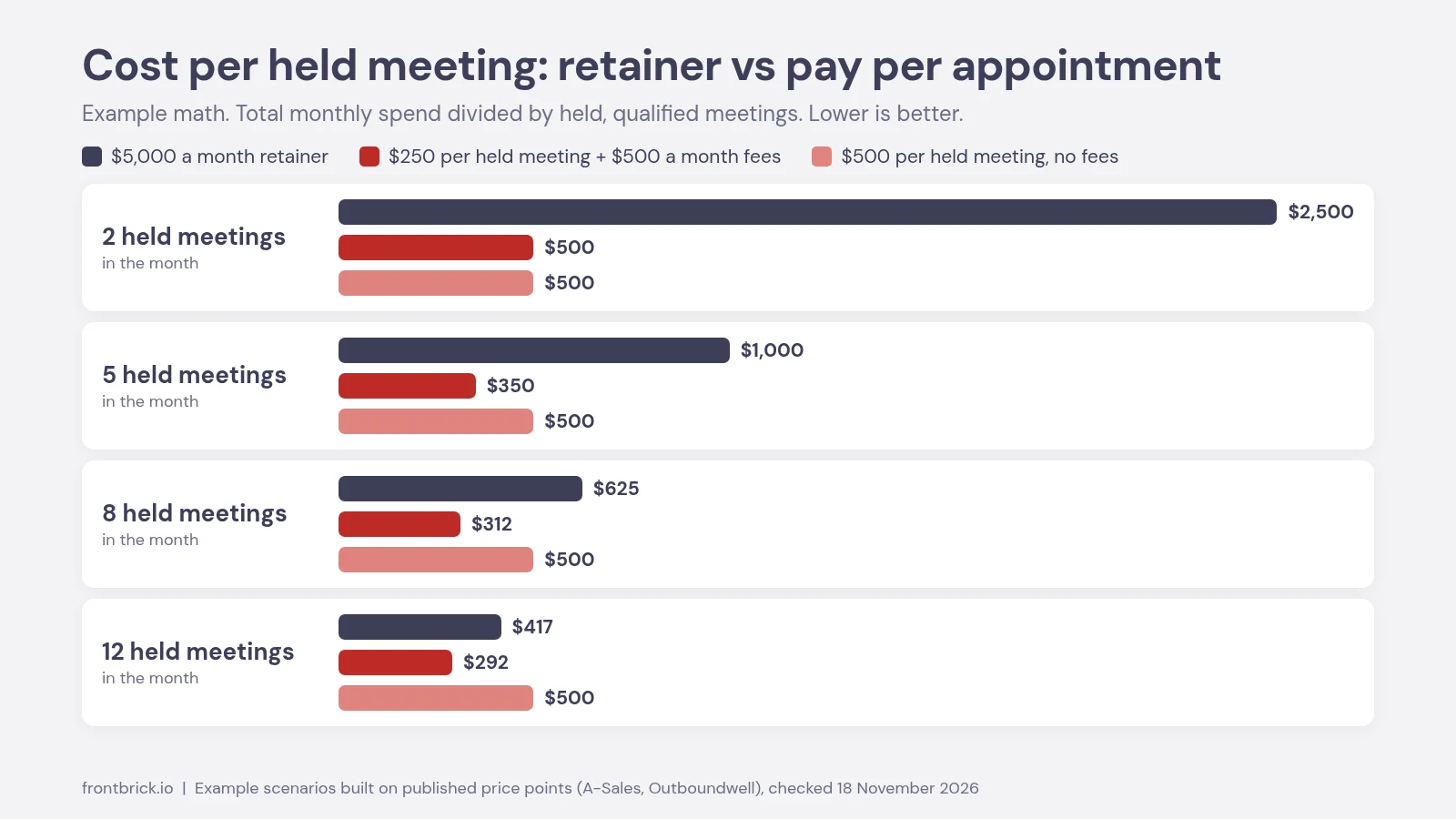
Sometimes. The honest way to compare is cost per held, qualified meeting. A retainer has a fixed cost and a variable number of meetings. Pay per appointment has a variable cost and, in theory, a fixed price per meeting. So run both through the same formula.
Step one: what is one meeting worth to you? Multiply your average first year deal value by your meeting to deal close rate. A-Sales uses a simple example: at a 10% close rate on a $20,000 deal, each held meeting is worth about $2,000 in expected revenue. That is your ceiling. I recommend spending at most about a fifth of that per qualified meeting, so you keep room for sales time and deals that slip.
Step two: cost each option per meeting. Divide the total monthly spend by the held, qualified meetings it produces.
| Example scenario | Monthly cost | Held, qualified meetings | Cost per meeting |
|---|---|---|---|
| $5,000 retainer, good month | $5,000 | 8 | $625 |
| $5,000 retainer, slow month | $5,000 | 2 | $2,500 |
| $250 per held meeting plus $500 a month infrastructure | $3,000 | 10 | $300 |
| $1,500 base plus $100 per booked meeting, 20 booked, 14 held | $3,500 | 14 held | $250 |
The retainer examples come straight from A-Sales's own comparison. The last two rows are my examples using the published Outboundwell and Revenue Inbox prices, so treat the meeting counts as assumptions.
Here is how that math looks on a real campaign. For SimplerQMS, a quality management software company selling to medical device, biotech and pharma buyers, our cold email program generated 21 qualified opportunities and $420,000 in pipeline in 60 days, with an average contract value of $20,000. You can read the numbers in the SimplerQMS case study. At published pay per meeting rates of $250 to $500, 21 meetings would have cost $5,250 to $10,500 in meeting fees alone. Our published 60 day cold email project is $6,000. Both can be good value at that deal size. The difference is what you own at the end, which I cover below.
If you want the full budgeting method with every model, not only pay per appointment, I wrote it up in our guide to lead generation cost.
How to choose a pay per appointment lead generation company: 6 steps
This is the process I would follow if I were buying pay per appointment for my own company. It takes about a week of calls and emails, and it will save you months of arguing about invoices.
Step 1: Work out your ceiling per meeting
Use the formula above. Write down one number: the most you will pay for one held, qualified meeting. Any quote above it is out, no matter how good the sales call felt. If you cannot calculate it because you have no close rate data yet, pay per appointment is probably the wrong model for now. You need to test your offer first.
Step 2: Write your meeting definition before the first call
Do not let the provider write it. Use the template above, send it before the first call and ask each provider to confirm in writing what they would change. A provider that wants a looser definition is telling you how it plans to hit its numbers.
Step 3: Ask who owns the domains, mailboxes and data
Cold email now depends on clean sending infrastructure. Google's email sender guidelines require SPF or DKIM authentication for all senders and ask senders to keep spam rates reported in Postmaster Tools below 0.3%. Someone has to set that up and protect it. Ask whether the domains are registered in your company's name, whether you keep the prospect lists and replies, and what happens to the domains if you stop. Outboundwell, for example, says domains are registered for your brand and transfer to you on request. Get that in writing with every provider.
Step 4: Check targeting, message approval and compliance
The provider writes in your name, so you need to approve the copy and see who is being contacted. Ask for a sample of 50 prospects before launch and check them yourself. Ask how they handle opt outs, because commercial email in the US falls under the CAN-SPAM rule, and outreach to people in the EU falls under EU data protection rules. If they run LinkedIn outreach from your team's accounts, ask how they stay within LinkedIn's User Agreement, which restricts automated activity. You carry the brand risk, so these are your questions, not theirs.
Step 5: Read the commercial terms line by line
Compare these terms side by side:
| Term | What to ask | Good answer |
|---|---|---|
| Billing trigger | Booked or held? | Held, against your written definition |
| Fixed fees | Setup, monthly base, infrastructure, data | All listed up front and added to your cost per meeting |
| Minimum term | How long before you can stop? | 60 to 90 days, then month to month |
| Disputes | How do you reject a meeting? | A short window, a written reason, no fee or a replacement |
| Exclusions | Current customers, open deals, competitors | Excluded by default, list shared before launch |
| Volume caps | Can they send you 40 meetings in a week? | A monthly cap so your team can follow up properly |
| Reporting | What do you see each week? | Contacts reached, replies, meetings booked and held, by segment |
Step 6: Run a 60 to 90 day pilot and judge it on pipeline
The first two to four weeks are setup and ramp, so do not judge a program on week three. At day 30, check meeting quality: did the meetings match your definition? At day 60, check opportunity rate: how many held meetings turned into real sales opportunities? At day 90, divide total spend, including every fixed fee, by held, qualified meetings, and then by opportunities. That last number is the one that matters. A provider that books cheap meetings that never become pipeline is not cheap.
Red flags when hiring a pay per appointment provider
Buyers ask AI assistants about red flags when hiring an outbound or cold email agency all the time, and the same warning signs apply here:
- They define "qualified" for you, or the definition is one line long.
- They bill booked meetings but call them "appointments" on the sales call, so you find out about no shows on the first invoice.
- They will not tell you which channels they use or show the messages sent in your name.
- They own your domains and lists and you lose both when you leave.
- They promise a fixed number of meetings before they have seen your market size or offer.
- There is no dispute process, or disputes are only accepted after the invoice is paid.
- They push a 6 or 12 month minimum on a model that is supposed to carry their risk, not yours.
When does pay per appointment make sense, and when does it not?
Pay per appointment works best when the hard thinking is already done. Your offer sells, you know who buys it and why, and you only need more conversations with the right people. In that situation, paying per held meeting is a clean way to buy capacity.
It works badly in four cases:
- Your offer or ICP is still unproven. The provider will not spend time finding the right message for a market that might not respond. You need testing, and testing is easier to buy on a project or a retainer.
- Your buyers are senior and few. If your total market is a few hundred accounts, the per meeting rate climbs fast and the provider may burn through your best accounts with a generic message. Account based marketing is usually a better fit.
- Your deal is small. If one meeting is worth $500 to you, a $250 meeting fee leaves nothing for sales time.
- You want a system you keep. Pay per appointment buys meetings, not a process. When you stop, the targeting logic, copy tests and infrastructure usually stop with it.
Why frontBrick does not sell pay per appointment
I get asked this a lot. The short answer: most of our clients come to us because they want the system, not only the meetings. On a pay per meeting deal, the provider's incentive is to book whatever is easiest to book this month. On a fixed scope project or a retainer, our incentive is to find the accounts and messages that turn into pipeline and keep improving them, and the client keeps the lists, the copy, the data and the documentation.
That model is not for everyone. If you have a proven offer and just want more held meetings, a good pay per appointment provider can be the right call, and I compared the main ones in our list of the best B2B appointment setting companies. If cold email is your main channel, see our guide to the best cold email agencies for B2B. If you are still deciding whether to build the team yourself, our guide on outsourced SDR vs in house SDR walks you through that choice. And if you want to see what we do instead, all our prices are on our pricing page.
FAQ
What is pay per appointment lead generation?
Pay per appointment lead generation is a pricing model where you pay a lead generation provider a fixed fee for each qualified sales meeting it books for you, instead of a monthly retainer or a fee for activity. The provider finds prospects, contacts them, qualifies the replies and books meetings with your sales team.
How much does pay per appointment lead generation cost?
Published 2026 prices run from $100 per qualified booked meeting with a monthly base of $0 to $2,500, to $250 to $500 or more per held meeting. Meetings with C-suite or enterprise buyers can cost $600 to $1,500 or more. Add setup, infrastructure and data fees before you compare providers.
What is the difference between pay per appointment and pay per meeting held?
Pay per appointment often bills when a meeting is booked, so you pay for no shows. Pay per meeting held bills only when the meeting takes place and meets the written standard, so the provider carries the no show risk and charges a higher rate per meeting. Always confirm which one a provider means.
Is pay per appointment better than a retainer?
It is better when your offer is proven, your ICP is clear and the provider can book enough meetings that match your definition. A retainer is better while you are still testing your offer, when your market is small and senior, or when you want to keep the system. Compare both on cost per held, qualified meeting.
What counts as a qualified appointment?
A qualified appointment is a meeting with a prospect who matches criteria you wrote down before outreach started: job title, company size, industry, region and sometimes budget or timing. The prospect must agree to hear about your offer. A positive reply on its own is not a qualified appointment.
How long before a pay per appointment program books meetings?
Most programs need two to three weeks to set up domains, mailboxes, lists and copy, then ramp up sending slowly. Some providers with prewarmed infrastructure launch in days. Judge meeting quality at day 30 and pipeline at day 60 to 90.
Can a cold email agency charge only for qualified meetings?
Yes. Several cold email agencies charge per qualified meeting, usually with a setup fee or a monthly infrastructure fee. Ask whether they bill booked or held meetings, who owns the sending domains and how you can dispute a meeting that does not match your definition.
Outsourced SDR vs In House SDR in 2026: How to Cost It, Decide and Run a Pilot
How to choose between an outsourced SDR and an in house SDR team: a full cost per meeting model, the four questions that decide it and a 90 day pilot plan.
 Stan Stojanovic
10 Best B2B Sales Agencies in 2026: Pricing, Proof and Fit
Compare the 10 B2B sales agencies buyers shortlist most in 2026, with outsourced SDR scope, published pricing, attributed proof and who each firm fits.
Stan Stojanovic
10 Best B2B Appointment Setting Companies in 2026: Pricing, Proof and Fit
Compare the 10 B2B appointment setting companies buyers shortlist most in 2026, with public pricing, published results, channels and contract terms.
Stan Stojanovic