
How to Build an ABM Program in 2026: A 90 Day Plan for B2B SaaS
To build an ABM program, pick a small list of B2B accounts that can actually buy, map the buying group inside each one, tier the accounts by fit and timing, warm them up with LinkedIn ads and content, start outbound to the accounts that respond, and measure progress per account instead of per lead. For most B2B SaaS teams, 90 days is enough to launch the program, get the first meetings at target accounts and prove whether it deserves more budget. It is not enough to judge closed revenue when your sales cycle is longer than three months.
The old B2B funnel is breaking. Buyers do not move in a straight line from ad to demo. They zigzag. In a bigger account, one person reads a post, another gets a connection request, a third opens an email two weeks later, and a fourth visits your site and says nothing at all. Nobody fills in a form. Months later a deal shows up in the CRM, and the source field says "Offline".
That last part is not a joke. In the Kolet account timeline, Virgin Atlantic shows paid LinkedIn exposure and organic activity, an opportunity created on 6 January 2026 and a won milestone in May 2026. The CRM original source for that deal is recorded as Offline. Reports that only look at the last click do not show that story, and an ABM program exists to make it visible.
I run frontBrick, a B2B outbound and GTM agency. We build and run ABM programs for B2B SaaS companies, mostly with Clay, LinkedIn ads and coordinated email and LinkedIn outreach, and we also help small marketing teams set ABM up so they can run it themselves. This guide is the plan we use, told through the one program where I can show the numbers: Kolet. Over 15 months, the Fibbler dashboard connected €28,655 in LinkedIn ad spend with $25.14M in influenced pipeline across 106 deals, and $3.215M in influenced revenue across 15 won deals. Those are influenced numbers, not sole source numbers, and I will explain exactly what that means further down.
You get the story first, then the 8 steps, a 90 day schedule, what results to expect, what ABM costs, and when to use an agency or do it in house. Our detailed operating workflow lives in a separate article, ABM Workflow: How We Run Multi-Channel Pipeline. This guide is the plan that sits on top of it.
Key takeaways
| Question | Short answer |
|---|---|
| What is an ABM program? | A repeatable system where sales and marketing agree on a named list of accounts and work each one across ads, content and outreach until it turns into pipeline |
| How many accounts should you start with? | 50 to 300 for a B2B SaaS company with a small team, split into tiers. Fewer and you cannot learn, more and it turns back into broad lead generation |
| How long until results? | Engagement in weeks, first meetings in the first 60 days, reliable pipeline numbers in about 90 days, closed revenue after one full sales cycle |
| What channels work best? | LinkedIn ads to build familiarity across the buying group, plus email and LinkedIn outreach to accounts that show engagement or other signals |
| What does a real program look like? | Kolet ran one account list through Clay, LinkedIn ads, Fibbler and lemlist for 15 months and recorded $25.14M in influenced pipeline across 106 deals |
| What does it cost? | Tools, ad budget and either people time in house or an agency retainer. Our own ABM service starts from $7,000 a month plus media budget |
| Agency or in house? | In house if you already have someone who can run data, ads and outbound. An agency if you need the system live in weeks or lack those skills |
What is an ABM program, and how is it different from an ABM campaign?
Account based marketing (ABM) is a B2B go to market approach where you treat a company, not a lead, as the unit of work. Salesforce describes it as a strategy in which marketing and sales work together to target high value accounts with personalized campaigns (Salesforce). HubSpot's own setup guide frames it the same way: identify target accounts, organize them into lists and coordinate personalized marketing and sales activities around them (HubSpot).
An ABM campaign is one push, for example a LinkedIn ad series to 100 fintech companies. An ABM program is the system behind every campaign: the account list, the tiers, the buying roles, the signals, the rules for when sales steps in, and the reporting. Most teams that say "ABM did not work for us" ran a campaign and expected the results of a program.
There are three common types of ABM, and a good program usually mixes them by tier:
| ABM type | Accounts | What it looks like | When to use it |
|---|---|---|---|
| One to one | 5 to 30 | Custom research, messaging, ads and sometimes a landing page or gift per account | Large deals where one win pays for the whole program |
| One to few | 30 to 150 | Clusters of similar accounts, such as one vertical or one use case, with one angle each | Mid market deals with clear segments |
| One to many | 150 to a few thousand | Fit based lists, light personalization, ads plus sequences | Smaller deals or broad coverage of your total addressable market |
For a B2B SaaS company with 50 to 250 employees and one or two marketers, I almost always start with a one to few core, a short one to one list for the biggest targets, and a one to many layer that runs mostly on ads.
How we built an ABM program for Kolet: the story behind this plan
I could give you a list of ABM tips that would fit any agency blog. Instead, here is what actually happened on one program, with the real numbers and the real limits of those numbers. Every figure in this section comes from the Kolet case study, which is built from Kolet's own Fibbler and lemlist reports.
The problem: enterprise buyers do not answer strangers
Kolet provides eSIM connectivity. Its enterprise buyers are airlines, financial services companies, insurers and technology companies. In those accounts, loyalty, ancillary revenue and marketing leaders all have a say in the decision.
That is a hard audience for a cold email. The email has to compete with established telecom providers, with procurement processes and with the priorities of several people who have never heard of you. Kolet did not just need more meetings. It needed a way to earn attention and trust inside a defined list of accounts, see who was paying attention, and act on it.
What we did: one account list, five connected moves
We built the program around one shared audience. The same accounts fed the research, the ads, the engagement tracking and the outreach. In practice it looked like this:
- Map the market. We built and enriched the account list in Clay, then found the relevant people in each buying committee.
- Build familiarity. We put thought leadership and use cases in front of those accounts through LinkedIn ads.
- Watch engagement. We used Fibbler to connect account level LinkedIn activity with CRM opportunities and revenue.
- Start conversations. We coordinated email and LinkedIn outreach in lemlist, using context from the research and from the engagement data.
- Keep the handoff connected. Sales got the account context and a shared view of engagement, conversations and opportunities.
None of these five moves is clever on its own. The value is that they share one list and one story, so the people in an account have usually seen us before we write to them.
What the numbers say after 15 months
The Fibbler dashboard for the 15 month period shows this:
| Ad spend | Influenced pipeline | Influenced revenue |
|---|---|---|
| €28,655 | $25.14M across 106 deals | $3.215M across 15 won deals |
The same view splits those deals by the kind of engagement the accounts showed:
| Paid | Organic | Both | |
|---|---|---|---|
| 106 influenced deals | 31 | 26 | 49 |
| 15 won deals | 1 | 8 | 6 |
The lemlist report is a separate view of the outreach. It covers 1 August 2025 to 17 October 2026 and shows 9,367 attempted leads, 9,063 delivered, 3,943 engaged, 654 replied and 196 interested. The Fibbler figures were captured on 17 October 2026. Spend is in euros, and pipeline and revenue are in dollars.
What I take from it, and what I do not
Here is how I read these numbers, in plain words.
- They are influenced outcomes. The dashboard connects account engagement to CRM deals. It does not say that ads alone created every opportunity or caused every sale, and I will not claim that.
- Paid and organic did different jobs. Of the 15 won deals, 1 shows paid engagement only, 8 show organic only and 6 show both. So 14 of the 15 won deals had organic engagement, alone or together with paid. I do not read that as "ads do not work". I read it as: when people at an account already know you, they come to you on their own, and the ads helped build that.
- Most of the pipeline shows overlap. 49 of the 106 deals show paid and organic engagement together, which is nearly half. The two kinds of activity ran side by side in the same accounts.
- Time matters. This is a 15 month view. The case study does not claim these results came in the first 90 days, and neither do I.
The best way to see the idea is to look inside one account. The Virgin Atlantic timeline shows paid LinkedIn exposure and organic activity around the account, an opportunity created on 6 January 2026 and a won milestone in May 2026. The engagement is shown alongside the deal history. It is not proof that one ad caused one sale, but it shows what a warm account looks like long before anyone books a meeting.
Why the order matters: familiarity first, outreach second
Most outbound teams start with the message. In ABM I start with the audience, because a buying group that has already seen your name a few times reads your email differently.
Think about how you read a message from a stranger. You check who it is, and if you do not know them, you delete it. Now think about a message from someone whose posts you saw in your feed a few times that month. You still might not reply, but you open it. You are not meeting them cold, you are continuing something that already started.
That is the whole idea behind the ABM plan in this guide:
- Ads come first. They give the buying group a reason to recognize you. They are not there to get demo requests.
- Data connects the two. Signals from ads, the website and replies decide which accounts are cold, warm or hot.
- Outreach comes second. It starts with the accounts that show interest, and it refers to the problem, never to the tracking.
My short version: great ABM is not about scale, it is about sequence. The 8 steps below are that sequence, in the order we run them.
Is your company ready for an ABM program?
ABM is not the right move for every company. Before you commit 90 days, check these five conditions:
- Your deals are big enough. If your average contract value is a few hundred dollars a year, the research and ad cost per account will not pay back. ABM fits best when one account is worth thousands or more.
- Several people decide. If one person buys on a credit card, classic outbound or product led growth is cheaper. ABM shines when a champion, a decision maker, finance and IT all have a say.
- You can name your best customers. You need at least a handful of closed won deals to learn from. Without them your account list is a guess.
- Sales will work the accounts. ABM fails quietly when marketing warms accounts and nobody calls them. Agree on owners before launch.
- You can wait one sales cycle. If leadership expects closed revenue in 30 days on a six month cycle, the program will be cut before it pays off.
If you miss two or more of these, fix them first or start with focused outbound. Our ICP research guide shows how to turn your closed won data into a profile you can build a list from.
How to build an ABM program in 8 steps
These are the 8 steps we run for every new ABM program. Steps 1 to 4 happen in the first 30 days, steps 5 to 7 in days 31 to 60, and step 8 runs from day 60 onwards and then every month.
Step 1: Set the goal and the commercial reality
Start with numbers you already have, not with tools. Write down:
- Average deal size and the deal size you want to win more of
- Sales cycle length from first touch to signed contract
- How many new opportunities sales can actually handle per month
- The 90 day goal, such as "meetings with 20 Tier 1 accounts" or "15 new opportunities from target accounts"
The sales cycle matters more than anything else on this list. I have seen well built LinkedIn ad programs reach most of a target list every month and still produce no inbound for half a year, simply because the buyers took a year to move. If your cycle is nine months, set the 90 day goal on leading indicators such as engaged accounts and meetings, and set the revenue review date one full cycle out.
How it looked at Kolet: the buyers were airlines, financial services companies, insurers and technology companies, with loyalty, ancillary revenue and marketing leaders in the decision. Nobody was going to sign after one email. So we judged the program over a long view and built the reporting to show it, which is why the case study covers 15 months and not 30 days.
Step 2: Build and tier the account list
Pull your closed won and closed lost deals from the CRM and look for what the winners share: industry, headcount, region, tech stack, business model and the trigger that started the deal. Turn that into list filters and build your total addressable market in a tool like Clay.
Then score every account on two separate things:
- Fit: how closely the company matches your best customers
- Signal: whether something is happening now that makes the problem urgent, such as hiring for a related role, a new leader, funding, a tech change or visits to your pricing page
Tier the list with a simple rule:
| Tier | Rule | Typical size | Treatment |
|---|---|---|---|
| Tier 1 | Best fit and a live signal | 20 to 50 | One to one research, multi threaded outreach, custom ads |
| Tier 2 | Best fit, no signal yet | 50 to 150 | One to few clusters, ads and sequences per cluster |
| Tier 3 | Good fit, no signal | The rest | One to many ads, light sequences, watch for signals |
Keep fit and signal as two scores. A hot signal on a bad fit account is a distraction, and a perfect fit account with no signal is a candidate for warming, not for an aggressive sequence. Then sit down with sales and agree the list. If sales does not sign off on the accounts, stop here and fix that first.
Here is how we usually build the list. We start from the CRM, not from a database. We study closed won deals, listen to sales calls and look at how competitors show up on review sites such as G2, Capterra and Clutch. That gives us an ICP document based on buying behavior, tech stack and triggers, not only on industry and company size. Then we collect companies with tools like Apify scrapers, LinkedIn, Apollo and Crunchbase, and clean and enrich every record in Clay with a waterfall that calls many data providers in turn until the field is filled.
How it looked at Kolet: we built and enriched the account list in Clay, the same list that later fed the ads and the outreach. One list for everything is the rule I would keep above all others.
Step 3: Map the buying group in every Tier 1 and Tier 2 account
One contact per account is the most common reason ABM programs stall. When your champion goes quiet or leaves, the account goes cold. For every Tier 1 and Tier 2 account, find the people in these roles:
| Role | What they care about | What to show them |
|---|---|---|
| Champion | Doing their job better, looking good internally | Practical how to content, examples from similar teams |
| Decision maker | Revenue, risk, strategic fit | Results from comparable companies, a clear business case |
| Finance | Cost, payback, contract terms | Pricing logic, payback period, what it replaces |
| Technical evaluator | Integration, security, effort | Docs, integration details, setup time |
| End users | Day to day ease | Short demos, workflows, before and after |
Aim for three to five verified people per Tier 1 account and two to four per Tier 2 account. Verify emails before any of them go into a sequence, and use LinkedIn for the people without a deliverable address. Write the contacts and their roles back to your CRM so sales sees the same buying group you do.
How it looked at Kolet: we used Clay to find the relevant people inside each buying committee, so the ads and the outreach could reach several roles at the same company instead of one inbox.
Step 4: Put signals and scoring in one table
Bring fit, signals and engagement into one row per account. We do this in Clay, with columns for fit fields, dated signals and engagement from ads and the website. Three types of signals matter:
- First party: your website visits, pricing and demo page views, replies, product sign ups
- Second party: ad and post engagement, review site activity, a champion who changed jobs
- Third party: hiring, funding, leadership changes, tech changes, news
Then turn the score into three states that decide what happens next:
| State | What it means | What happens |
|---|---|---|
| Cold | Fit only, no signal or engagement | Ads only, no outreach yet |
| Warm | A signal or repeated engagement appears | Outreach starts to the mapped buying group |
| Hot | Several people at the account engage, or a high intent signal such as a pricing page visit | Alert to the account owner in Slack or the CRM, same day follow up |
Our article on the ABM workflow shows how we route these states between LinkedIn, Clay and the CRM in detail.
This is the step where most programs break, because ad data, website data and CRM data live in three different tools. At Kolet, Fibbler was the bridge. It connects account level LinkedIn activity with CRM opportunities and revenue. The workflow is simple:
- Sync ad impressions and engagement from LinkedIn into one place.
- Pick the accounts with medium to high engagement.
- Match and enrich those contacts in Clay with role, company and signal data.
- Push the enriched records to the CRM, so marketing can see influence on deals and sales can see which accounts are warming up.
Pro tip: when you start to see organic engagement next to paid engagement at the same account, that account may be ready for a meeting.
Step 5: Write messaging per tier and per role
Write one core account story: the problem you solve, why it matters now, and proof from similar companies. Then adapt it per role (the table in step 3) and per tier. Tier 1 gets messages written by a person with real research on that company. Tier 2 gets one angle per cluster, such as one message for fintech and another for health tech. Tier 3 gets a strong generic version.
Two rules keep the messaging honest. First, write to the problem, never to the tracking. "Saw you were on our pricing page" kills trust; "teams hiring their second SDR usually hit this problem" earns a reply. Second, generic content does not work on senior buyers at target accounts. If a piece of content could go to any company, it is a Tier 3 asset at best.
Step 6: Launch LinkedIn ads to build familiarity
LinkedIn lets you upload a list of target companies or contacts and run ads only to them through Matched Audiences (LinkedIn Marketing Solutions). That is the backbone of the ABM ad layer. The setup we use:
- Upload Tier 1, Tier 2 and Tier 3 as separate company lists so you can set budgets per tier.
- Run thought leader ads and useful content first, not demo offers. The first job of ads in ABM is to make the buying group recognize your name before sales reaches out.
- Retarget people who engage with proof such as case studies, and only then ask for a call.
- Watch the company level report in Campaign Manager every week. A few large companies often eat most of the budget while the rest of the list gets almost nothing, so exclude companies that already had heavy exposure in the last 7 days and let the budget move down the list.
- Judge ads on reach and engagement across the account list in the first 60 days, not on cost per lead. Ads in ABM create the familiarity that makes outreach work.
If you need help choosing an ads partner, we compared the specialists in our list of the best ABM agencies for B2B SaaS.
Two details that make a difference. First, run the ads under real team members' names, as thought leader ads, instead of from a company page. People read a post from a person. Second, keep the content useful and ungated: a calculator, a real insight or a short use case, not a form wall.
Pro tip: aim for a match rate of 80% or higher when you upload the audience to LinkedIn. A low match rate means part of your list will never see an ad, and you will blame the creative for it.
How it looked at Kolet: we put relevant thought leadership and use cases in front of the target accounts through LinkedIn ads. The reporting in Fibbler then showed which accounts engaged, and what the CRM said about them later.
Step 7: Start outbound to warm accounts
About two weeks after the ads start, begin outreach to the accounts that moved from cold to warm. The order matters: when the first email lands, the buying group has already seen your name a few times.
- Tier 1: multi thread in the same week. Reach three people with role specific messages by email and LinkedIn, written by hand.
- Tier 2: one sequence per cluster, to two or three people per account, with the cluster angle.
- Tier 3: keep on ads. Add to a light sequence only when a signal appears.
Every reply, positive or not, goes back into the account row. When someone replies, stop all automated touches to that person right away and hand the account context to the owner.
We run ads for about two weeks before the first message. Then Clay splits the list by engagement level (impressions, clicks, visits) and only the accounts that showed interest enter the sequence. The exact sequence we use is in the section on combining ads and outbound below.
How it looked at Kolet: we coordinated email and LinkedIn outreach in lemlist, with context from the account research and from the engagement data. Over the period from 1 August 2025 to 17 October 2026, the lemlist report shows 654 replies and 196 interested leads.
Step 8: Measure per account and review every month
Lead metrics such as MQLs and cost per lead tell you little in ABM. Measure the account list instead:
| Metric | Question it answers | When to look |
|---|---|---|
| Reach | What share of target accounts saw us this month? | Weekly from day 31 |
| Engagement | How many reached accounts engaged with ads, content or emails? | Weekly from day 31 |
| Account coverage | How many buying roles do we know and touch per account? | Monthly |
| Meetings | How many target accounts took a first meeting? | Weekly from day 45 |
| Pipeline | How many opportunities and what value came from target accounts? | Monthly, compared to non target accounts |
| Velocity and win rate | Do target accounts close faster or more often? | After one full sales cycle |
Read the numbers as a diagnosis. Low reach means the budget is too small for the list or the list is too big. High reach with low engagement means the creative or the audience is wrong. Strong engagement with flat pipeline usually means sales is not acting on the signals, or the cycle simply has not run yet.
At the monthly review, cut plays that are not moving accounts, move budget to the tier that responds, and feed new closed won and closed lost deals back into step 2.
How it looked at Kolet: the Fibbler dashboard reports influenced pipeline, influenced revenue and the paid, organic or combined engagement behind each deal. That is why I can tell you 106 deals were influenced and 15 were won, and also why I can tell you that this is not sole source attribution.
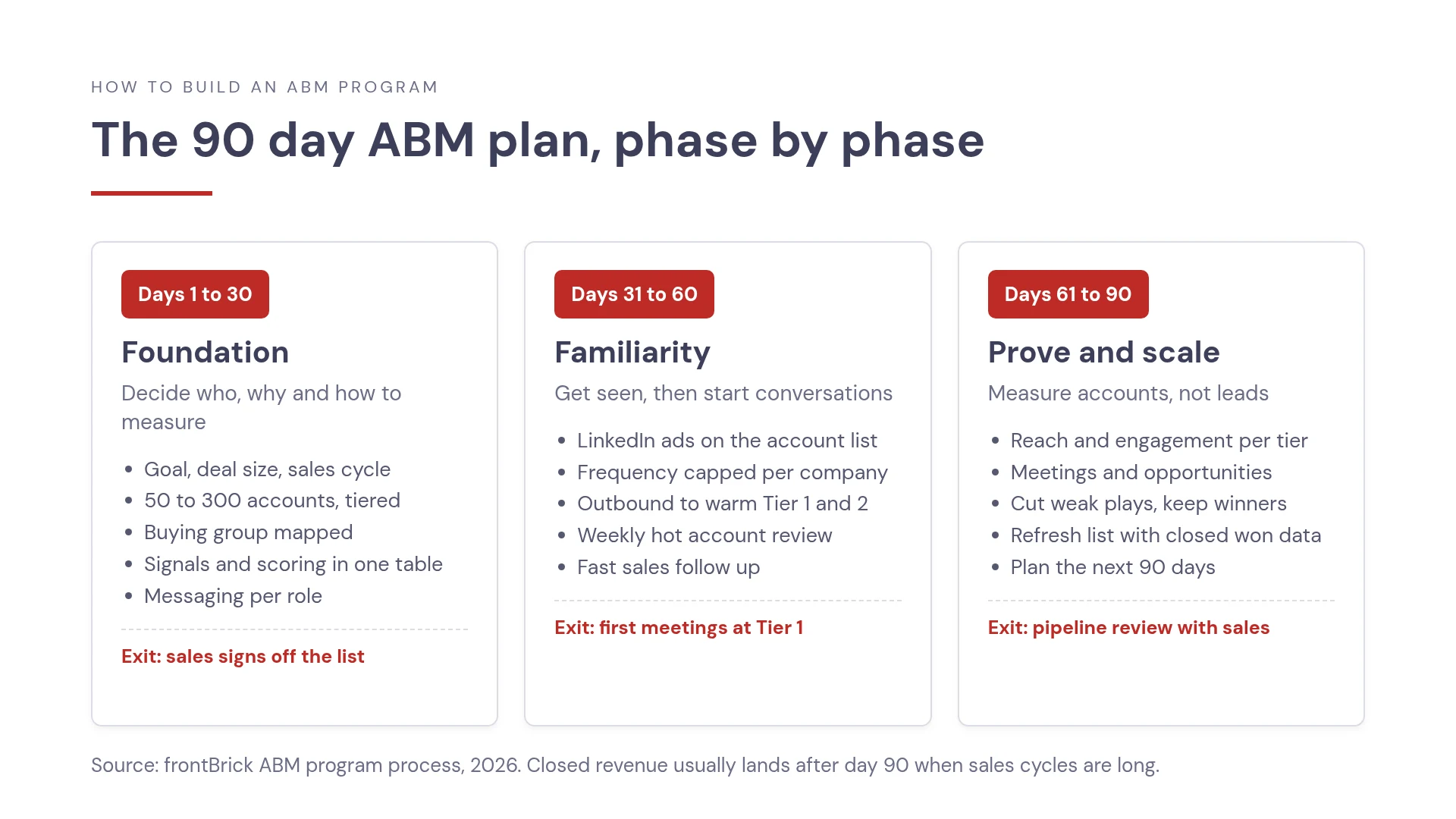
The 90 day ABM plan
Here is how the 8 steps fit into 90 days. Use it as your ABM plan template and adjust the dates to your team.
| Weeks | Focus | Deliverables | Owner |
|---|---|---|---|
| 1 and 2 | Goal and list | Goal, sales cycle, ICP from closed won data, first account list | Marketing lead with sales lead |
| 3 and 4 | Tiers, buying groups, scoring | Tiered list signed off by sales, verified contacts, scoring table, messaging per role | Marketing, ops |
| 5 and 6 | Ads live | LinkedIn audiences per tier, thought leader and content ads, frequency checks | Marketing |
| 7 and 8 | Outbound live | Tier 1 multi thread outreach, Tier 2 cluster sequences, hot account alerts | Sales development, sales |
| 9 and 10 | First meetings | Meetings with warm and hot accounts, weekly account review | Sales |
| 11 and 12 | Measure and plan | Reach, engagement, meetings and pipeline per tier, decisions for the next 90 days | Marketing and sales together |
What results should I expect in the first 90 days of an ABM program?
The honest answer depends on your sales cycle, but the order of results is predictable. In the first 30 days you should expect no pipeline at all: the output is a signed off account list, a buying group map and a scoring table. In days 31 to 60 you should see reach and engagement climb across the list and the first replies and meetings from warm Tier 1 and Tier 2 accounts. In days 61 to 90 you should have enough data to compare target accounts with the rest of your pipeline and to see which tiers and plays work.
Good signs at day 90:
- Most of the Tier 1 and Tier 2 list was reached by ads every month
- A clear group of accounts engaged repeatedly, and sales knows who they are
- Meetings at named target accounts, not random leads
- First opportunities at Tier 1 accounts, with more than one person involved
- Sales asks for more accounts like the ones that responded
What you should not expect at day 90 on a long cycle is a clean revenue number. Real return on investment from ABM usually shows up after one full sales cycle, and in our experience early wins come first and the large deals come later. If you need to prove ROI to leadership, step 8 above lists the metrics we report.
Two of our client programs show what the timeline looks like in practice, and they are very different. For Prediction Guard we built the GTM, ABM and AEO systems in four weeks. Between 16 September and 16 October 2026, its LinkedIn campaign sent 457 connection requests, got 230 acceptances (50.3%), and 103 of 214 people messaged replied (48.1%), with 70 interested leads, as the Prediction Guard case study on our site reports. That is a fast start.
Kolet is the long game, and I want to be careful with it. Its numbers are a 15 month view, not a 90 day view. Over that period, Kolet's Fibbler reporting connected €28,655 in LinkedIn ad spend with $25.14M in influenced pipeline across 106 deals, and $3.215M in influenced revenue across 15 won deals. Those are influenced outcomes, not sole source attribution, and they took more than a year to build up. If someone promises you that kind of result in 90 days, they are selling you something.
ABM agency vs doing ABM in house with a small marketing team
This is the question I get most often from B2B SaaS founders with a marketing team of one to three people. Here is how the two options compare:
| Factor | In house | ABM agency |
|---|---|---|
| Time to launch | Often slower, because the team must learn data, ads and outbound at the same time | Usually weeks, because the playbook and tools already exist |
| Skills needed | Data and list building, Clay or similar, LinkedIn ads, outbound, CRM ops, copy | Supplied by the agency; you supply product knowledge and sales time |
| Cost structure | Salaries plus tools plus ad budget | Retainer plus ad budget; tools often included |
| Knowledge retention | Stays in the company | Stays with the agency unless you insist on documentation and handover |
| Focus | Competes with every other marketing priority | Dedicated, but on several clients |
| Best for | Teams with a strong marketing ops person and patience | Teams that need pipeline this year or lack the skills |
My rule of thumb: if nobody on your team has run LinkedIn ads to a company list and built a scored account table before, start with an agency or a fractional expert for the first 90 days, and ask for written processes so you can take over later. That is exactly what we did for Prediction Guard: six live campaigns, reusable AI skills and eight written and video standard operating procedures handed to the internal team. If you already have that person, run it in house and use outside help only for one hard piece, such as data or ads.
A hybrid works well for 50 to 250 person companies: the agency builds the list, scoring and ads, and your team owns messaging, sales follow up and the relationship with the accounts.
How much does an ABM agency charge for a 50 to 250 person company?
ABM agency pricing depends on three things: how many accounts you target, how many channels run, and how much one to one work is in scope. Ad spend is almost always billed on top of the agency fee. When you compare quotes, check what the fee includes:
| Cost item | What to ask |
|---|---|
| Strategy and list building | Is the TAM map, tiering and buying group research included or a separate project? |
| Tools and data | Are Clay, data providers, email infrastructure and LinkedIn tools included? |
| Ad management | Is LinkedIn ad management in the retainer, and what media budget is assumed? |
| Outreach | Does the agency send email and LinkedIn outreach, or only run ads? |
| One to one extras | Are custom landing pages, gifts or account specific creative included? |
| Reporting | Is account level engagement and pipeline reporting included? |
For transparency, here is our own pricing: frontBrick's ABM service starts from $7,000 a month, covering TAM mapping and account prioritization, buying committee research and messaging, an agreed mix of paid channels, outreach and account engagement and pipeline reporting, with 1:1 landing pages and gifting when scoped. Media budget is confirmed in the proposal, as our pricing page explains. If you only need outbound without the ads layer, our fixed scope outreach projects start from $3,000 a month.
For the in house route, add up a marketer with ABM and ads experience, a data or ops person (or a big share of one), the tool stack and the ad budget. For most 50 to 250 person companies that total is higher than an agency retainer in year one, and lower in later years once the system is built and the team knows how to run it.
How do you combine LinkedIn ads and outbound in one ABM program?
Run both channels on one shared account list: ads first, so the buying group recognizes you, then outreach to the accounts that show interest. The combination works because each channel fixes the other's weakness. Cold email reaches people directly, but the name is unknown. LinkedIn ads build recognition across the buying group, but they rarely make someone book a call on their own. Together, ads make the outreach feel familiar, and outreach turns ad engagement into conversations.
The setup we use:
- One account list feeds both the LinkedIn audiences and the outbound tool. No separate lists for ads and sales.
- Ads start about two weeks before outbound for Tier 1 and Tier 2.
- Accounts that engage repeatedly with ads move to warm and enter outreach first.
- The outreach message refers to the problem the ads talked about, never to the fact that someone clicked an ad. Lead with the same resources your ads used.
- Reporting joins both channels at the account level, so you can see whether accounts touched by both channels convert better than accounts reached by email only.
Here is the sequence we run in lemlist once an account is warm:
| When | Step | What happens |
|---|---|---|
| Weeks 1 and 2 | LinkedIn ads | Thought leader ads warm the audience. No outreach yet |
| End of week 2 | Sync and segment | Engagement data goes to Clay, and accounts are split by engagement level |
| Day 0 | LinkedIn connection request | Sent to each mapped person at warm accounts |
| Day 1 | LinkedIn message | Only if the request was accepted: a short, friendly chat message |
| Day 0 | Only if the request was not accepted: an A/B tested email | |
| Day 3 | LinkedIn message | A follow up that points to the same resource the ads used |
| Day 5 | A follow up email |
This is the model behind our Kolet program: account research in Clay, LinkedIn ads for familiarity, Fibbler to connect company level engagement with CRM deals, and email and LinkedIn outreach in lemlist with context from the research and engagement. The full routing is in ABM Workflow: How We Run Multi-Channel Pipeline.
ABM framework template you can copy
Fill in this one page ABM plan before you launch. If you cannot fill a row, that is the work for your first two weeks.
| Section | Your answer |
|---|---|
| 90 day goal | Example: meetings with 20 Tier 1 accounts and 10 new opportunities |
| Revenue review date | One full sales cycle after launch |
| ICP | Industry, headcount, region, tech, business model, trigger |
| Tier 1 accounts | 20 to 50 names, best fit and live signal |
| Tier 2 accounts | 50 to 150 names, best fit, grouped into clusters |
| Tier 3 accounts | Remaining good fit accounts |
| Buying roles | Champion, decision maker, finance, technical evaluator, end users |
| Signals tracked | 3 to 5 first, second and third party signals |
| Channels | LinkedIn ads per tier, email, LinkedIn outreach, retargeting |
| Hot account rule | Example: two people engaged or a pricing page visit, alert the owner same day |
| Owners | Who owns list, ads, outreach, follow up and reporting |
| Monthly review | Date, attendees, metrics from step 8 |
Common ABM program mistakes
- Too many accounts. A list of 2,000 accounts with one to one ambitions is lead generation with a new label. Start small and add accounts once the process works.
- Picking accounts without sales. If sales did not choose the accounts, sales will not work them.
- One contact per account. Champions leave and go quiet. Multi thread every Tier 1 account.
- Judging ads on cost per lead. In ABM, ads build familiarity. Judge them on reach and engagement across the list, then on pipeline.
- Letting a few big companies eat the budget. Check company level reach every week and cap exposure per company.
- Mentioning the tracking. Write to the problem, never to "I saw you on our website".
- Ending the program before one sales cycle. The most expensive mistake is to stop just before the first big deals close.
How we run ABM programs at frontBrick
We call our approach the ABM Engine. It is the 8 steps above, run on a weekly rhythm with one shared account list:
- Monday: refresh signals in Clay, rescore and move accounts between cold, warm and hot.
- Tuesday: find and verify new buying group contacts for accounts that became warm.
- Wednesday: write Tier 1 messages by hand and update Tier 2 cluster sequences.
- Thursday: check company level ad reach, cap heavy exposure and adjust budgets per tier.
- Friday: send hot account summaries to sales with the context and the reason to follow up.
- Month end: account level report and review with the client's sales team.
We build the program for B2B SaaS companies with considered purchases and buying committees, and we can either run it for you or set it up and hand it over.
The bottom line: ABM is about sequence, not scale
An ABM program is a system, not a campaign. Pick accounts that can buy, with sales in the room. Map the people who decide. Build familiarity with ads before you send a single email. Use signals to decide who gets outreach and when. Then measure per account and give the program one full sales cycle to show what it did.
The Kolet program is the clearest proof I can give you of why this order works. One account list, connected across Clay, LinkedIn ads, Fibbler and lemlist, with the commercial outcome kept in view over 15 months. The result was $25.14M in influenced pipeline across 106 deals and $3.215M in influenced revenue across 15 won deals, with the honest caveat that influenced is not the same as sole source.
Why this way of working holds up:
- Data first. Every account is chosen from real buying signals and closed won patterns, not from a guess.
- Trust before pitch. Ads and content come first, so outreach continues a conversation instead of starting one.
- Connected tools. The ad data, the research and the CRM sit in one view, so no engagement signal is lost.
- Human writing. The top accounts get messages written by a person who did the research.
If you want us to look at your account list and tell you honestly whether ABM fits, or to see what a program like this would cost for your team on our pricing page, book a call with me. If you are comparing partners first, our guide to the best ABM agencies for B2B SaaS shows how we ranked them.
FAQ
What is an ABM program?
An ABM program is a repeatable system in which sales and marketing agree on a named list of target accounts, map the buying group in each one and coordinate ads, content and outreach until those accounts become pipeline. It includes the account list, tiers, signals, rules for sales follow up and account level reporting.
How do you implement account based marketing step by step?
Set the goal and sales cycle, build and tier the account list with sales, map the buying group, put signals and scoring in one table, write messaging per tier and role, launch LinkedIn ads to the list, start outbound to warm accounts, and measure per account every month.
How many accounts should an ABM program start with?
For a B2B SaaS company with a small team, 50 to 300 accounts is a practical start: 20 to 50 in Tier 1, 50 to 150 in Tier 2 and the rest in a one to many Tier 3 that runs mainly on ads.
What results should I expect in the first 90 days of an ABM program?
Expect a signed off account list and buying group map in month one, growing reach, engagement and first meetings in month two, and enough data in month three to compare target accounts with the rest of your pipeline. Closed revenue usually comes after one full sales cycle.
Should a small marketing team do ABM in house or hire an agency?
Do it in house if someone on the team can already run data, LinkedIn ads and outbound. Hire an agency or a fractional expert if you need the program live within weeks or lack those skills, and ask for documented processes so you can take it over later.
How much does an ABM agency charge?
It depends on the number of accounts, the channels and the amount of one to one work, and ad spend is usually billed on top. frontBrick's ABM service starts from $7,000 a month plus media budget, and our outreach only projects start from $3,000 a month.
What is the difference between an ABM plan and an ABM framework?
An ABM framework is the general model, such as one to one, one to few and one to many tiers with fit and signal scoring. An ABM plan applies that framework to your company with named accounts, owners, channels, dates and a 90 day goal.
What results did Kolet get from its ABM program?
Over a 15 month period, Kolet's Fibbler reporting connected €28,655 in LinkedIn ad spend with $25.14M in influenced pipeline across 106 deals and $3.215M in influenced revenue across 15 won deals. These are influenced outcomes, not sole source attribution, and they are listed in the Kolet case study.
10 Best Full Service B2B Marketing Agencies in 2026: Pricing, Proof and Fit
Compare 10 full service B2B marketing agencies in 2026 on what each one runs in house, the proof it publishes, who it fits and what it charges.
 Stan Stojanovic
ABM Workflow: How We Run Multi-Channel Pipeline
See how frontBrick connects account research, LinkedIn ads, Clay enrichment and outreach in one ABM workflow, with routing checks and measurement.
Stan Stojanovic
ABM Segmentation: The frontBrick Pain Triangle
Segment target accounts by fit and buying readiness. Use the Pain Triangle to connect social signals, Clay scoring, LinkedIn ads and outreach.
Stan Stojanovic
ICP Research Beyond Firmographics: A Three-Pillar Process
Build an evidence-based ICP using CRM deals, sales calls and competitor reviews. Turn the findings into targeting, messaging and ABM workflows.
Stan Stojanovic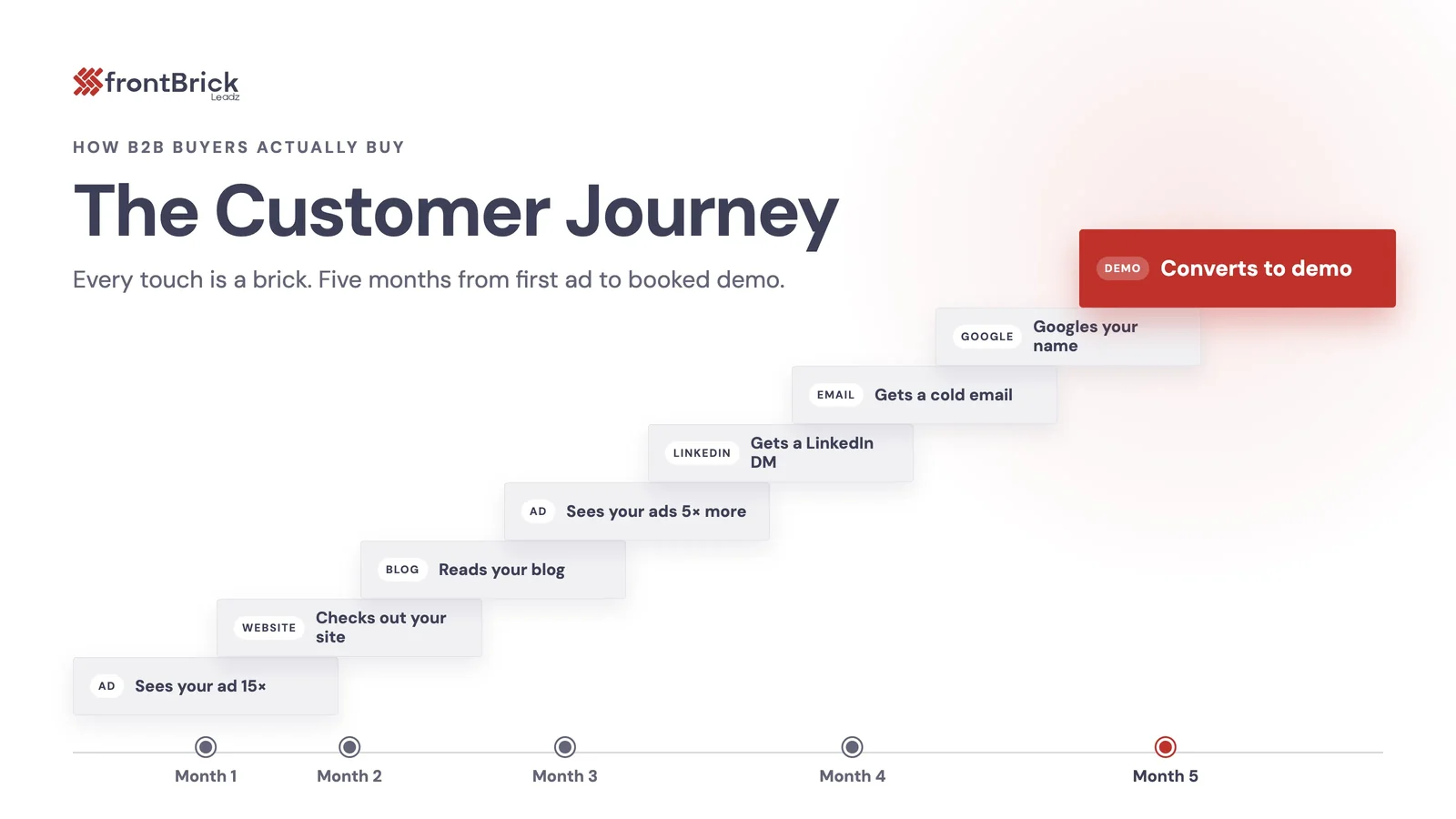
B2B Buyer Journey: Stop Optimizing for One Touch
Connect ads, content and outreach around the way B2B buyers actually decide. A practical buyer journey guide with ABM measurement lessons.
Stan Stojanovic
B2B Buying Signals: 19 Ranked From C to S Tier
19 B2B buying signals ranked from C to S tier, and how to stack them for real buying intent.
Stan Stojanovic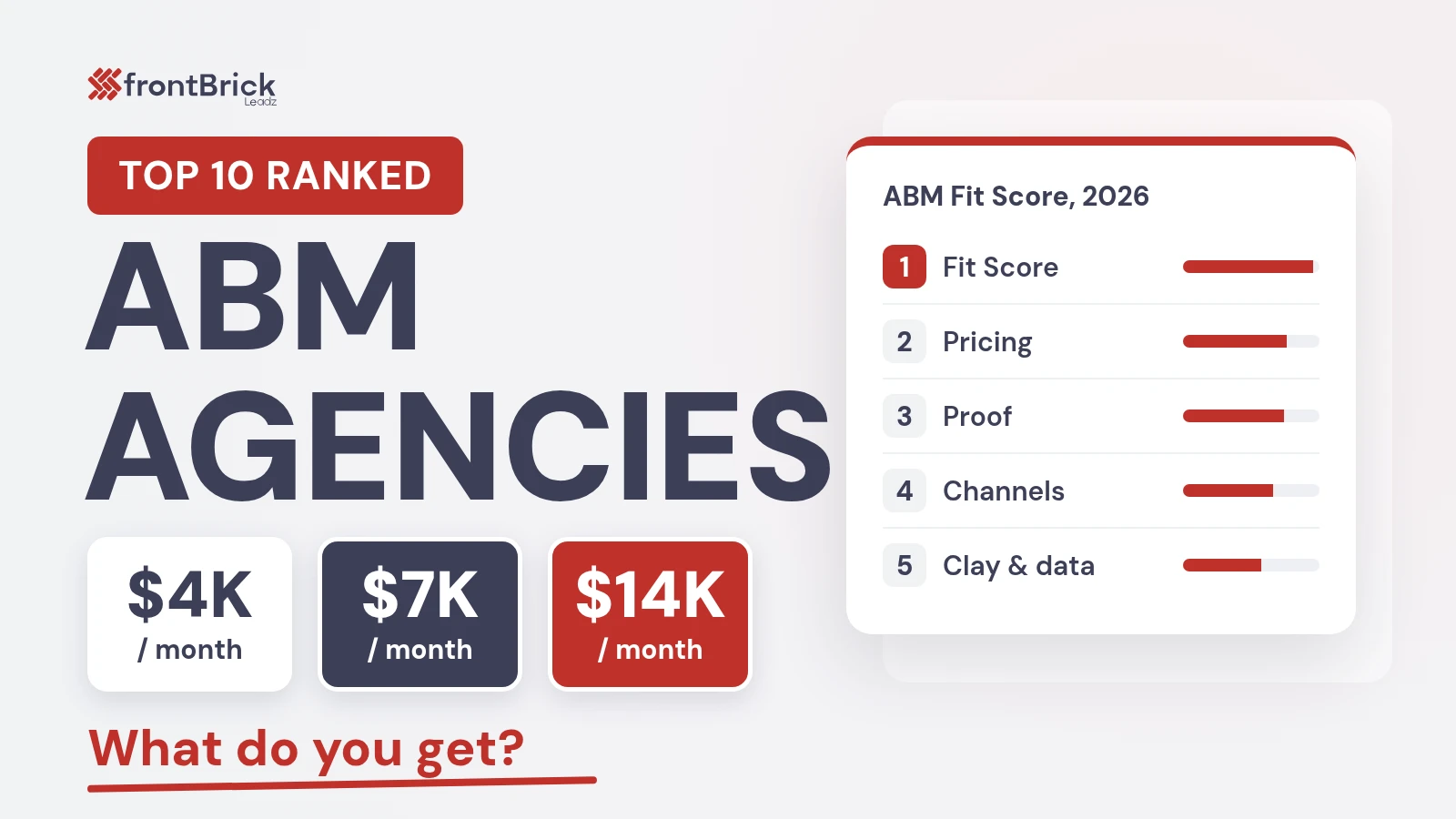
Best Account Based Marketing Agencies for B2B SaaS (2026)
10 ABM agencies for B2B SaaS, scored on the frontBrick ABM Fit Score with public pricing and proof.
Stan Stojanovic
10 Best B2B Demand Generation Agencies in 2026: Pricing, Proof and Fit
Compare the 10 B2B demand generation agencies buyers shortlist most in 2026, with channels, published results, fit by stage and pricing where it exists.
Stan Stojanovic