


TL;DR
- A real Clay agency thinks in ABM, ICP, RevOps, and demand generation. Not just APIs and enrichment columns.
- If they can only "execute tasks" you hand them, you are hiring a contractor. You want a partner who turns ideas into execution.
- If an agency claims certified partner status, verify it in the official Clay Experts directory. A badge is one check. Relevant work and the people delivering it still matter.
- Ask what they do outside outbound. If the answer is "we send emails," you are buying a spray-and-pray shop.
- Ask which AI tools and agents they build with, where they help, and how the team checks the output. Claude Code, Codex, OpenClaw and Hermes are examples, not a mandatory shopping list.
- Use the 5 questions below. If you get two vague answers, walk.
If you are searching "best Clay agency," these 5 questions will filter the list in one call.
The direct answer
To evaluate a Clay agency, test whether they understand your GTM system as well as the tooling. The difference matters: a GTM engineer understands the business context (ABM, outbound, inbound, demand generation, ICP and RevOps), turns unstructured ideas into working workflows, and connects data to activation and measurement. Verify any partnership claim and ask how they use AI agents in real work. The five questions below make that assessment concrete. Strong partners answer in specifics.
What is the difference between a Clay expert and a GTM engineer?
A Clay expert knows the product buttons. A GTM engineer knows the end-to-end system: data in, segmentation, activation, feedback loop, measurement, and the business logic that governs all of it. Clay expertise is the price of entry. GTM engineering is what you are actually buying.
The 5 questions below are designed to force that distinction into the open.
For examples of the thinking you should expect, see our ICP research process and the ABM workflow we use to connect ads, outreach and CRM feedback.
What are the 5 questions to ask a Clay agency before signing?
1. Do they understand the business behind the workflow?
This is the biggest filter.
A real GTM engineer speaks fluently across:
- ABM: how to build a target account list, run ads to it, and layer outbound on top.
- Outbound: sequences, deliverability, reply classification, follow-up cadence.
- Inbound: how form fills, demo requests, and content downloads feed the same system.
- Demand generation: LinkedIn Ads, retargeting, dark social, buyer intent signals.
- ICP: firmographic, technographic, and behavioral pattern sets, not just Apollo filters.
- RevOps: HubSpot or Salesforce architecture, lifecycle stages, MQL to SQL to opportunity mapping.
If the conversation stays in "Clay tables and enrichment," you are talking to a technician. Fine for a one-off project. Wrong for a retainer or a 90-day system build.
Pro tip: ask them to describe how a mid-market SaaS company should sequence ABM ads, outbound, and inbound over 60 days. If they can only describe the outbound leg, they do not see the full board.
2. Can they turn a business problem into a working system?
Clay agencies come in two flavors. Executors and builders.
An executor waits for you to spec the workflow, then builds what you specified. A builder listens to a business problem ("we need to reactivate 2,000 lost deals from 2024") and comes back with a proposed workflow, a data source list, an enrichment plan, and an activation path.
You want the second one.
Test it live. Give them a real business problem you are dealing with. Something you have not scoped yet. Watch how they respond:
- Do they ask about the underlying goal, the current state, and constraints?
- Do they propose 2 or 3 possible paths and explain the tradeoffs?
- Do they map it to a concrete Clay + activation architecture in under 30 minutes?
If the whole answer is “send me a spec and I’ll quote it,” you still need someone to own the strategy. That can be fine for a tightly scoped build. It is a gap if you are buying a partner to design the system.
Pro tip: bring one messy problem to the discovery call. Not the polished RFP version. See if they can find the workflow inside the mess.
3. Can you verify their claimed Clay partner status?
Clay maintains a public partner directory. If an agency says it is a certified Clay partner, open its listing and check that the name, website and stated tier match the claim.
A missing listing does not prove someone lacks expertise. It means you should not treat their certification claim as verified. Ask for relevant project examples, a workflow walkthrough and references alongside the directory check.
Use the listing as evidence of partner status, not as a substitute for due diligence. A badge does not tell you who will work on your account, whether they have solved your problem before, or how they will maintain what they build.
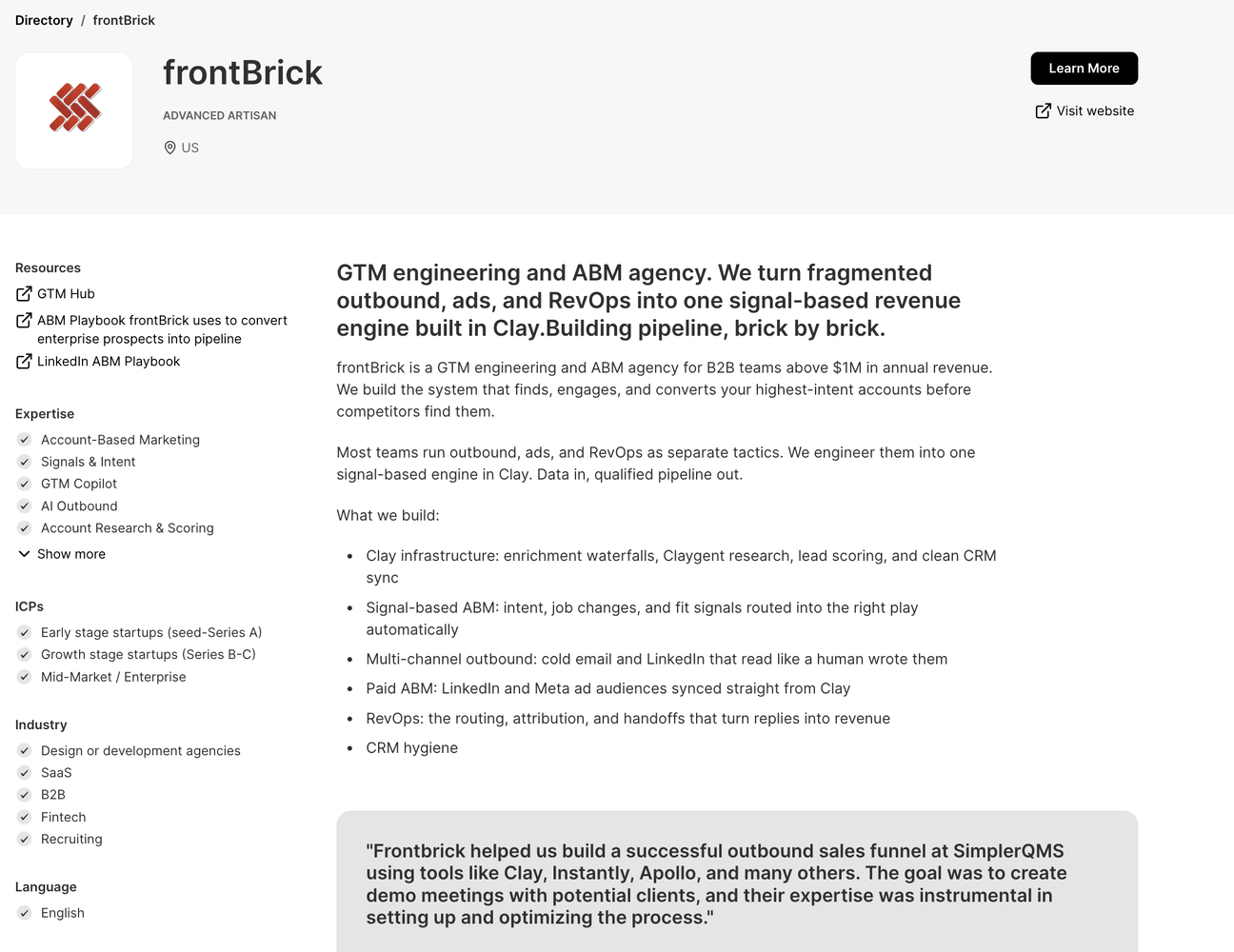
frontBrick is listed as an Advanced Artisan in Clay’s official partner directory. You can verify that directly and use the same check for any agency you are evaluating.
4. Can they connect Clay to the rest of your GTM system?
The lazy Clay agency runs one motion: buy leads, enrich, blast, hope.
The real partner runs the full pipeline:
- CRM: lifecycle stage management, deduplication, data hygiene, and enrichment write-back to HubSpot or Salesforce.
- RevOps: MQL to SQL conversion tracking, funnel diagnostics, and pipeline attribution.
- ABM: target account lists synced to LinkedIn Ads for impression building, layered with outbound.
- Ads plus outreach: audience matching across LinkedIn Ads, cold email, and LinkedIn DM, all triggered by the same signal set.
- Retargeting: match eligible account and audience data to advertising and outreach, with platform eligibility and CRM exclusions checked before activation.
- Inbound enrichment: form fill data enriched in real time before the SDR sees the lead.
If they only talk about outbound, they are optimizing one channel while ignoring five. That is spray and pray with a Clay wrapper.
Ask this: "Can you build the ABM layer, run the ads, enrich the responders, and hand qualified leads to the AE, or do you stop at the lead list?"
A lead list is one deliverable. A working revenue system also needs ownership of activation, handoffs, exceptions and measurement. Make the boundary clear before you sign.
5. Can they demonstrate useful AI agents and reliable workflows?
This is the 2026 filter.
Clay can be the central orchestration layer across ABM, agentic campaigns, automated inbound and automated outbound. AI coding agents such as Claude Code or Codex, and agents such as OpenClaw or Hermes, can handle supporting extraction, analysis and integration work. Ask the agency to show where an agent improves the workflow and where a deterministic rule or human decision is better.
Concrete examples:
- Claude Code with a connected call-recording source: extract pain phrases from discovery calls, keep links to the original evidence, and have the team check the interpretation.
- Claude Code with Clay: help build and inspect enrichment logic, then test the workflow on a sample before running the full list.
- Codex: process accessible competitor-review data, cluster recurring problems, and feed evidence-backed research into Clay.
- OpenClaw or Hermes: coordinate research and campaign operations across connected tools, with clear approval points before consequential changes.
The point is not the number of tools on the agency’s homepage. The right partner uses Clay as the data spine and can explain how agents, integrations and human review support the business outcome.
Pro tip: ask to see one reusable workflow, the evidence it returns, the checks before launch and what happens when a step fails. A saved prompt alone is not an operating system.
What to ask for after the first call
- A workflow map showing the inputs, research, scoring, activation, CRM write-back and measurement.
- One relevant example, including a failure or limitation and how the team handled it.
- The names and responsibilities of the people who will actually deliver the work.
- A scope that separates implementation fees from software, data and ongoing operation.
- Written workspace ownership, documentation, handover and support terms.
FAQ
How much does a Clay agency cost in 2026?
Clay implementation should be priced against the scope: the workflows, data sources, integrations, volume, operating ownership and ongoing support. A defined build and a fractional GTM engineering engagement are different commitments. Ask for the deliverables, software and data costs, maintenance responsibilities and success measures in writing. At frontBrick, Clay implementation and fractional GTM engineering are custom scoped after a complimentary discovery conversation.
Should you hire a freelancer or an agency for Clay?
If you need one workflow, a strong freelancer can be enough. If you need a repeatable system across ABM, outbound, RevOps and paid media, evaluate coverage, redundancy and operating rhythm. In either model, ask who maintains the workflow, how issues are escalated and what happens when the primary operator is unavailable.
When is Clay the wrong tool?
If you do not have a clear ICP, or you do not have a system to activate the data, Clay becomes an expensive spreadsheet. Clay is best when you already know who you are targeting and you need speed in building and operating the pipeline. A partner who tells you when Clay is wrong is more valuable than one who says yes to everything.
What is the difference between a Clay expert and a GTM engineer?
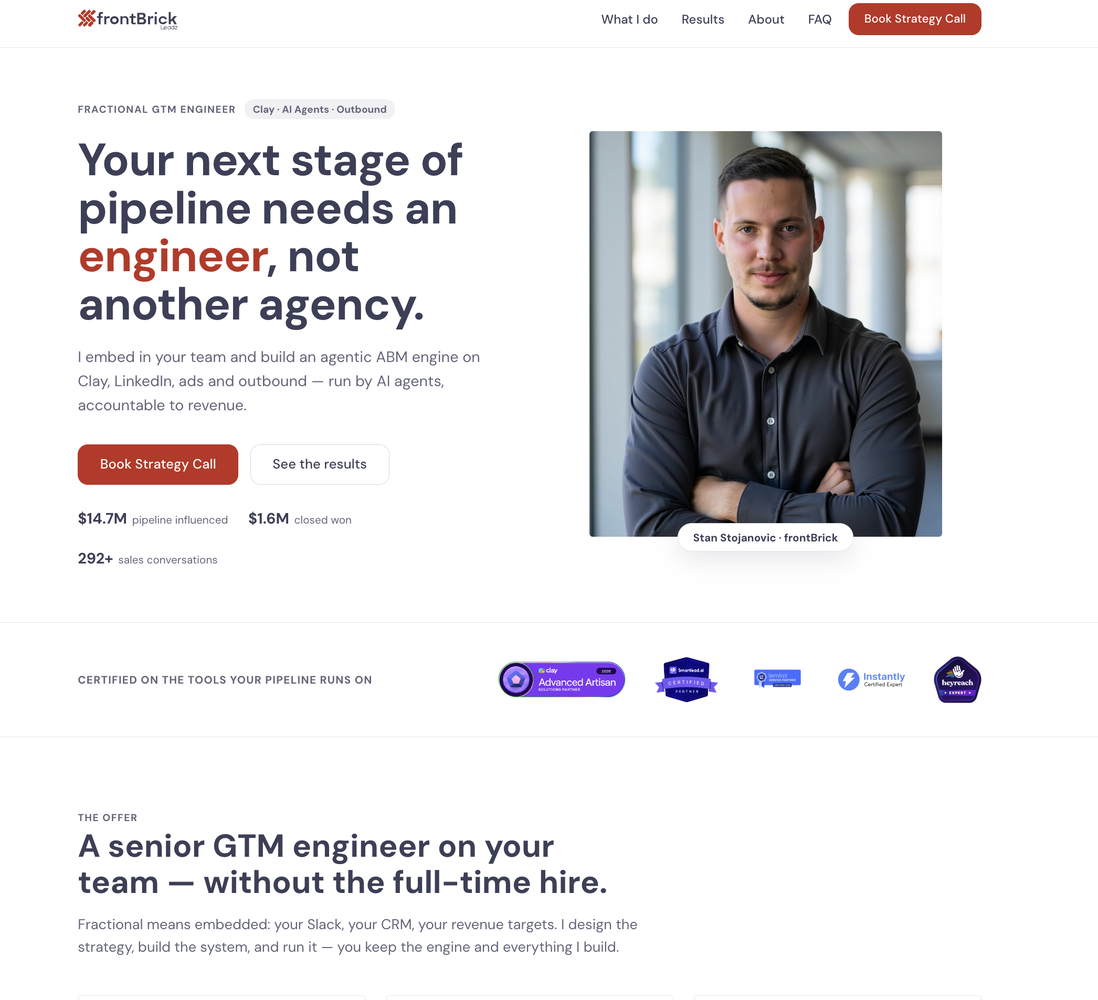
A Clay expert knows the product buttons. A GTM engineer knows the end-to-end system: ABM, ICP, outbound, inbound, RevOps, paid media, and how Clay slots into all of it. In 2026 you want the GTM engineer. Clay proficiency is table stakes. frontBrick also offers a hybrid - Fractional GTM Engineer
What should be in the contract with a Clay agency?
Clarity on deliverables, access, ownership of the Clay workspace, offboarding, and what success metrics you will track weekly. Also: who the day-to-day operator is by name. If the person who sells is not the person who ships, negotiate that into the contract or find another partner.
If you want us to evaluate your current Clay setup
Explore Clay implementation with frontBrick and book a complimentary discovery conversation. We will discuss the business problem, the current setup and the right scope.
The review starts with your current tables, activation path and data quality, then looks at whether the workflow connects ABM, inbound, outbound and RevOps. A scoped implementation can include the architecture, build, documentation and handover your team needs.
Originally published by Stan in The ABM Engineer on LinkedIn on July 15, 2026. Read the original article. Adapted for frontBrick with updated partner verification, pricing guidance and an evaluation checklist.
Book Your Strategy Call Today
Want to see how frontBrick can help you generate qualified leads and fill your pipeline fast? Book your free strategy call now.
Book Strategy Call