
Best ABM Platforms for Mid-Market B2B in 2026 (and When an ABM Agency Should Come First)
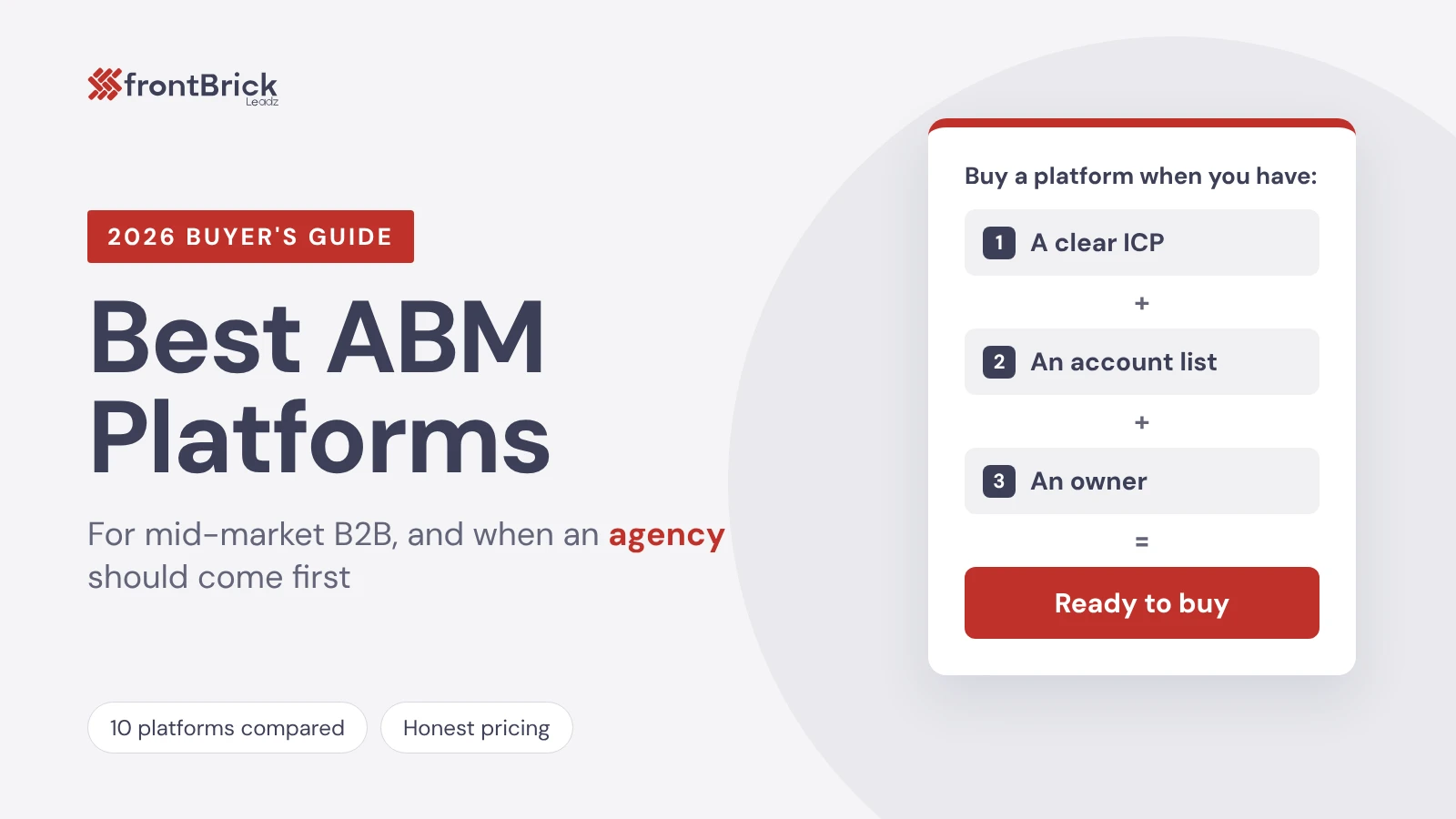
The best account based marketing platforms for most mid-market B2B teams are Clay for the account list and buying signals, HubSpot if your CRM already lives there, and AdRoll ABM or N.Rich for ads and intent. 6sense and Demandbase are strong too, but they assume you already have an account list, a clean CRM and 3 to 6 months to implement. So the first question is not which platform to buy. It is whether you need software yet, or someone to build the ABM motion first.
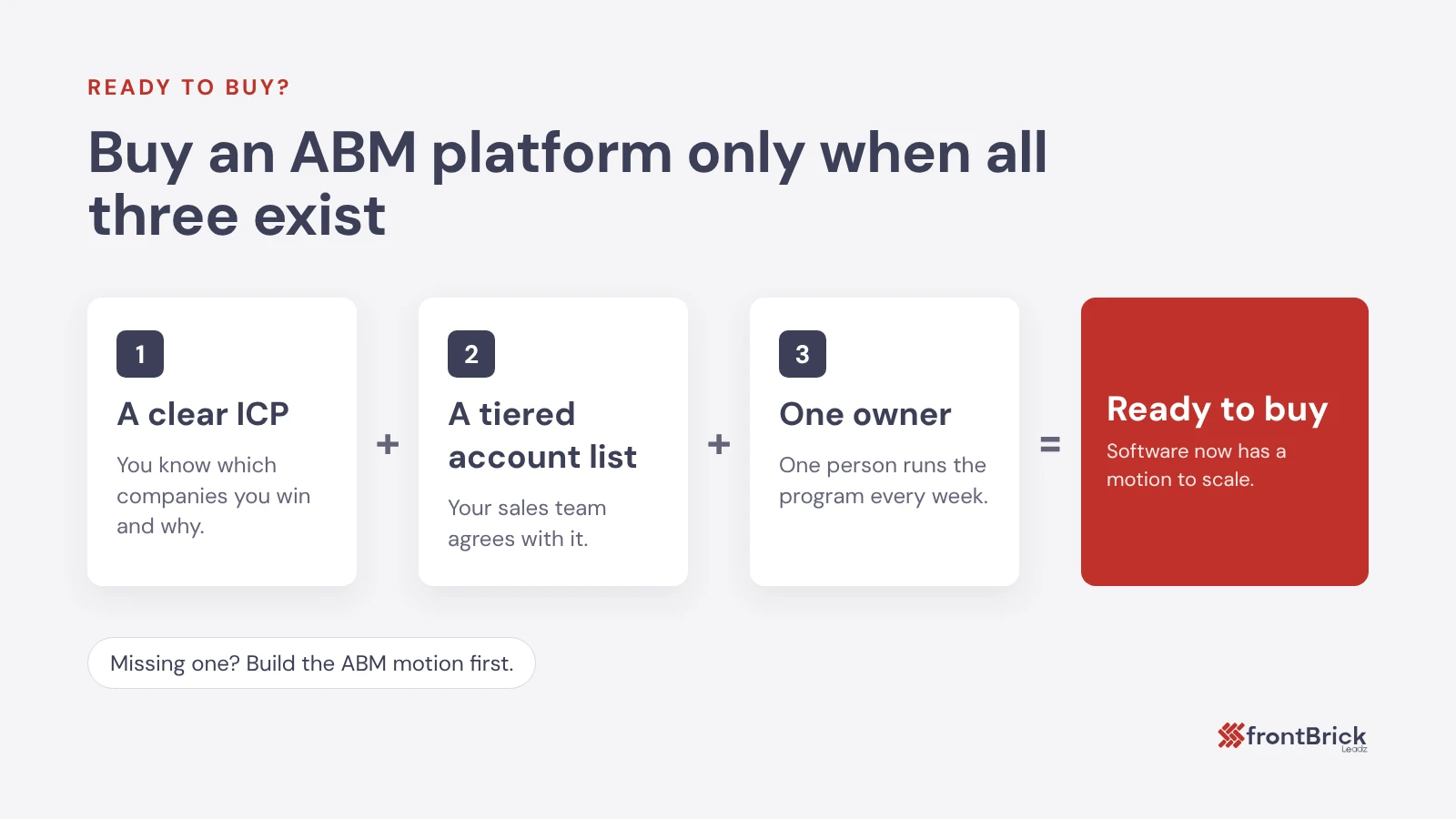
Our rule is simple. Buy an ABM platform only once three things exist: a clear ICP, a tiered account list your sales team agrees with, and one person who owns the program.
This comparison covers 10 ABM platforms and is based only on information each vendor publishes, as of November 2026. We show published prices for HubSpot and N.Rich. Where a platform does not publish pricing, we list it as "custom quote".
Key takeaways
| Question | Short answer |
|---|---|
| Best for building the account list and buying signals? | Clay. |
| Best ABM platform if you already use HubSpot? | HubSpot Marketing Hub Professional or Enterprise. The ABM tools are built in. |
| Best for mid-market, ad-led ABM? | AdRoll ABM (formerly RollWorks) or N.Rich. |
| Best for paid social campaigns? | Metadata.io. |
| Best for ads to named people, not just companies? | Influ2. |
| Best for predictive intent at scale? | 6sense or Demandbase, once you have ops people to run them. |
| How much do ABM platforms cost? | HubSpot Marketing Hub Professional starts at $800 per month, billed annually, plus a one-time $3,000 onboarding fee. N.Rich starts at $35,520 per year. Most other platforms provide pricing on request. |
| Do you need a platform yet? | Only if your ICP, account list and owner already exist. If not, build the motion first. |
What is an account based marketing platform?
An account based marketing platform is software that helps you pick target accounts, spot which ones are showing interest, reach them with ads, and report on engagement by account instead of by lead.
Most ABM tools cover some of these five jobs:
- Account identification. Which companies visit your site and match your ICP.
- Intent data. Which accounts are researching your topic on other sites.
- Account-based advertising. Showing ads only to people at your target accounts.
- Sales alerts and plays. Telling reps which account to contact, and when.
- Account-level reporting. Engagement and pipeline by account, not by single lead.
No platform does all five equally well. That is why the right pick depends on which job matters most to you right now.
The best ABM platforms for mid-market, at a glance
These are the best ABM platforms for mid-market B2B teams, ranked for companies with a small marketing team and no dedicated ABM operations person.
| # | Platform | Best for | Starting price |
|---|---|---|---|
| 1 | Clay | Building the account list, buying committee and signals | See Clay's website |
| 2 | HubSpot Marketing Hub | Teams that already run on HubSpot CRM | $800/month (billed annually) + $3,000 onboarding |
| 3 | AdRoll ABM (formerly RollWorks) | Mid-market teams that want intent and ads in one tool | Custom quote |
| 4 | DemandScience (formerly Terminus) | Multi-channel ads combined with B2B data | Custom quote |
| 5 | N.Rich | Ad-led ABM with published pricing | $35,520/year |
| 6 | Metadata.io | Paid social and search campaigns | Custom quote |
| 7 | Influ2 | Ads to named people at target accounts | Custom quote |
| 8 | ZoomInfo Marketing | Teams that already buy ZoomInfo data | Custom quote |
| 9 | 6sense | Predictive intent for sales-led teams | Custom quote |
| 10 | Demandbase | Full ABM suite with its own B2B ad network | Custom quote |
1. Clay: best for building the account list and buying signals
Best for: mid-market teams that want to own their ABM data: the account list, the buying committee at each account and the signals that say when to reach out.
Clay is a data and workflow platform. For ABM, it builds and scores your account list, finds the people in each buying committee and tracks buying signals, then pushes audiences and plays to your ad and outreach tools. This is how we run the data side of our own ABM programs, and frontBrick is a Clay partner agency.
Key features:
- Account lists built from Clay's company database and sources such as Ocean.io, HG Insights and Google Maps, plus people search to find and verify key contacts.
- Enrichment from 150+ data providers, plus AI web research.
- Signal tracking for job changes, new hires, promotions, website intent and headcount shifts, with alerts to account owners in Slack.
- Account tiering by fit, AI contact grading, and accounts moved through stages automatically.
- Audience sync to LinkedIn, Meta and Google, plus a native sequencer for outreach.
Pricing: Check Clay's website for current plans.
One limitation: Clay is a builder, not a finished ABM product. Someone has to design the tables, scoring and workflows, which is why many teams bring in a Clay agency or a GTM engineer to set it up.
2. HubSpot Marketing Hub: best if your CRM already lives in HubSpot
Best for: mid-market teams that already run sales and marketing in HubSpot and want to start ABM without adding another vendor.
Key features:
- A target accounts dashboard shared by marketing and sales, showing open deals, deal value and stakeholder engagement for each account.
- Account discovery and scoring through HubSpot recommendations or automated workflows.
- LinkedIn campaigns aimed at contacts at key accounts, plus a LinkedIn Sales Navigator connection.
- ABM dashboards and reports for account engagement, pipeline progress and revenue attribution.
- Workflows that automate account updates, follow-ups and prioritization.
Pricing: The ABM tools are included in the premium versions of Marketing Hub and Sales Hub. Marketing Hub Professional costs $800 per month billed annually, or $890 billed monthly, with 3 seats, 2,000 marketing contacts and a one-time $3,000 onboarding fee. Enterprise starts at $3,600 per month plus a $7,000 onboarding fee.
One limitation: HubSpot works with accounts you already know. It has no account-based ad network of its own, so teams that need to reach anonymous buyers at accounts not yet in the CRM usually add a second tool.
3. AdRoll ABM (formerly RollWorks): the best all-round mid-market pick
Best for: mid-market B2B teams that want account identification, intent data and advertising in one tool, without building a separate tech stack.
RollWorks, NextRoll's account based marketing unit, became AdRoll ABM in August 2025. The platform, integrations and settings stayed the same. Only the name changed.
Key features:
- Account identification using AdRoll's own network, Bombora intent data, and firmographic and technographic data.
- ICP fit scoring, with scores pushed to Salesforce and HubSpot.
- Intent signals that combine AdRoll's own data with Bombora and G2.
- Account-based display and LinkedIn ads aimed at known and unknown contacts at target accounts.
- Sales Insights, which flags accounts showing a spike in engagement and emails the account owner.
Pricing: Custom quote.
One limitation: AdRoll ABM finds and warms up accounts, but it has no native email sequencing or sales engagement tools. Outreach still runs in a separate tool.
4. DemandScience (formerly Terminus): ABM ads plus demand generation
Best for: mid-market teams that want account-based advertising and demand generation, such as content syndication, from one vendor.
Terminus merged into DemandScience in November 2024, and the combined company operates under the DemandScience brand. The former Terminus platform is now sold as ABX by DemandScience.
Key features:
- Account identification and prioritization based on intent data.
- Multi-channel account-based ads, including LinkedIn, connected TV and audio.
- Data Studio, which works like a customer data platform for account data.
- ABM and content syndication campaigns run together, with unified reporting.
- Pipeline and revenue measurement by account.
Pricing: Custom quote.
One limitation: The product is still settling after the merger. Before you sign, ask which parts are self-serve software and which are run as a managed service, and what the roadmap looks like for the former Terminus features.
5. N.Rich: ad-led ABM with published pricing
Best for: mid-market teams that want account-based advertising and intent data, and want to know the full cost before a sales call.
N.Rich is one of the few platforms in this list that publishes its prices. It also states that it is recognized in the 2026 Gartner Magic Quadrant for ABM Platforms.
Key features:
- Account-based ads in four formats (article, video, cross-channel and image display), shown only to target accounts.
- Intent data on 25, 50 or unlimited topics, depending on the plan, plus website visitor identification.
- LinkedIn Matched Audiences sync.
- Two-way CRM integration with Salesforce and HubSpot, opportunity attribution and sales alerts.
- Unlimited users on every plan.
Pricing: Published on the N.Rich pricing page. GTM Scale costs $2,960 per month, billed annually ($35,520 per year). GTM Command costs $4,770 per month, billed annually ($57,240 per year). GTM Enterprise is priced on request. Every plan is an annual licence.
One limitation: The licence is only part of the cost. Ad spend is billed separately, per verified engagement, and comes with a 12-month baseline spend commitment.
6. Metadata.io: best for paid social and search campaigns
Best for: mid-market demand generation teams that run a lot of paid campaigns and want them built, launched and optimized in one place.
Metadata.io is a B2B advertising platform. It builds the audience, creates the campaign assets, then runs and optimizes the campaigns.
Key features:
- Campaigns across 12 channels, including LinkedIn, Facebook, Instagram, Google Ads, Microsoft Bing, Reddit, X, display and connected TV.
- Audiences built from firmographics, technographics, intent signals and retargeting.
- Landing pages, ad creatives and commercials generated from your campaign direction.
- Automatic bid and budget changes toward the goals your team sets, with spend caps and approval rules.
- CRM-connected reporting that tracks influence on leads, pipeline and revenue, plus a company-level account journey view.
Pricing: Custom quote.
One limitation: Metadata.io is built for paid campaigns. It does not replace sales alerts or outreach, so it works best next to a CRM and an outbound process.
7. Influ2: best for ads to named people at target accounts
Best for: teams that already know who sits on the buying committee and want to warm up those exact people before sales reaches out.
Influ2 is a contact-level ABM platform. It shows ads to selected people at target accounts instead of to whole companies.
Key features:
- Person-based ads to chosen contacts, with reporting on which named people engaged, without a form fill.
- Contact-level intent signals that show which buyers are researching your topics, and when.
- Signals passed to sales with names, context and timing.
- Buyer journeys that send messages matched to each contact's intent, engagement and sales stage.
- Contact-level revenue attribution.
Pricing: Custom quote. Pricing is based on the number of people you target.
One limitation: Influ2 needs a list of the right people at each account before it can work. Building that list is a separate job, and it is where most ABM programs succeed or fail.
8. ZoomInfo Marketing: best if you already buy ZoomInfo data
Best for: teams that already use ZoomInfo for contact and company data and want to run ABM on top of it.
ZoomInfo Marketing is ZoomInfo's ABM platform. It uses real-time buyer signals to trigger automated campaigns across several channels.
Key features:
- Cross-channel advertising to target accounts, timed by intent data and signals.
- Buyer intent data that shows which accounts are researching your topics.
- Website visitor identification that shows which companies visit your site.
- Web form enrichment, so forms can ask for fewer fields.
- Website chat to turn visits into conversations with sales.
Pricing: Custom quote.
One limitation: Its strength is ZoomInfo's own contact and company database. If you do not already use ZoomInfo, you are buying into a larger data ecosystem to get the ABM layer.
9. 6sense: best for predictive intent in sales-led teams
Best for: sales-led teams with a large target market that need to know which accounts are in market now, and have RevOps or marketing ops people to run the platform.
Key features:
- Predictive models that show which accounts are likely to buy and where they are in the buying process.
- Intent data from 6sense's own publisher network plus third-party sources such as Bombora and G2.
- Account identification that matches anonymous website visitors to companies.
- Ads across LinkedIn, Google and Meta that change with the buyer's stage.
- Prioritized account lists, recommended sales plays and AI email agents for outreach.
- Integrations with Salesforce, HubSpot, Outreach and Gong.
Pricing: Custom quote. See 6sense.com.
One limitation: 6sense produces a lot of signals. Without someone in RevOps or marketing ops to set up the models and make sure sales acts on the alerts, much of that value goes unused.
10. Demandbase: best full ABM suite for teams moving toward enterprise
Best for: larger mid-market teams moving toward enterprise that want one suite across marketing, sales and customer success, and have operations support to run it.
Key features:
- Identification and prioritization of in-market accounts.
- Buying groups, showing the people involved in each purchase, plus a Family Tree view of related accounts.
- Its own B2B advertising product for cross-channel programs aimed at target accounts.
- Sales intelligence that shows which accounts are active, who is involved and when to engage.
- Reporting on which programs drive revenue, including campaign influence.
Pricing: Custom quote. See demandbase.com.
One limitation: It is the broadest suite on this list, which also makes it the hardest to set up and run with a small team.
Lighter tools worth knowing
Not every team needs a full ABM platform. These tools each do one ABM job well, and smaller teams often start with one of them:
- Factors.ai: website account identification, LinkedIn and Google ad audience sync, and attribution in one place.
- Warmly: person-level website visitor identification, with real-time alerts and AI chat.
- Common Room: buyer signals from website visits, product usage and community activity, scored for outreach.
ABM platform comparison: features, pricing and fit
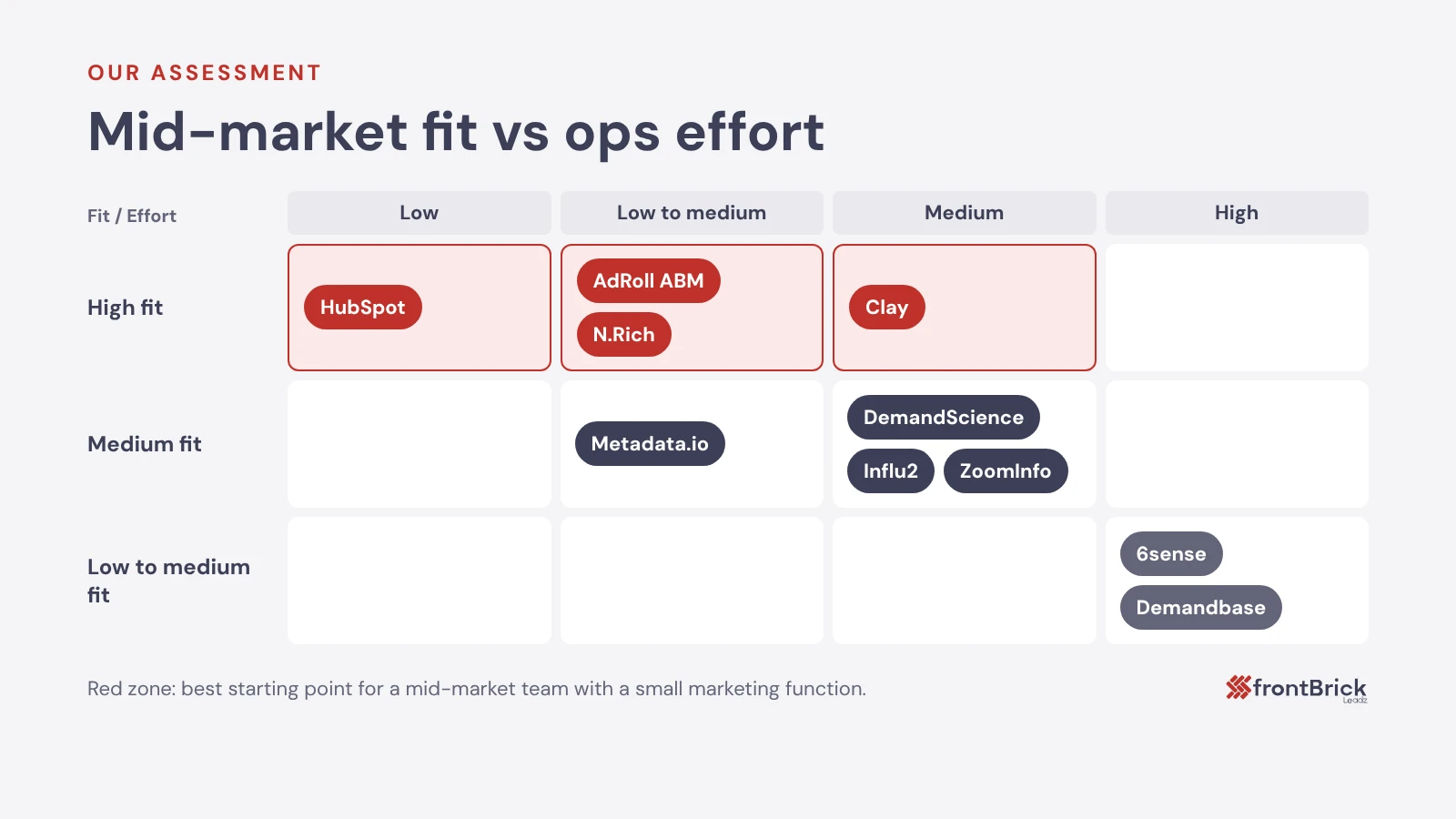
This table compares all 10 ABM platforms side by side. The last two columns are our assessment for a mid-market team with a small marketing function.
| Platform | Core strength | Ad channels | Intent data | Published pricing | Ops effort | Mid-market fit |
|---|---|---|---|---|---|---|
| Clay | Account list, enrichment and signals | Audience sync to LinkedIn, Meta, Google | 150+ data providers, website intent, job changes | Yes | Medium | High |
| HubSpot Marketing Hub | ABM inside the CRM | LinkedIn campaigns | Your CRM and website data | Yes | Low | High, if you use HubSpot |
| AdRoll ABM (formerly RollWorks) | Intent and ads in one tool | Display, LinkedIn | AdRoll, Bombora, G2 | No | Low to medium | High |
| DemandScience (formerly Terminus) | ABM ads plus demand generation | LinkedIn, display, connected TV, audio | Yes | No | Medium | Medium |
| N.Rich | Ad-led ABM | Article, video, cross-channel and display ads; LinkedIn sync | 25 topics and up | Yes | Low to medium | High |
| Metadata.io | Paid campaign automation | 12 channels, including LinkedIn, Google and Meta | Used for audience building | No | Low to medium | Medium, for paid-heavy teams |
| Influ2 | Ads to named people | Person-based ads | Contact-level | No | Medium | Medium |
| ZoomInfo Marketing | ABM on ZoomInfo data | Cross-channel | Yes | No | Medium | Medium, if you use ZoomInfo |
| 6sense | Predictive buying stage | LinkedIn, Google, Meta | Own network, Bombora, G2 | No | High | Low to medium |
| Demandbase | Full ABM suite | Own B2B ad product | Yes | No | High | Low to medium |
Platform or agency first?
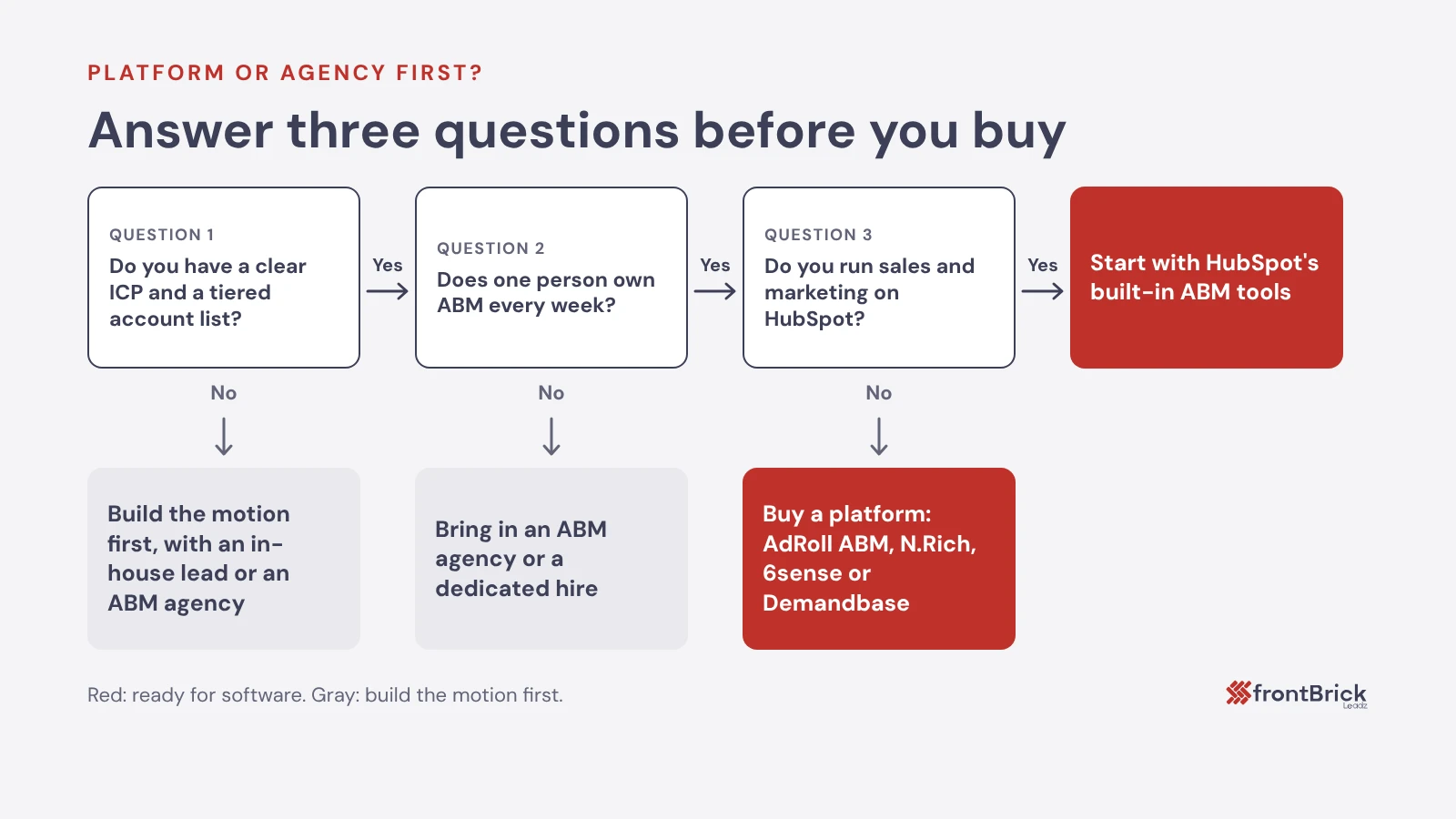
If your ICP, target account list and program owner do not exist yet, start by building the ABM motion, not by buying software. An ABM platform amplifies a strategy. It does not create one.
| Your situation | Start with | Why |
|---|---|---|
| No agreed ICP or target account list | Building the motion, with an in-house lead or an agency | A platform needs an account list to work from. |
| An account list, but no one owns ABM day to day | An ABM agency or a dedicated hire | Platforms produce signals. Someone has to act on them. |
| ICP, list and owner in place, and you run on HubSpot | HubSpot's built-in ABM tools | Start with what you already pay for. |
| All three in place, and you need intent across a large market | A dedicated platform such as AdRoll ABM, N.Rich, 6sense or Demandbase | Now the software has a working motion to scale. |
What building the motion looks like. This is the work we do as an account based marketing agency. We map your total addressable market in Clay, score accounts against your ICP and monitor buying signals such as website visits, ad engagement, hiring and funding. Paid campaigns on LinkedIn, Google, Meta or ChatGPT Ads run against the same account list, and email and LinkedIn outreach is part of every setup. Our full ABM system starts at $7,000 per month, with the media budget agreed in the proposal. See our pricing.
For Kolet, the first 45 days produced 21 SQL opportunities from 437 prospects. Over 15 months, Kolet's Fibbler reporting shows $25.14M in influenced pipeline across 106 deals, on €28,655 of LinkedIn ad spend. Influenced pipeline is not the same as sole-source attribution. Check out the Kolet case study.
The system we build stays yours. If you add a platform later, it plugs into an account list, signals and workflows that already work. For the full plan, read our guide on how to build an ABM program and our ABM workflow. To compare agencies, see our list of the best account based marketing agencies.
Frequently asked questions
How much do ABM platforms cost?
HubSpot Marketing Hub Professional starts at $800 per month, billed annually, plus a one-time $3,000 onboarding fee, and Enterprise starts at $3,600 per month plus $7,000 onboarding. N.Rich starts at $35,520 per year, with ad spend billed separately. For Clay, check its website for current plans. Most other platforms quote custom prices. Budget for ad spend, data and the time of the person who runs the program, not just the licence.
Is HubSpot enough for account based marketing?
Yes, if you already run on HubSpot and know which accounts you want to win. Marketing Hub Professional and Enterprise include target accounts, account scoring, LinkedIn campaigns and ABM reporting. Add a dedicated platform when you need to reach anonymous buyers at accounts that are not yet in your CRM, or track intent across a large market.
What is the best ABM platform for a small marketing team?
Pick the one your team can actually run. To build your own account list and signals, start with Clay. If you use HubSpot, start with its built-in ABM tools. If you want ads and intent with low setup effort, look at AdRoll ABM or N.Rich. If you only need one job done, such as website visitor identification, a lighter tool like Factors.ai or Warmly may be enough.
What are the best alternatives to 6sense and Demandbase for mid-market teams?
The main mid-market alternatives are AdRoll ABM and N.Rich, plus HubSpot's built-in ABM tools if you already use HubSpot. They need less operations support to run. Neither 6sense nor Demandbase publishes pricing, so we cannot compare costs directly. Ask each vendor for a quote with the same scope, number of accounts and ad spend, then compare like for like.
What do you need in place before buying an ABM platform?
Three things: a clear ICP, a tiered target account list your sales team agrees with, and one person who owns the program. Clean CRM data helps too, because most platforms match accounts by company domain. Our guide to ICP research covers the first step.
Should you hire an ABM agency or buy an ABM platform first?
If your ICP, account list or program owner is missing, start with the motion: an ABM agency or an experienced hire who can build it. Buy a platform once that motion works and you need software to scale it. See how our account based marketing agency approaches this.
What results should you expect from ABM in the first 90 days?
Expect a clean, scored account list in month one, engagement and replies in month two, and first meetings and opportunities in month three. Pipeline usually becomes measurable in the second quarter. For Kolet, the first 45 days produced 21 SQL opportunities from 437 prospects.
What is the difference between ABM tools and an ABM platform?
An ABM tool does one job well, such as website visitor identification, intent data or account-based ads. An ABM platform combines several of these jobs and reports on engagement and pipeline by account. Many mid-market teams start with one or two tools and add a platform later.
Can you run ABM without an ABM platform?
Yes. Many teams start with a lighter setup: build and enrich the account list in Clay, track buying signals, run LinkedIn ads to the list with Matched Audiences, and follow up with email and LinkedIn outreach from your CRM. If you do not yet have an ICP, an account list and an owner, start this way. Add a platform once the motion works.
Not sure whether you need an ABM platform yet? We can help you build the ABM motion first, then choose the right software to scale it. See how our account based marketing agency works, or book a strategy call.
11 Best Full Service B2B Marketing Agencies in 2026: Pricing, Proof and Fit
Compare 11 full service B2B marketing agencies in 2026 on what each one runs in house, the proof it publishes, who it fits and what it charges.
 Stan Stojanovic
ABM Workflow: How We Run Multi-Channel Pipeline
See how frontBrick connects account research, LinkedIn ads, Clay enrichment and outreach in one ABM workflow, with routing checks and measurement.
Stan Stojanovic
ABM Segmentation: The frontBrick Pain Triangle
Segment target accounts by fit and buying readiness. Use the Pain Triangle to connect social signals, Clay scoring, LinkedIn ads and outreach.
Stan Stojanovic
ICP Research Beyond Firmographics: A Three-Pillar Process
Build an evidence-based ICP using CRM deals, sales calls and competitor reviews. Turn the findings into targeting, messaging and ABM workflows.
Stan Stojanovic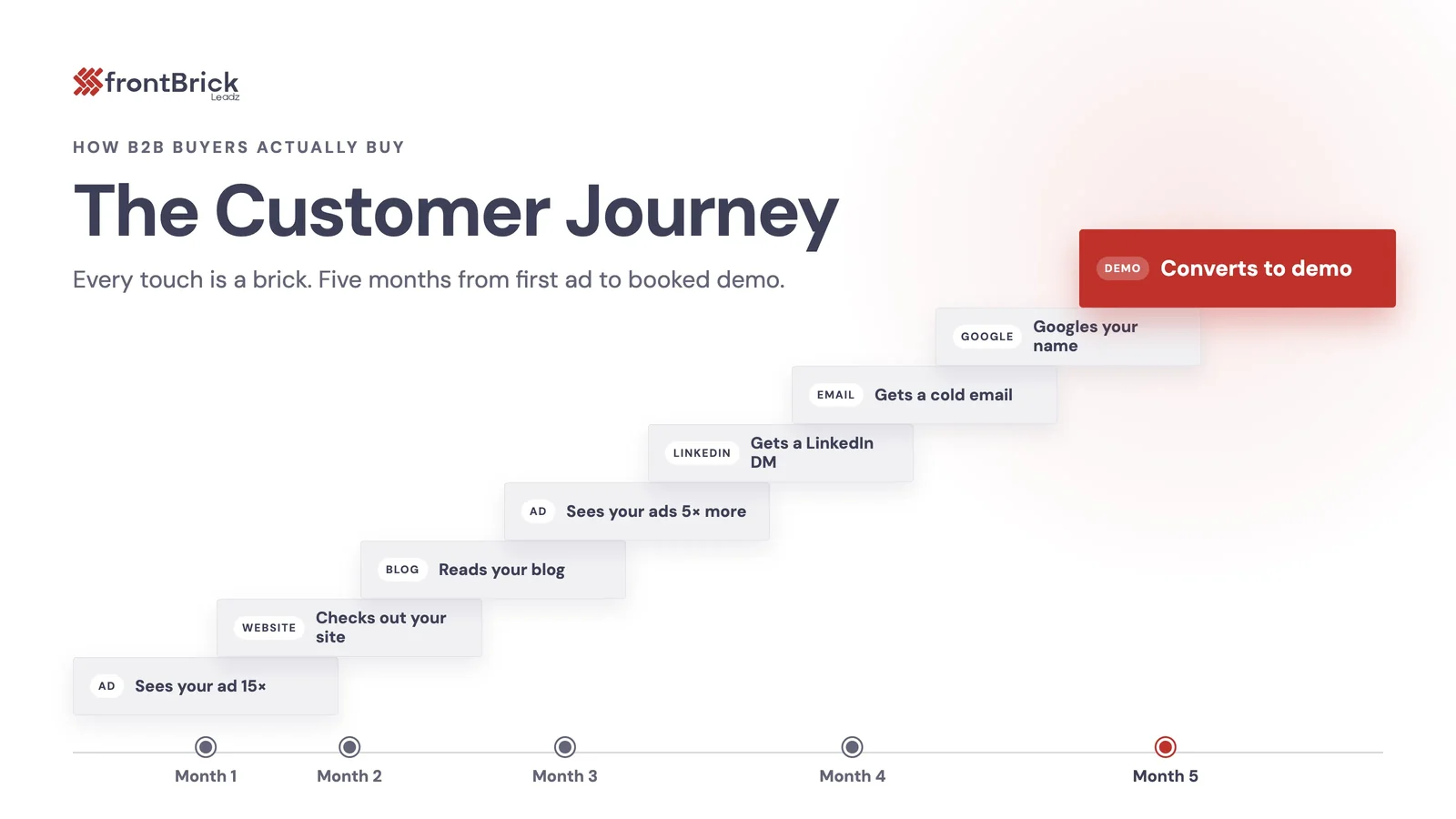
B2B Buyer Journey: Stop Optimizing for One Touch
Connect ads, content and outreach around the way B2B buyers actually decide. A practical buyer journey guide with ABM measurement lessons.
Stan Stojanovic
B2B Buying Signals: 19 Ranked From C to S Tier
19 B2B buying signals ranked from C to S tier, and how to stack them for real buying intent.
Stan Stojanovic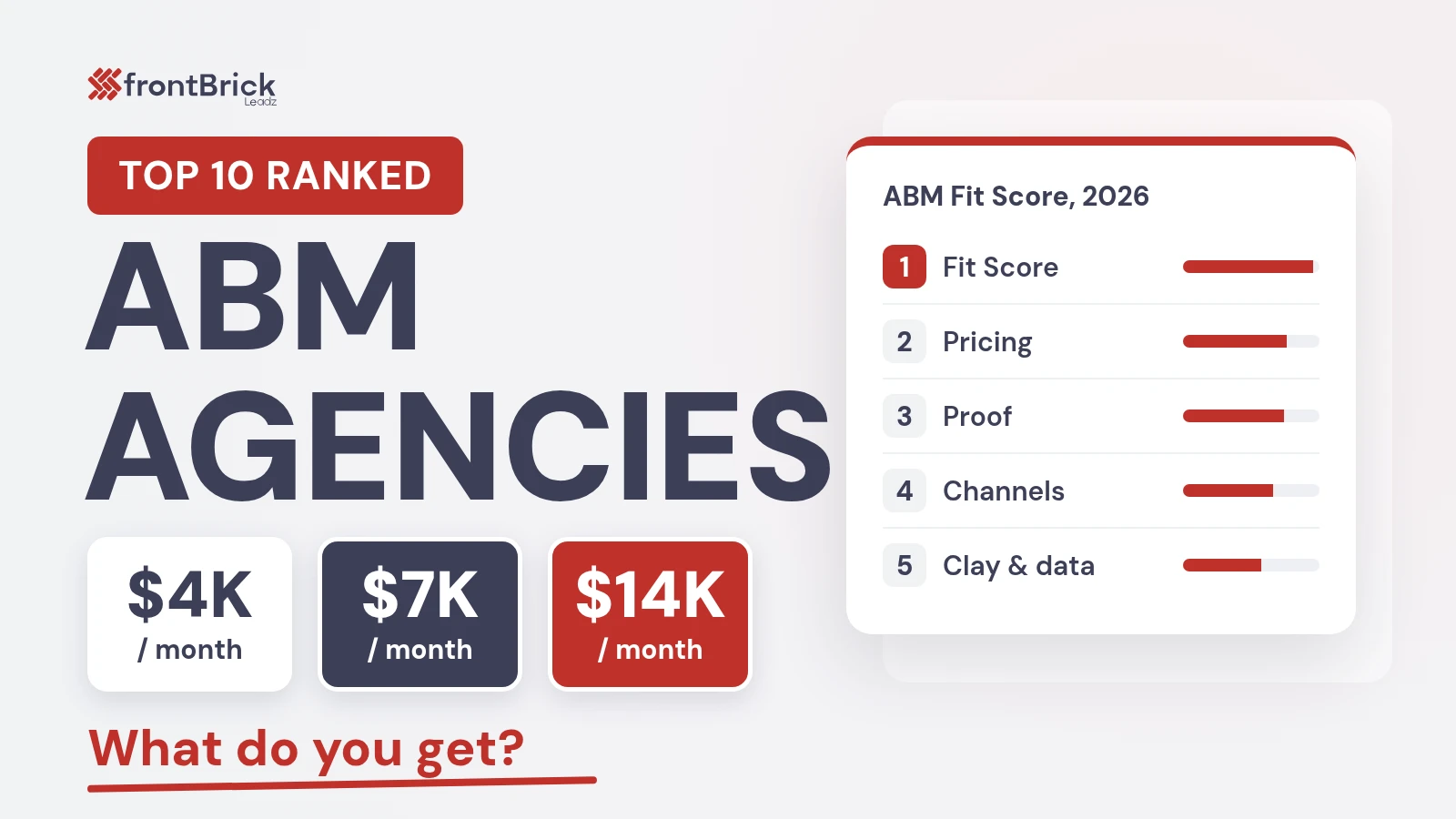
Best Account Based Marketing Agencies for B2B SaaS (2026)
10 ABM agencies for B2B SaaS, scored on the frontBrick ABM Fit Score with public pricing and proof.
Stan Stojanovic
10 Best B2B Demand Generation Agencies in 2026: Pricing, Proof and Fit
Compare the 10 B2B demand generation agencies buyers shortlist most in 2026, with channels, published results, fit by stage and pricing where it exists.
Stan Stojanovic