Evaluate with preferred AI model
A GTM engineer (go-to-market engineer) is the person who builds the systems behind your pipeline. They connect your data, enrichment, scoring, outreach and CRM into one workflow that finds the right accounts and gets them to sales, with as little manual work as possible. Think of them as part RevOps, part growth marketer, part developer.
The title is new. Clay says it coined it in 2023, and the role has grown fast since. Most founders I talk to have the same question: do I need one, and when? This guide covers what a GTM engineer does, the skills to look for, how the role compares to SDRs and RevOps, and when it makes sense to hire full time versus bringing in a fractional GTM engineer.
Key takeaways
| Question | Short answer |
|---|---|
| What is a GTM engineer? | The person who builds the data, automation and AI systems that create pipeline. |
| What do they own? | Data and enrichment, scoring, signals, campaign automation and the tool stack. |
| How is it different from RevOps? | RevOps keeps the CRM and reporting clean. A GTM engineer builds the pipeline engine. |
| When should you hire one? | Usually between Series A and Series B, once your ICP is clear. |
| Full time or fractional? | Fractional or agency first, full time once the motion is proven. |
What is a GTM engineer?
A GTM engineer designs, builds and runs the go-to-market systems a revenue team uses every day. Instead of doing outbound by hand, they build the machine that does it: list building, enrichment, scoring, signal monitoring, message personalization and routing into the CRM.
The easiest way to understand GTM engineering is to look at what it replaces. A few years ago, a team of SDRs would research accounts one by one, copy data into spreadsheets and write each email from scratch. A GTM engineer automates the research and the data work, so people only spend time on the parts that need judgment: the conversation.
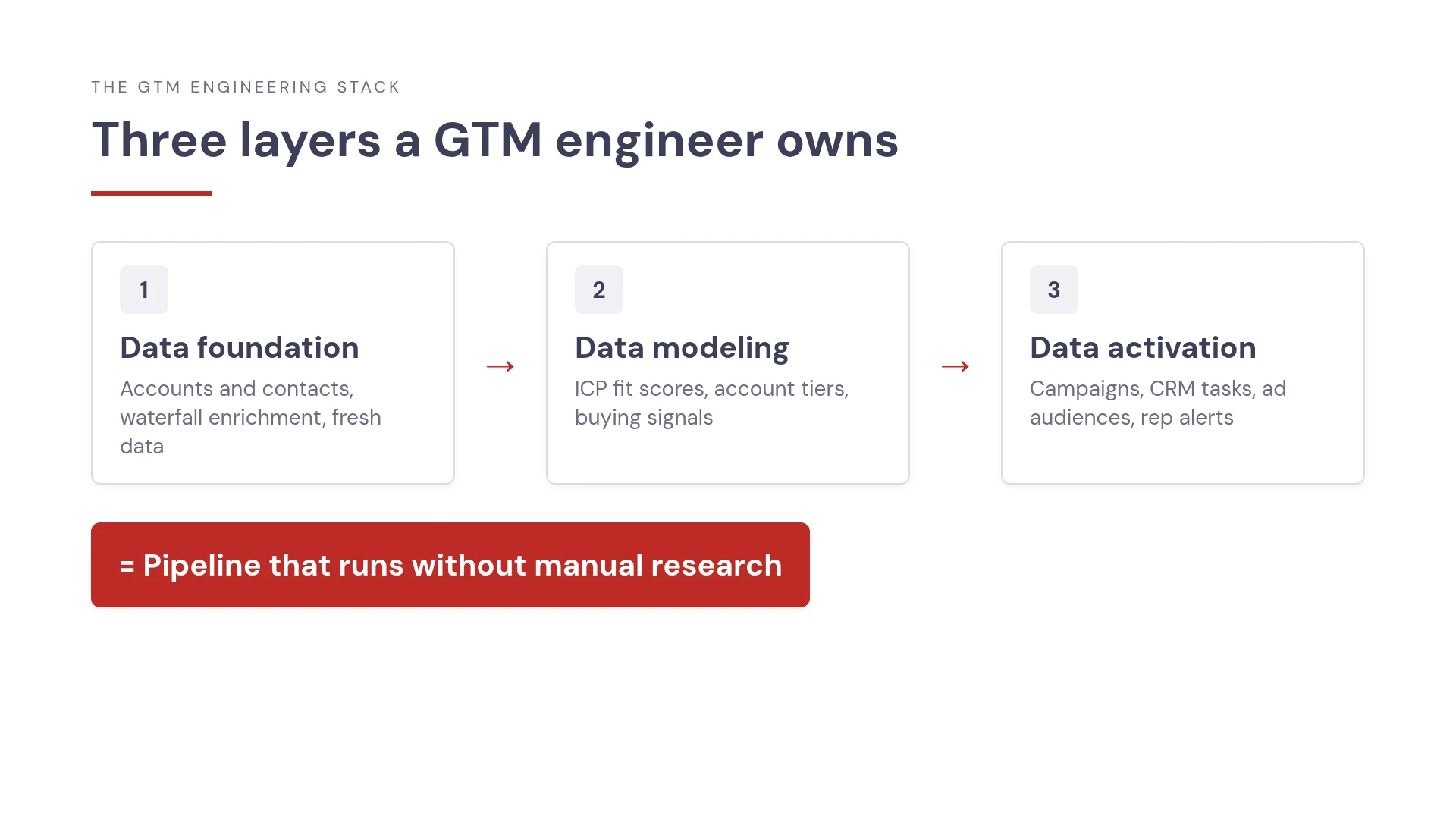
Clay describes the role in three layers, and I think it is the clearest model out there:
- Data foundation. Getting clean, complete data on companies and contacts, usually through a waterfall of several enrichment providers.
- Data modeling. Turning raw data into decisions: ICP fit scores, account tiers, buying signals.
- Data activation. Pushing those decisions into action: campaigns, CRM tasks, ads audiences and alerts for reps.
What does a GTM engineer do day to day?
Norwest Venture Partners surveyed 177 GTM leaders in 2025 and found the role usually owns five areas. Here is what each one looks like in practice:
| Area | What it looks like |
|---|---|
| Data and enrichment | Building account and contact lists, running waterfall enrichment, keeping data fresh |
| Scoring and segmentation | ICP fit scores, account tiers, deciding who gets attention first |
| Signals and intent | Monitoring hiring, funding, job changes and website visits, then routing hot accounts |
| Campaign automation | AI research, personalized messaging, sequencing across email and LinkedIn |
| Tool stack and CRM | Connecting Clay, the CRM and sending tools so data flows without manual exports |
In our own client work, a typical week is a mix of building and fixing. A new signal gets added, an enrichment provider starts returning bad emails and gets swapped, a campaign underperforms and the scoring gets tightened. The work is never finished, because the market and your data keep changing.
What does a GTM engineer actually build? 6 example workflows
Definitions only go so far. Here are six workflows we build again and again for clients. If a candidate or agency can explain how they would build each one, you are talking to a real GTM engineer.
1. Inbound lead routing with instant research
A demo request comes in. Within a minute the system enriches the company and the person, checks ICP fit, looks at which pages they visited and sends the right rep a Slack message with a short summary. Bad fits get a polite nurture email instead of a sales call. Speed matters here, because the first useful reply usually wins the meeting.
2. Website visitor to outbound
Most of your website visitors never fill in a form. A GTM engineer connects a visitor identification tool to Clay, filters companies by fit, finds the two or three people most likely to care and drops them into a sequence that references the problem, not the visit. This is one of the highest intent sources most teams ignore.
3. Hiring signal campaigns
A company posting several sales roles is about to invest in pipeline. The system watches job boards for those roles at ICP accounts, pulls the hiring manager and writes a first line about the specific hire. We cover how to rank signals like this in our B2B buying signals guide.
4. Job change tracking for champions
When a happy customer moves to a new company, they are the warmest lead you will ever get. A GTM engineer tracks past champions and buyers, flags the move and triggers a personal note from the account owner, not an automated sequence.
5. Account scoring and tiering
Instead of one giant list, every account gets a fit score and a tier. Tier 1 gets research by hand and multi-channel outreach. Tier 3 gets light automation. This is how a small team covers a big market without spraying everyone with the same email.
6. CRM hygiene on autopilot
Duplicate records, missing industries and contacts who left the company years ago quietly kill reporting. A GTM engineer runs scheduled enrichment that fills gaps, flags people who changed jobs and keeps the CRM usable, so RevOps can trust the numbers.
The GTM engineer tool stack
Tools change fast, but the categories stay the same. This is a typical stack, not a shopping list. Most teams need one tool per row, not three.
| Layer | What it does | Common tools |
|---|---|---|
| Data and enrichment | Find companies and contacts, fill in emails, phones and firmographics | Clay, Apollo, ZoomInfo, Prospeo |
| Workflow and automation | Move data between tools, run logic on a schedule or trigger | Clay, n8n, Zapier, Make |
| AI research and writing | Summarize websites, classify accounts, draft first lines | LLMs inside Clay, or via API |
| Signals | Hiring, funding, job changes, website visitors | Clay signals, job board data, visitor identification tools |
| Sending | Email and LinkedIn sequences, inbox management | Smartlead, Instantly, lemlist, HeyReach |
| CRM | The system of record for accounts, deals and activity | HubSpot, Salesforce, Attio |
The real skill is not knowing every tool. It is knowing how data moves between them, what each step costs in credits, and where the system breaks when one provider returns bad data. For enrichment specifically, Clay's Clay University is the best free place to learn how waterfalls and credits work.
GTM engineer vs SDR vs RevOps: what is the difference?
This is where most confusion comes from. The three roles overlap, but they solve different problems.
| SDR | RevOps | GTM engineer | |
|---|---|---|---|
| Main goal | Book meetings | Clean process and reporting | Build the pipeline engine |
| Daily work | Prospecting, calls, emails | CRM admin, dashboards, routing rules | Workflows, enrichment, scoring, automation |
| Core tools | Sequencer, LinkedIn, phone | CRM, BI tools | Clay, APIs, n8n, AI models, CRM |
| Output | Meetings | Accurate data and forecasts | A system that finds and prioritizes accounts |
| Scales by | Hiring more reps | Better process | Automation |
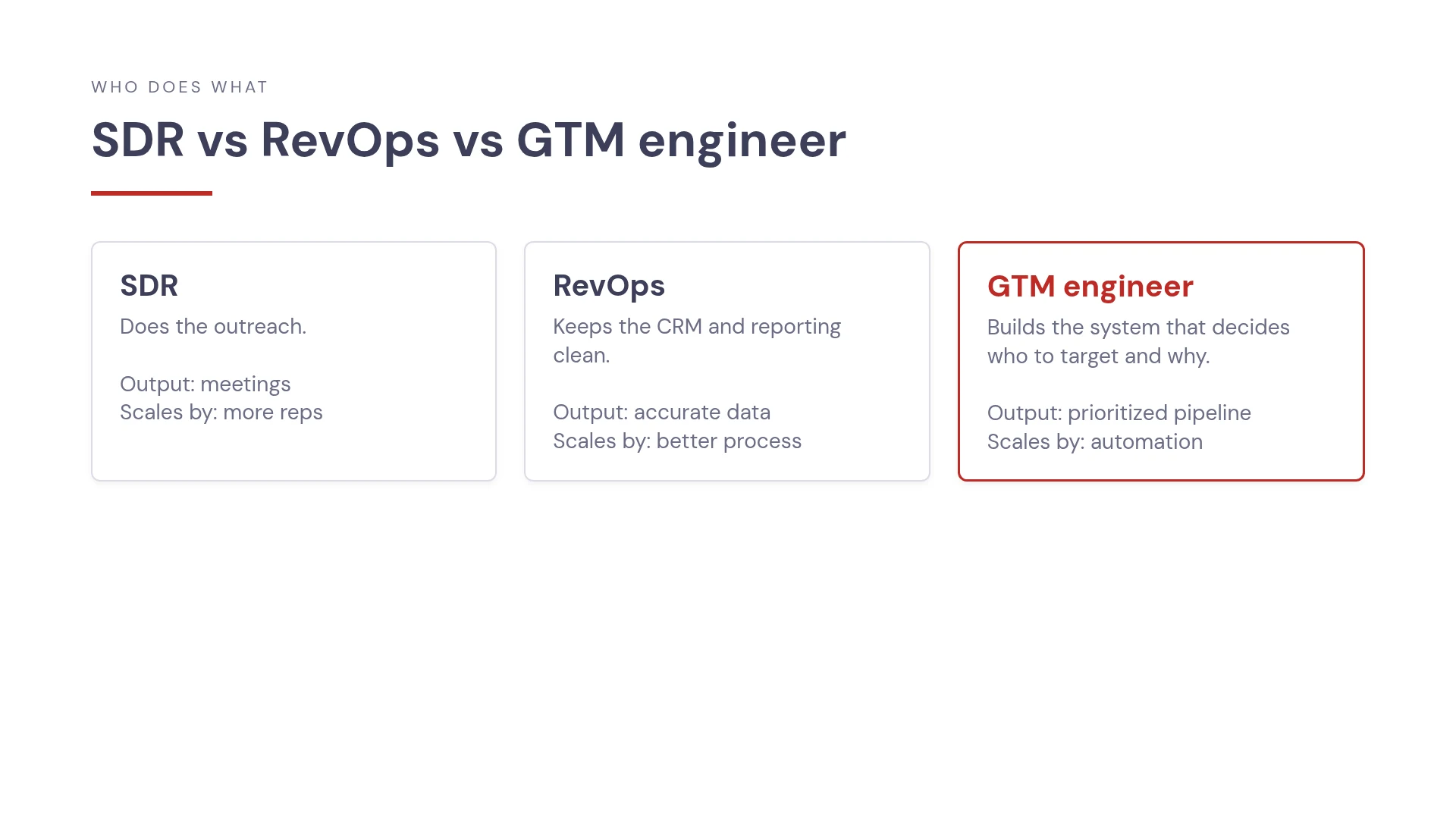
The short version: an SDR does outreach, RevOps keeps the CRM and reporting healthy, and a GTM engineer builds the system that tells both of them who to focus on and why. Norwest also found that SDR and BDR hiring is going down at many companies, while GTM engineering use cases are going up. That does not mean SDRs disappear. It means each rep can cover more accounts when the research is automated. Clay's write-up on Verkada is a good example: they automated about 80% of SDR workflows and reps reached 80 to 100 meetings each.
What skills should a GTM engineer have?
You are hiring for a rare mix. The best GTM engineers I have worked with have:
- Technical fluency. Comfortable with APIs, webhooks, JSON, basic scripting and tools like Clay, n8n or Zapier. They do not need to be software engineers, but they should not be scared of a failed API call.
- Commercial sense. They understand ICP, positioning and why a buyer would reply. A beautiful workflow that targets the wrong accounts is worthless.
- Data judgment. They know which data is reliable, which is stale and when a signal is noise. Our guide to B2B buying signals shows how much this matters.
- Writing. Most outbound still lives or dies on the message. They need to write prompts and copy that sound human.
- Documentation habits. If the system only lives in one person's head, you do not own it.
Norwest groups GTM engineers into three profiles: the Builder (technical, ships workflows fast), the Operator (process and reliability) and the Strategist (connects systems to revenue goals). Early on, you want a Builder with strong commercial sense. Later, as the team grows, Operators and Strategists matter more.
When should you hire a GTM engineer?
Not on day one. If you do not yet know who buys from you and why, automation just helps you reach the wrong people faster. Do the ICP research first.
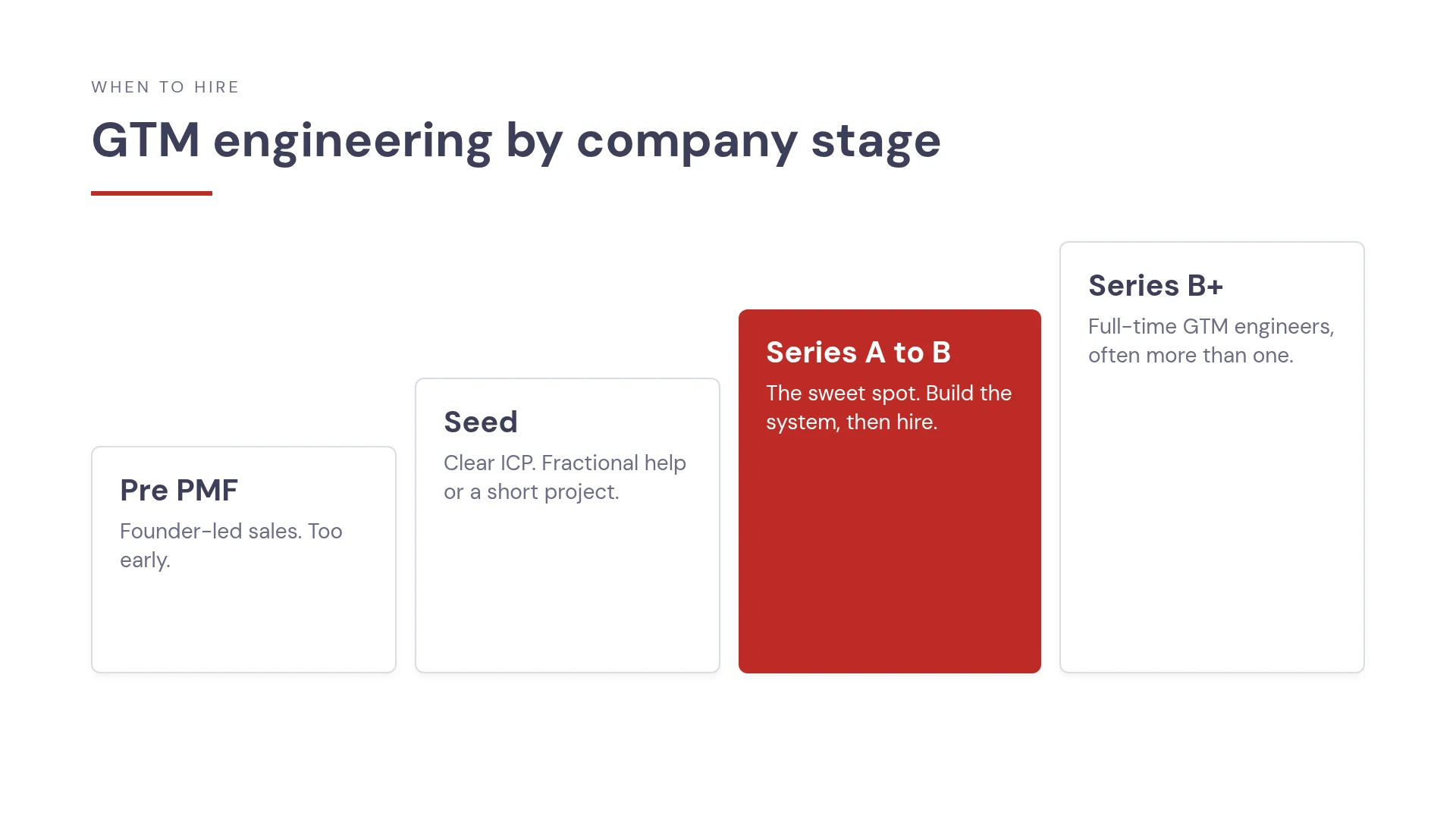
Norwest points to Series A to Series B as the typical inflection point. That matches what we see. Here is how I would think about it by stage:
| Stage | What you need | My take |
|---|---|---|
| Pre product market fit | Founder-led sales and customer conversations | Too early. Learn who buys first. |
| Seed | A clear ICP and a first repeatable outbound motion | Fractional help or a short project |
| Series A to B | Scale outbound without adding headcount at the same rate | The sweet spot. Build the system, then hire. |
| Series B and later | Multiple segments, products and teams | Full-time GTM engineers, often more than one |
Full-time hire, fractional or agency?
A full-time GTM engineer makes sense when you have a clear ICP, a repeatable motion and enough volume to keep someone busy every week. Before that, a fractional GTM engineer or a Clay agency is usually faster and cheaper, because you get someone who has already built these systems many times.
The risk with outsourcing is dependency. That is why we use a simple method we call Build, Document, Hand Over:
- Build. In about three months we set up the data foundation, scoring, signals and campaigns inside your own tools.
- Document. Every workflow gets an SOP, so anyone on your team can run it.
- Hand over. Your team runs it, and a full-time hire can take over a working system instead of starting from zero.
For example, with Prediction Guard we scored 30,000+ people, launched 6 campaigns and wrote 8 SOPs. Their team was running the system internally 1 day after handover. If you want to see what such a system includes before talking to anyone, the GTM system blueprint lays it out step by step.
How do you assess a GTM engineer candidate?
Skip the trivia questions. Clay suggests a three-part assessment, and it works well:
- Problem investigation. Give them a real GTM problem, for example "our reply rate dropped by half." See what questions they ask before they jump to tools.
- Systems sketch. Ask them to draw the workflow they would build: data sources, scoring, routing and where humans step in.
- Mini build. Have them build one small piece, like enriching and scoring 50 accounts in Clay. You learn more in an hour than from ten interviews.
The same test works if you are evaluating an agency. We wrote a full checklist on how to evaluate a Clay agency.
GTM engineer job description: a template you can copy
Most GTM engineer job descriptions are a list of tools. That attracts tool operators, not system builders. Describe the outcomes instead. Here is a short template you can adapt:
GTM Engineer
You will build and run the systems that create our pipeline. In your first 90 days you will set up our account data foundation, build ICP scoring, launch two signal based outbound campaigns and document every workflow so the sales team can run it.
You will own: data and enrichment, account scoring, signal monitoring, campaign automation, and the connections between Clay, our CRM and our sending tools.
You have: shipped GTM workflows that booked real meetings, worked with APIs and webhooks, written outbound copy that got replies, and left documentation behind that someone else could follow.
Two tips. Put real numbers in the 90 day plan, and say who they report to. GTM engineers who report to a sales leader tend to focus on pipeline. Those who report to marketing or ops tend to focus on data and process. Both work, but pick on purpose.
GTM engineer interview questions
Pair the three-step assessment above with these questions. Good answers are specific and include a number or a failure. Weak answers stay at the tool level.
- Walk me through a workflow you built that booked meetings. Listen for the data source, the logic, the message and the result.
- Tell me about a workflow that broke. What failed, how did they find out, and what did they change?
- How would you decide which accounts get human research and which get automation? You want to hear about tiers and scoring, not "we automate everything."
- Our enrichment finds emails for only part of our list. What do you do? Good answers mention waterfalls across providers, verification and checking the list itself.
- How do you keep credit and tool costs under control? They should talk about filtering before enriching and only running expensive steps on qualified rows.
- How would you write the first line for a company that just posted three SDR roles? This tests whether they can turn a signal into a message that does not sound creepy or generic.
- What would you document first, and for whom? If the answer is "nothing, I just know how it works," keep looking.
Hiring checklist
- Your ICP is written down and the sales team agrees with it.
- You know which two or three signals matter most for your market.
- Someone owns the CRM, and the data is at least usable.
- There is a budget for tools and data credits, not only salary.
- The candidate passed a mini build, not only interviews.
- There is a 90 day plan with measurable outcomes.
- Documentation is part of the job description.
How do you become a GTM engineer?
Most GTM engineers did not start with that title. They came from SDR, RevOps, growth marketing or sales engineering roles and kept automating the boring parts of their job. If that is you, here is the shortest path I know:
- Learn one workflow tool deeply. Clay is the most common starting point. Learn tables, waterfalls, conditional runs and AI columns.
- Learn the plumbing. Webhooks, APIs, JSON and one automation tool like n8n or Zapier.
- Understand the sales side. ICP, positioning, deliverability and what makes someone reply. Systems that ignore this do not book meetings.
- Build something real. Pick a real company, even your own employer or a friend's startup, and build a working outbound system end to end.
- Show your work. Document the build, the logic and the results. A public write-up of one real system beats a long list of certificates.
How much does a GTM engineer cost?
Salary data for the title is still thin because the role is so new, and public numbers vary a lot by location and seniority. When you budget, look past salary. The total cost includes:
- Salary or fees
- Tools and data credits (Clay, enrichment providers, sending infrastructure)
- Ramp time, usually a few months before the system runs well
- Maintenance, since data and signals break over time
If you want to test the waters first, a single working session is the lowest-risk start. You can see our options on the pricing page.
FAQ
What does GTM stand for in GTM engineer?
GTM stands for go-to-market: everything a company does to reach, win and grow customers, including sales, marketing and customer success.
Is a GTM engineer a software engineer?
Usually not. Most GTM engineers come from RevOps, growth or sales backgrounds and learned to work with APIs and automation tools. Some have engineering backgrounds, but writing production software is not the core of the job.
What tools do GTM engineers use?
Common ones are Clay for enrichment and workflows, n8n or Zapier for automation, a CRM like HubSpot or Salesforce, and sending tools for email and LinkedIn. More and more of the work also involves AI models for research and personalization.
Can a founder do GTM engineering?
Yes, for a while. Many technical founders build their first Clay tables themselves. It stops making sense when the system needs daily maintenance and the founder's time is worth more elsewhere.
Do I need a GTM engineer or a GTM agency first?
If your ICP is still unclear or volume is low, start with an agency or fractional help and make sure you own the system and the documentation. Hire full time once the motion is proven and there is enough work to fill a week.
Is GTM engineering a good career?
For people who like both systems and selling, yes. The role sits close to revenue, which makes the impact easy to see, and the skills carry over to RevOps, growth and sales leadership. Clay reports seeing around 100 GTM engineer job listings a month, so demand is real, even if the title is still young.
What is the difference between a GTM engineer and a growth engineer?
A growth engineer usually works on the product: signup flows, onboarding and in-app experiments. A GTM engineer works on the sales and marketing systems around the product: data, outbound, routing and the CRM. In product-led companies the two often work closely together.
How long does it take to build a GTM system?
A first working version of the core workflows can be live in a few weeks. A complete system with scoring, several signal campaigns and documentation takes longer. Our own builds run about three months before handover.
Do GTM engineers replace SDRs?
Not fully. They replace the manual research and list building that used to eat most of an SDR's day. The conversations, follow ups and judgment calls still need people. In practice, teams with a GTM engineer often need fewer SDRs, and each one is more productive.
Book Your Strategy Call Today
Want to see how frontBrick can help you generate qualified leads and fill your pipeline fast? Book your free strategy call now.
Book Strategy Call